
BOOKBUSTER REVIEW: Fighting for the Living World
Ecosocialist Futures Issue 1 From Anti-Capitalist Resistance, RRP £4 at Bookbuster
End Times Fascism By Naomi Klein and Astra Taylor Published by Allen Lane, RRP £25 at Bookbuster
Review by Tim Barton
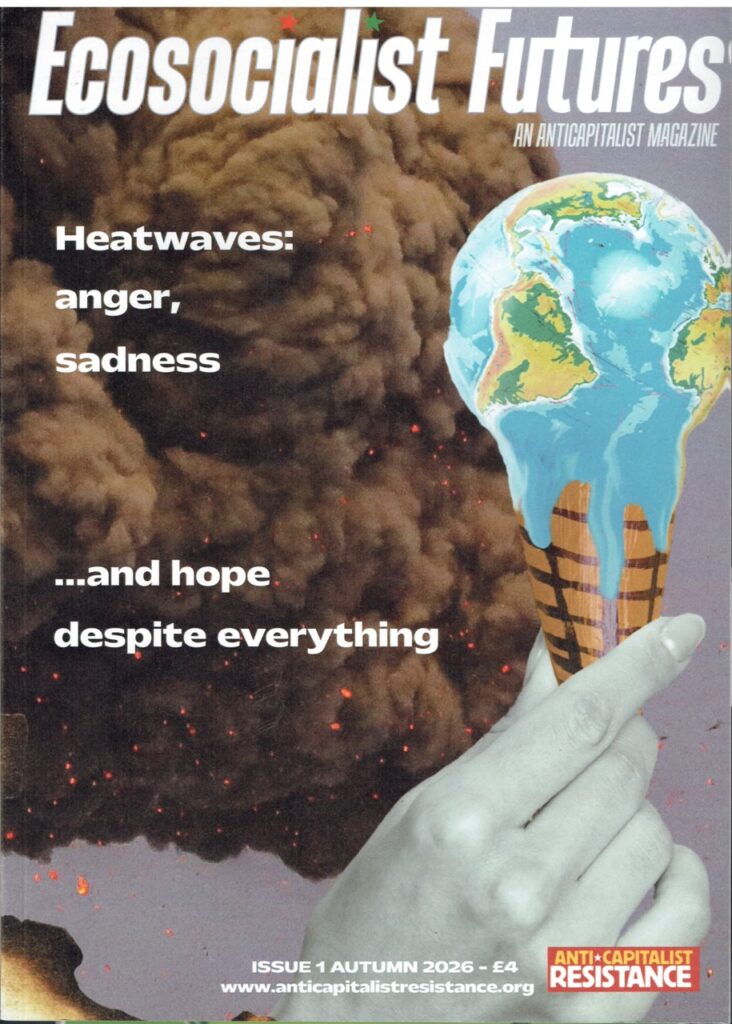
Ecosocialist Futures is ‘a new magazine for revolutionary ecosocialism’, and shares Klein and Taylor’s intent to, using the subtitle of End Times Fascism, ‘fight for the living world’. Also, the magazine includes a critical review of End Times Fascism by Simon Pearson.
The magazine’s main content is bookended by features on, at the beginning, The Battle of Cable Street to celebrate its 90th anniversary, and, at the back, on ‘The Lucas Plan’. Both these articles look at activism. The former, against overt fascism in the East End, and the latter, the Lucas Aerospace workers’ radical 1976 programme to challenge ‘the whole basis of the manufacture of munitions and aerospace components’. Ian Townsend looks at this 1976 project in order to explore ‘what relevance the proposals and ways of organising from fifty years ago have in today’s age of increasing climate catastrophe and the struggle for an ecosocialist future’.
HOSTILITY TO RADICAL CHANGE
Part of his conclusion is that ‘the opposition from trade union bureaucrats to the plan and the present trade union leadership’s hostility to radical change is almost a replication of the fear that a just transition is a threat to jobs.’ This was written before the early November deal, celebrated by the union Unite, where workers succeeded in negotiating with the weapons manufacturer GKN in avoiding a below-inflation pay rise.

This ‘win’, of course, is a celebration of a union win for weapons manufacturing workers, as if the radical ‘Lucas plan’ never existed. Whilst not to be sneezed at in itself, the fact is that the 1976 plan seems further away than ever. A plan that ‘detailed over 15 designs for alternative products including wind turbines, hybrid cars, heat pumps, house insulation and solar cell research with full market analyses, economic arguments and training programmes in place’. The end of the Cold War just over a decade later offered a similar, missed, opportunity to re-engineer arms manufacturing in order to make the UK a world leader in alternative technologies: as suggested, for example, by the Ecology Party (later rebadged the Green Party).

In between these articles are features on Gaza, Israel, & Trump; on El Nino, ‘a disaster made in corporate boardrooms’; heatwaves; on a new manifesto for the Fourth International; socialist unity in India; and the failure of ‘Your Party’ in Scotland’. The magazine finishes with a position statement from Anti-Capitalist Resistance.
RESISTANCE TO NECESSARY CHANGE
The themes dove-tail with Klein’s interests in ecology, climate change, and the resistance to necessary change from the forces of evil. Pearson’s review is critical of the degree to which Klein and Taylor’s differentiation between the ‘mainstream’ corporate and government resistance to change and the rise of the new ‘alt-right’, and the degree to which it is ‘different’ to past ‘fascism’.
Overall though, his take on the book is very positive. He concludes, ‘the question being fought over is no longer simply who governs the existing order. It is increasingly who will be protected from the crises that order produces, who will pay for that protection and who will be left out.’
Klein and Taylor bring very topical issues to the fore, including ‘big tech’ and AI; ‘great replacement theory’; the rise of ‘MAGA’ and the supposedly ‘Christian’ American right-wing grifters; the inclination of the rich to enter gated communities, live on islands, and buy bunkers to hide in when the excrement they breed hits the fan. They feature a lot here, one chapter being titled ‘For-Profit Fascism’. The book is not unremittingly negative, celebrating localism, and the success of New York mayor Zohran Mamdani. Obviously, they will be pleased with the Mid-terms, but the book came out before that – and as Grace Blakeley has noted, the Democrats are in no way ‘radical’, any more than Starmer and Burnham’s centrist idiocy is. Their conclusion pushes for ‘a new disarmament movement’, and for pushing against the tech bro culture, and against the hyper-wealthy whose interests are so completely not ours.
Here are Klein and Taylor’s concluding two sentences: ‘We can either follow end times fascism into oblivion, or we can commit to building the unruly, boundary-crossing movement they so deeply fear. One that wrests away their weapons, holds them accountable for their crimes, and defends the paradise of here.’ Contextually, I half cheer this and half despair.
We hope you have enjoyed reading this article. The future of our volunteer led, non-profit publication would be far more secure with the aid of a small donation. You can also support local journalism by becoming a friend of HIP. It only takes a minute and we would be very grateful.

Leave a Reply