
OPINION: Unhealthy Hastings
Between them, Hastings and Rother councils contain the eight most deprived areas in East Sussex, with Hastings itself one of the most deprived towns in England. Deprivation contributes to higher rates of long-term illness, disabilities, cancer, lung disease and heart problems. Merlin Betts considers complex structural changes designed to combat this health inequality.
Professor Chris Whitty’s report last year on health in coastal communities has given a lot of people pause for thought. It’s taken years of investigations and similar reports for the powers that be to realise things need to change in the NHS. Specifically, they need to change locally. Government needs to empower local authorities and their communities, and the NHS administrators really need to pay more attention to medical staff. Between the pandemic and years of cuts, the whole country knows the NHS needs to change.
So, some things are now happening. There are national shifts following the dissolution of Clinical Commissioning Groups (CCG) in July. They’re being replaced by brand new Integrated Care Systems (ICS).
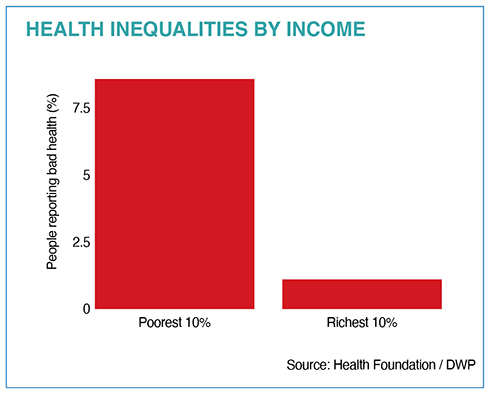
Where the clinical groups were looking at populations overall and then making decisions on behalf of everyone, the ICS plan to involve service users – individual people – and community organ-isations in their own healthcare.
But as Hastings Borough Council (HBC) Health Portfolio holder Andrew Batsford admits, the ICS are currently more hierarchical than their inefficient and problematic predecessors. Yes, they’re a result of years of research and feedback saying local communities have different challenges and need to be involved in designing and delivering their own solutions – so the system needs to be less centralised. But the plan is to have ICS replace CCG in one fell swoop so, the theory goes, they need to be centrally-organised, monolithic organisations… but just for now. Soon they’ll partition into localised systems and partnerships that will finally ’integrate’ with the people using NHS services.
Over the past year HBC, or at least the Hastings and St Leonards Strategic Partnership, has been making recommendations in line with the ICS rollout. It says “a ‘whole system’ approach is needed for Hastings” and “Key
to success will be collaboration, peer support… scaling up community-centred approaches to tackling inequality and poverty”. A subgroup of the partnership is organising a seminar in September which will feature a speech from Professor Chris Whitty, our Chief Medical Officer mentioned above. But “As ever, the issue of resources and capacity to achieve the objectives set out by the group was identified.” In other words, will anything actually get done?
Well, before our local CCG departed, Cllr Mike Turner – HBC’s representative on East Sussex County Council’s
Health Overview and Scrutiny Committee secured £3.4m of funding. Turner has an excellent reputation fighting for the town’s healthcare needs. Most of the funding secured is going to be used for a Universal Healthcare Programme, a year-long initiative working with Bradford local authority and Southbank University. This, it is hoped, will start the kind of good work that ICS are supposed to be bringing to us in the near future. It’s a local experiment that will get national attention.
What will it actually do? There’s the same talk of “bringing together”, “paying attention to the… seldom heard”, and testing new ways of designing and delivering NHS services. A local design team is supposed to start this process of bringing people together. At a recent HBC Cabinet meeting, Cllr Hilton wondered whether service users themselves might be included on this team, to help design their own services – isn’t that what all these reports are saying should happen, after all? The Cabinet was unsure.
But this Universal Programme is our best hope for making progress on healthcare provision in the borough, and possibly on a broader scale. Keep an eye on the kind of plans being considered and provisions being tested. At present, it’s early, hopeful days. But hope isn’t the same as optimism.
We hope you have enjoyed reading this article. The future of our volunteer led, non-profit publication would be far more secure with the aid of a small donation. You can also support local journalism by becoming a friend of HIP. It only takes a minute and we would be very grateful.

Leave a Reply