
Three Key Takeaways from the Recent Local Elections
James Prentice analyses the results for Hastings Independent Press
The local election held within the Hastings borough produced significant shifts. Reform emerged as a competitive party for the first time, and the Greens took control of Hastings Borough Council. Beneath these obvious headline-grabbing events, there are important trends that tell a deeper story about politics within the town.
The disparity between votes and representation is greater than ever
Due to quirks of our antiquated voting system, a candidate does not always require a majority, 50%+, to be elected. With more parties and candidates than ever contesting these elections, only 9 out of the 50 elected county councillors secured a majority. 14 candidates won their seats with less than 35% of the vote, and in St Helens and Silverhill, the winner secured less than 30%. Further, due to a by-election being held on the same day, in the St Helens borough election, the winning candidates only secured 15% of the vote.
The large split in the vote across East Sussex led to a very large disparity between how people voted and how the parties were allocated seats. Reform was the main beneficiary of this, gaining 44% of all county council seats with only 29% of the vote, see Figure 1. The main losers were Labour and the Conservatives, collectively gaining just 6% of seats on 24% of the vote (a total of 3 seats). Traditionally, Labour and Conservative have benefited from this, but no longer. Therefore, all parties should care about this as they will at some point end up on the unfair side, not to mention the need to make sure how people vote is fairly reflected.

This unfairness was reflected in Hastings, with a majority of votes not being allocated towards a winning candidate. Figure 1 shows that 59% of all votes cast in the East Sussex County Council elections, 114,262, were awarded to candidates who could not secure a seat on the council. Therefore, if the majority of voters had not participated, it would not have made a difference to how seats were allocated. The historically large disparity primarily occurred due to how fragmented and divided the voters were.
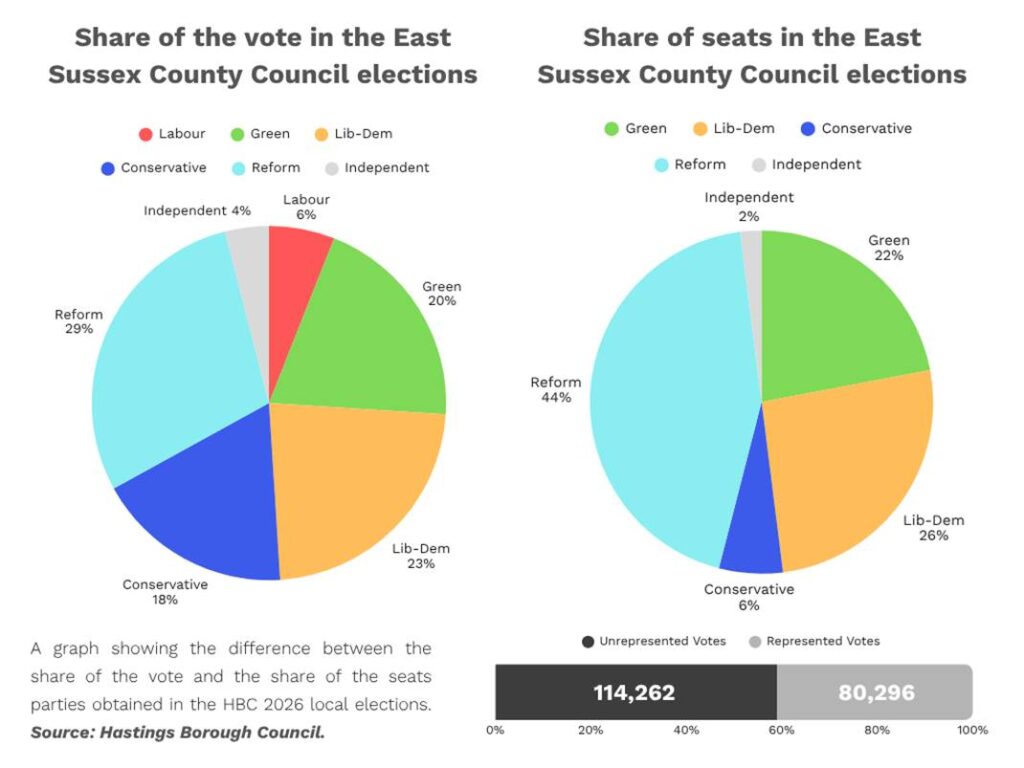
Figure 1: Share of the vote compared to the seat share in the 2026 East Sussex County Council elections. It shows ta large disparity and how a majority of votes did not translate into seats. Source: Results announced at the Hastings count.
We have a highly polarised and volatile electorate
The second important trend to note is just how divided and unpredictable the electorate has become. Firstly, Figure 2 highlights how the town has been sharply divided between liberal-left and right-authoritarian parties. When combining the Green, Labour and Lib-Dem borough council votes, Figure 2 clearly demonstrates that left-liberal supporters are concentrated in the southern central parts of town. Few are located in the northern, eastern and western parts of town. Yet, when looking at the bottom map of Figure 2, this is precisely where support for right-authoritarian parties (Reform and Conservative) is most located. This presents sharp geographical and social divides in the town’s politics.
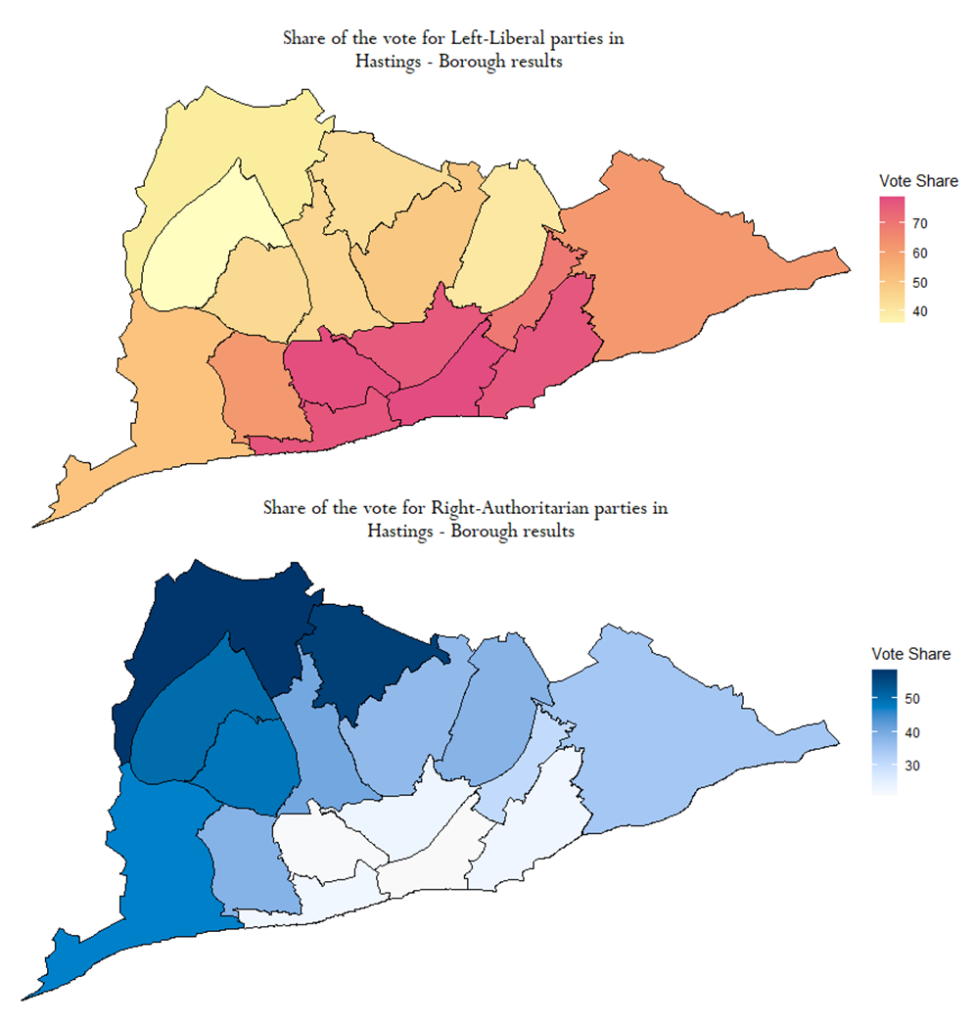
Figure 2: Share of the vote for liberal-left parties and right-authoritarian parties in Hastings. Source: results from the Hastings count.
The town also saw large voting shifts from the previous local election. In the county council elections, there were four divisions that saw Reform go from nowhere to over 29% of the vote. Three divisions saw the Greens increasing its vote share by over 33%, meaning a more than a third of the electorate switched to the Greens. In contrast, the two main parties witnessed large decreases in support. Labour lost more than 25% of the vote in four divisions, whilst the Tories more than 35% of the vote in three divisions, and more than 25% in a further two. In fact, the greater support these two parties had in the previous county council elections, the worse they tended to perform. This reflects how over half the electorate shifted their support towards two new parties, creating far greater shifts in support than we have ever seen in the town. Some may argue that this will translate into general election voting patterns, but local elections trends often do not predict general election outcomes, leaving much uncertainty. Rather, all this confirms is that Hastings has multi-party politics, something that already witnessed in the 2024 local and general elections.
A motivated electorate

Figure 3: Change in turnout and the parties’ share of the vote in the ESCC elections (2021 – 2026).
These large shifts can partly be explained by changes in the number of people voting. Across the country, there was a significant increase in turnout. In Hastings and St Leonards, an additional 6,042 people voted compared to the number that voted in 2021. Some of these new voters will have been highly motivated to support Reform, whereas others will have been enthused by a desire to stop the anticipated Reform surge. Also, the one common theme that likely energised most of these voters was a desire to punish the government. Therefore, this increase in support likely favoured the Greens and Reform over the traditionally two dominant parties. It also likely strengthened the polarisation of results as many voters sought to beat the party they most disapproved of.
These local elections have clearly been partly driven by national issues, and they have completely changed the political map of East Sussex. With many new councillors being sent to County Hall and many former councillors retiring or losing their seats, only time will tell if the public prefer the change they are about to get.
We hope you have enjoyed reading this article. The future of our volunteer led, non-profit publication would be far more secure with the aid of a small donation. You can also support local journalism by becoming a friend of HIP. It only takes a minute and we would be very grateful.

It would be interesting to see the left/right maps using the same colour and scale – it currently implies an even split from the tone strengths but the scale says otherwise.
Really interesting analysis. It’s clear that Reform were successful in most of those areas because the Labour/Green vote was split. This intel will probably benefit the Greens next time as progressives will vote tactically to keep Reform out at all costs.
The fourth takeaway is that many people still seem to be of the belief that voting means they have a say, rather than just adding a slight semblance of credibility to a corrupt system.
Correction needed.
An objective analysis of the policies and approaches of the primary political postures presented to the electorate at this time would characterise them as ‘authoritarian left’ (we take your money and spend it for you) and ‘liberal right’ (small state, individual freedom and individual responsibility).