
Scorched Earth
At 10 am on 1st June, as happens every day of the year, a local volunteer at the Met Office Weather Observations compound in White Rock Gardens took weather measurements for the previous 24 hours: maximum and minimum temperatures, number of sunshine hours, cumulation of rainfall and other data. Rainfall for that day was recorded as 3.2 mm, about an eighth of an inch: enough to keep a gardener happy without spending too long under an umbrella. On the 2nd, 7th and 8th June there was further minuscule rainfall, in each case less than 1mm. Then not a drop until last Friday 20 July when a sheet of grey cloud finally deposited 5mm on Hastings over the course of the day. The drought had lasted in absolute terms 42 days, to all intents and purposes 50.
 PICTURE: DAVE YOUNG
In many, perhaps most, parts of the world rain is seasonal. There may be monsoons each year when it torrents down, followed by dry periods when none may be expected for months on end. But Britain is not supposed to be like that, and is not geared for it. In Hastings cumulative rainfall is higher, and there are more rainy days, on average in winter months than in summer – but not so you would necessarily be aware of it from one year to the next. Over the 40 year period from 1981 to 2010 Met Office statistics, compiled from the data collected at White Rock Gardens, show the average number of rainy days (defined as those with over 1mm precipitation) between October and January as around 12 per month, whereas June, July and August net just over 7. Cumulative rainfall has actually been peaking in October at an average of 96mm (3.78 inches) for the month whereas the months between February and August have averaged fairly consistently around the 50mm mark (just under 2 inches). Our town may vie with Eastbourne to have the sunniest beach on mainland Britain, but no one expects the golden orb to beam down uninterrupted.
Is this summer’s drought what global warming will bring us in future? Climate scientists have tended to warn that the underlying changes will not only bring additional heat to the earth’s surface over the course of this century (though not necessarily at any given site) but also give rise to more extreme weather patterns. On the other hand, there have been both sunnier and hotter periods affecting Hastings in most of our lifetimes. There were 272 sunshine hours in June here this year, but 285 in 1959 and 317 in 1976. Mean minimum temperatures (i.e. averaging the lowest figure for each day) were 12.6 this June, but 13.2 in 1976 and 13.3 in 2003; mean maxima (the highest figure) were 20.1 this June but 21.2 in 1976.
Winners and Losers
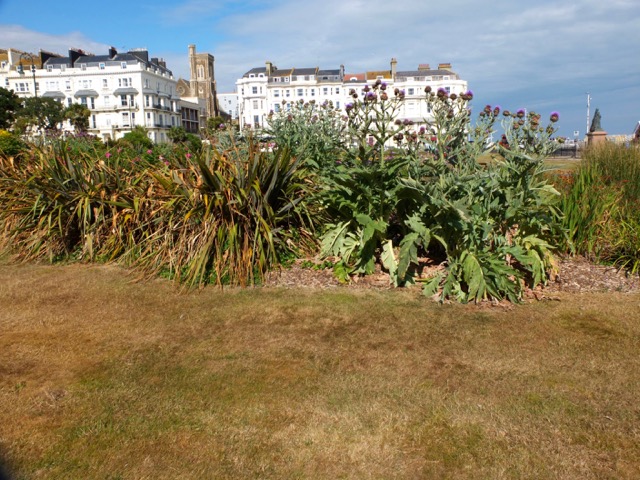
The observable consequences of drought – brown fields, shrinking water courses, shrivelled lawns, unwashed streets, the turning of our green and pleasant land into, let us hope temporary, semi-desert – create obvious winners and losers.

If you’re a holidaymaker or an events organiser or an ice-cream seller, it’s bliss. If you’re a seafront bar owner it’s a mixed blessing: the punters are roaring in from the A21 and the railway station, but staying too long on the beach. (“What we would like is a light shower around 11.30 in the morning”, one trader confides).
If you’re a farmer, particularly with livestock, then you may well be struggling. Unlike in 1976, this summer’s drought was preceded by heavy rains in winter and spring, so the water table was high to start with; grass grew plentifully, and crops sown in early spring will have benefitted from the high temperatures and dry conditions; wheat harvesting will be undertaken two or three weeks earlier than usual. But later spring sowings will have struggled to get enough moisture, much will have very poor yields or be written off altogether. And while sheep, the main focus of local Rother farmers, are essentially desert animals, and can survive on parched soil for long periods if necessary, they are bound to need extra feed, and it’s going to be costly. The whole of northern Europe has been in drought, Scandinavia worse than southern Britain, and prices on the open market in Europe are soaring.
If you’re a gardener, at least the weeds have stopped growing, and well-established plants will in most places tunnel their roots down to the water table below. As for lawns the Turfgrass Growers Association are advising homeowners that watering established lawns during hot weather is wasteful and unnecessary. ‘Don’t worry if your lawn goes brown during the summer’, says their spokeswoman. ‘Going brown is the natural survival mechanism of grass. When water is in short supply, grass responds by shutting down. The brown colour shows that it has stopped growing until more favourable conditions return. Grass is remarkably resilient, and as long as you follow a few basic rules, most lawns will recover completely when the rain finally arrives’. She recommends increasing usual mowing height in order to create deeper roots and more shade, and keeping blades sharp, since blunt blades bruise the leaf causing the plant to lose more water.
With hotter temperatures returning over the past few days, July seems likely to break fresh records for sunshine, heat and lack of rainfall – and there’s still August to come. The faithful volunteers of White Rock Gardens will be there to measure.
Postscript: since this paper doesn’t go in for fake truth, we should tell
you that the 40-year Met Office climate study records Eastbourne
as receiving an average of 16.5 more sunshine hours per year than Hastings. That’s of course if you trust the good faith and accuracy of our near neighbours’ measuring methods.
We hope you have enjoyed reading this article. The future of our volunteer led, non-profit publication would be far more secure with the aid of a small donation. It only takes a minute and we would be very grateful.
https://www.hastingsindependentpress.co.uk/articles/news/scorched-earth/https://www.hastingsindependentpress.co.uk/wp-content/uploads/2018/07/NEWS-drought.jpeghttps://www.hastingsindependentpress.co.uk/wp-content/uploads/2018/07/NEWS-drought-150x150.jpegNewsMet Office Weather ObservationsAt 10 am on 1st June, as happens every day of the year, a local volunteer at the Met Office Weather Observations compound in White Rock Gardens took weather measurements for the previous 24 hours: maximum and minimum temperatures, number of sunshine hours, cumulation of rainfall and other data....Hugh SullivanHugh Sullivan[email protected]AdministratorHastings Independent Press
Leave a Reply