
Potholes– More or Less?
JAMES PRENTICE
Last year during my travels through the town, I began to notice fewer potholes. Also whilst walking around, I’ve noticed more road maintenance teams filling in potholes that had been long unaddressed. Could East Sussex County Council (ESCC) have finally got its act together and started to address the problem?
To test my perceptions, I submitted a Freedom of Information request to ESCC, asking how many potholes had been repaired and the percentage of those reported that had been done on time. I also did the same for broken pavements as another test of maintenance improvements.
The council’s response has confirmed that the number of potholes repaired each year by ESCC contractors has increased greatly in the last decade. In 2016, there were only 529; in 2023, there were 3,328 – a peak figure which, according to the council, was associated with a change of contractors: completing a backlog of cases had been a condition of their service offer. The number decreased to 2,240 in 2024 but rose again to 2,752 in 2025.
There has also been a large rise in the number of pavement defects being repaired. In 2023, 796 defects were reported; this figure rose to 1,462 in 2025, an 84% increase.

TEMPORARY REPAIRS?
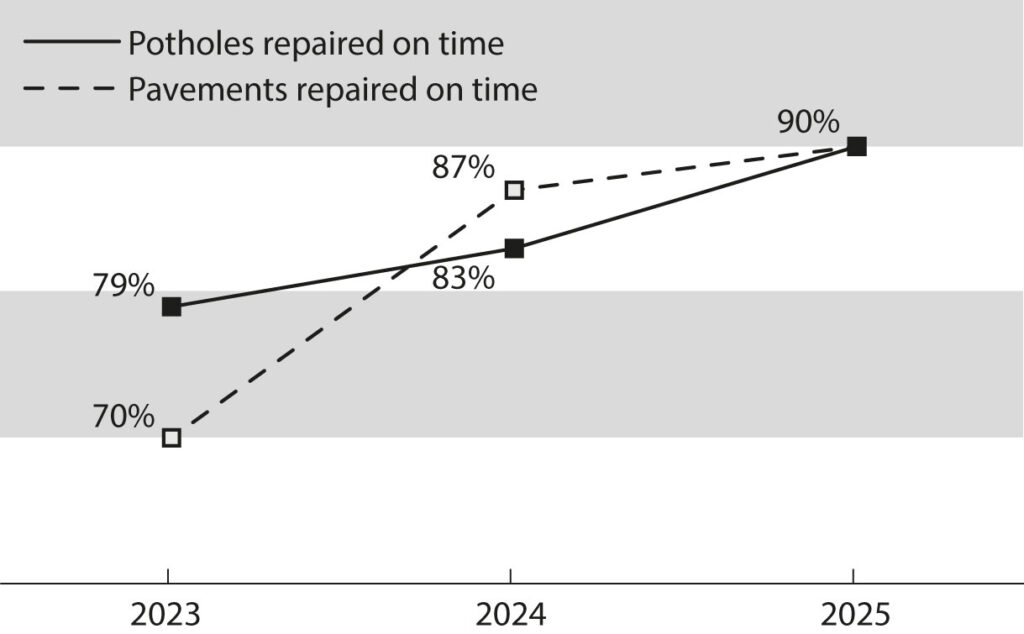
One reason for this gradual increase could be that potholes and pavement defects are being identified but only temporarily repaired. On the other hand, since 2023 at least, the proportion of pothole defects being repaired within requisite times has also been increasing – see the adjacent graph and box-out below. In 2023, only 75% of pothole defects were repaired within a month, but in 2025 this rose to 91%. Likewise, in 2023, only 70% of pavement defects in Hastings were being repaired within the set times: in 2025, it was 90%.
So how should these figures be interpreted? It could be that the ring-fenced money given to councils by central government to fix our poorly maintained roads – £21 million in the current financial year 2025/26 – is starting to produce results. With some roads in the town having been partially resurfaced, and with more funding on the way, the pothole epidemic might be past its peak.
Alternatively, the numerical increase in repairs might represent a series of patch jobs: more temporary repairs having been implemented to provide short-term relief to a problem that was getting out of control.
One concern is that ESCC reports no plans to fully resurface any roads within the county (excluding trunk roads and motorways, which are not their responsibility) in the coming year. If repairs were temporary patch jobs and they begin to fail, pothole numbers could rise again.
HIP would like to hear readers’ impressions and opinions. Do you feel there has been an improvement in road maintenance within the Hastings area? Please write to [email protected] or post on Facebook or Instagram). We’ll report feedback in a future edition.
‘On time’ as far as government policy for a pothole repair is concerned is 30 days, unless it amounts to a sinkhole that endangers drivers, in which case there’s a three-day maximum.
As regards pavement repairs, minor defects should be dealt with in 28 days, more major defects in 17, and again a sinkhole dangerous to the public should be filled in within three.
We hope you have enjoyed reading this article. The future of our volunteer led, non-profit publication would be far more secure with the aid of a small donation. You can also support local journalism by becoming a friend of HIP. It only takes a minute and we would be very grateful.

I would be interested in an investigation into costs of Balfour Beatty’s pothole repairs over the past ten years in Hastings and Rye. Balfour Beatty may not be the contractor who actually do the jobs on our roads and may well subcontract the work out. Temporary repairs are a bit of a misnomer I think because they are a euphemism for ‘inadequate repair’ quite often, and are left so long, they are no longer temporary. The cost of doing a proper, long- lasting repair versus a poor short-term repair that needs redoing is one thing. The cost to the car owner is another. One local pensioner I know, one of the main supporters of the charity Hastings Cat Lovers, who does a lot of travelling about, rescuing local cats, had to pay over £750 to her garage for damage to her car caused by potholes. The whole system seems to be a false economy. Of course the early January cold spell also weakened some of the recent work. It is so frustrating. I have no doubt that perceptions of success with curing the pothole problem will link in closely to how well a political party might do in elections. Like Housing, it is a hot topic with strong relevance and resonance for local people. On a lighter note, but risible nonetheless, a few years ago the Tory controlled Kent County Council (KCC) publicly blamed the Romans (in the pages on the Times newspaper) for the state of our roads. Something to do with the rubble they used. The Romans left Britain in the 5th century AD. That was even worse than the Water Companies blaming the Victorians for the state of our water infrastructure. Reform now runs KCC. Let that be a warning and not a worrying prediction for our own future governance in East Sussex!