
Northeye: Back in the Frame for Detaining Would-Be Migrants?
HUGH SULLIVAN
Amidst a flurry of news about cross-channel migration, including stepped-up border security and multiple drownings, there has been no word from Sir Keir Starmer’s government about the future of Northeye – the former prison premises outside Bexhill which the Home Office purchased last year for the stated intention of detaining illegal immigrants.
Progress towards this prospective usage seemed to have stalled under previous Home Secretary James Cleverly while Rishi Sunak put all his energies into pursuing the policy of deportations to Rwanda. Sir Keir made it quite clear on his accession as prime minister that the Rwanda scheme had been abandoned. It has been replaced, at least in the new government’s rhetoric, by the launch of a new Border Security Command which will enrol “hundreds of new specialist investigators” and use counter-terror powers “to smash criminal boat gangs”.
However, Home Secretary Yvette Cooper announced on 21 August “a major surge in immigration enforcement and returns activity”, claiming that the government has new plans for the next six months “to achieve the highest rate of removals of those with no right to be here, including failed asylum seekers, for five years (since 2018)”. This will entail “increased detention capacity”, according to Ms Cooper, as well as an increase in the rate of determination of asylum claims and negotiation of agreements with foreign governments to accept returns.
EXPANSION OF DETENTION CAPACITY
In her speech she identified the reopening of two former detention centres, one at Campsfield House in Oxfordshire, the other at Haslar outside Gosport, to serve her immediate purpose as Immigration Removal Centres. Together these would accommodate an additional 290 detainees on top of the current capacity across the country of approximately 2,300. But with over 23,000 would-be immigrants arriving by small boats across the Channel this year as of 15 September – a slightly higher rate than the total of 29,437 (according to Home Office figures) over the whole of 2023 – the government is also reported to be “studying options” for further expansions of detention capacity.

With regard to Campsfield, closed since 2019, a Home Office spokesperson said they “have held discussions with local councillors and other stakeholders to ensure the impact of the plans on the local community and environment is fully taken into account”. However, newly elected Liberal Democrat MP for Bicester & Woodstock, Calum Miller, and leaders of both Oxford City Council and Oxfordshire County Council all publicly oppose the plans to reopen. Councillors on Cherwell District Council, which is the local planning authority, have complained in a letter sent to the Home Secretary of “a complete lack of parliamentary scrutiny”.
The plan to reopen the Haslar site seems, on the other hand, to meet with the approval of at least local Conservative MP, Dame Caroline Dinenage. AVID, a national network of visitor groups to people in immigration detention, has pointed out that it was closed in 2015 after numerous reports of mistreatment and inhumane conditions. But Dame Dinenage praised the removal of asbestos from the site during the period of closure, and earlier this year welcomed the plan, describing the refurbishment as “high quality” and remarking positively on “the 200 jobs” which reopening would bring.
OPPOSITION TO NORTHEYE
Asbestos has been identified as a problem at Northeye too. And the local MP (Dr Kieran Mullen, newly elected in July) is also a Conservative, unlikely in principle to oppose the government’s detention programme. However, at the beginning of August he was reported by the BBC to have called on the government to “let people know what is going on”, and to have stated that “bringing in hundreds and hundreds of people” into “a quiet residential road in a town that’s already struggling with infrastructure” wouldn’t be “the right decision”.
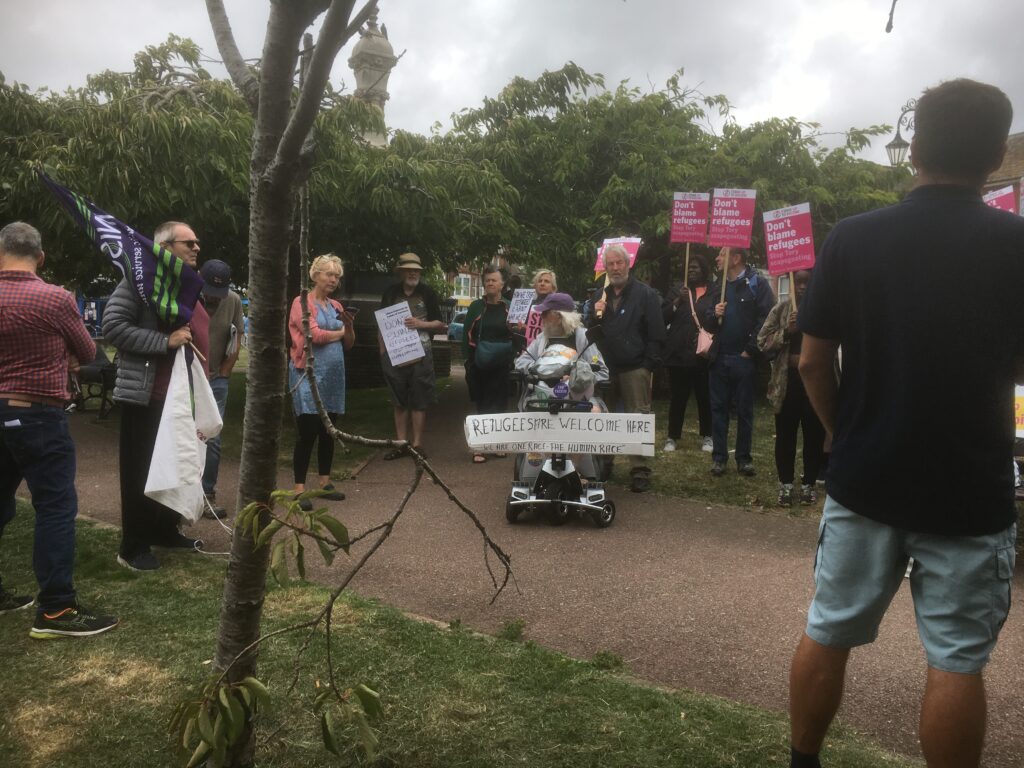
In this view he aligns with his Bexhill constituents who opposed the use of the site for migrant accommodation and/or detention purposes in demonstrations and counter-demonstrations last year – from the Stand Up To Racism pro-asylum activists on the political left to No to Northeye local residents concerned at threats to indigenous security and property values on the political right. Any Home Office move to revive the original plan will no doubt be responded to with a dusting out of respective placards and renewed marches. Another local campaigner Jeff Newnham, who raised nearly £20,000 from a crowdfunder appeal to bring a legal case for judicial review, has indicated that he still intends to proceed with it in this circumstance.
On the other hand, newly elected MP for Hastings & Rye Helena Dollimore endorses Labour’s policy as committed to restore order to the system so that it is “swift, firm and fair – with the rules properly enforced”. The new Border Security, Asylum and Immigration Bill announced in the King’s Speech in July, she said, “will bring in new replacement arrangements, including fast track decisions and returns to safe countries”.
And the Home Office is indeed reported to have signed new return agreements with Vietnam, Bangladesh, India, Pakistan, Nigeria, Serbia and Georgia to follow a previous fast-track removal deal with Albania. But the fact is that the majority of illegal entrants, at least those arriving in small boats crossing the Channel, are from countries which can hardly be described as “safe” – apart from Vietnam, the five most common nations of origin being Afghanistan, Iran, Turkey (highly oppressive and discriminatory as far as many Kurds are concerned), Eritrea and Iraq. How is Ms Cooper going to negotiate safe return for dissident nationals from these?
AMNESTY CRITIQUE
Steve Valdez-Symons, refugee and migrant rights programme director at Amnesty commented: “It’s dismaying to see the new government reheating the last government’s rhetoric over ‘border security’ and ‘smashing gangs’ even while neglecting the pressing need to provide safe asylum routes and a clear guarantee of asylum to refugees arriving here.

“People in urgent need – including those fleeing war and persecution in places like Sudan, Afghanistan, Syria and Iran – will keep coming to the UK and other countries, and the government needs to establish safe routes that reduce the perils of dangerous border crossings and the risk of exploitation by ruthless smuggling gangs.
“This ‘securitised’ approach to asylum and immigration will simply deter and punish many of the people most in need of crossing borders, people who are therefore often most vulnerable to criminal exploitation.”
We hope you have enjoyed reading this article. The future of our volunteer led, non-profit publication would be far more secure with the aid of a small donation. You can also support local journalism by becoming a friend of HIP. It only takes a minute and we would be very grateful.

Leave a Reply