
Falling through the Cracks in St Leonards
A personal view by Dr Ralitsa Hiteva

In February, HIP reported on the landslip at the Old Roar Ghyll, which had a devastating impact on the lives of those forced to flee their homes. Dr Ralitsa Hiteva was one of those affected and she has written a personal view about her experience.
The first time we realised something was wrong was on 14 February, when we heard the cracking sound of falling trees coming from the Old Roar Ghyll. We spent the night listening to the sound of the trees falling down the slopes of the Ghyll and in the days that followed watched in dismay as the banks of the Ghyll collapsed, taking with them the public path that stood between our homes and gardens and the Old Roar Ghyll.
The landslip then took over our garden and our lives. I thought one of the hardest things I have ever had to do in my life was to watch the landslide eat through fences, trees, stone steps and sheds, and advance towards our home. However, several weeks after we were forced to leave our home because of the Emergency Prohibition Orders (EPO) served by HBC, I realised that what is infinitely harder is bearing witness to the multiple ways in which the landslide is still affecting our lives.
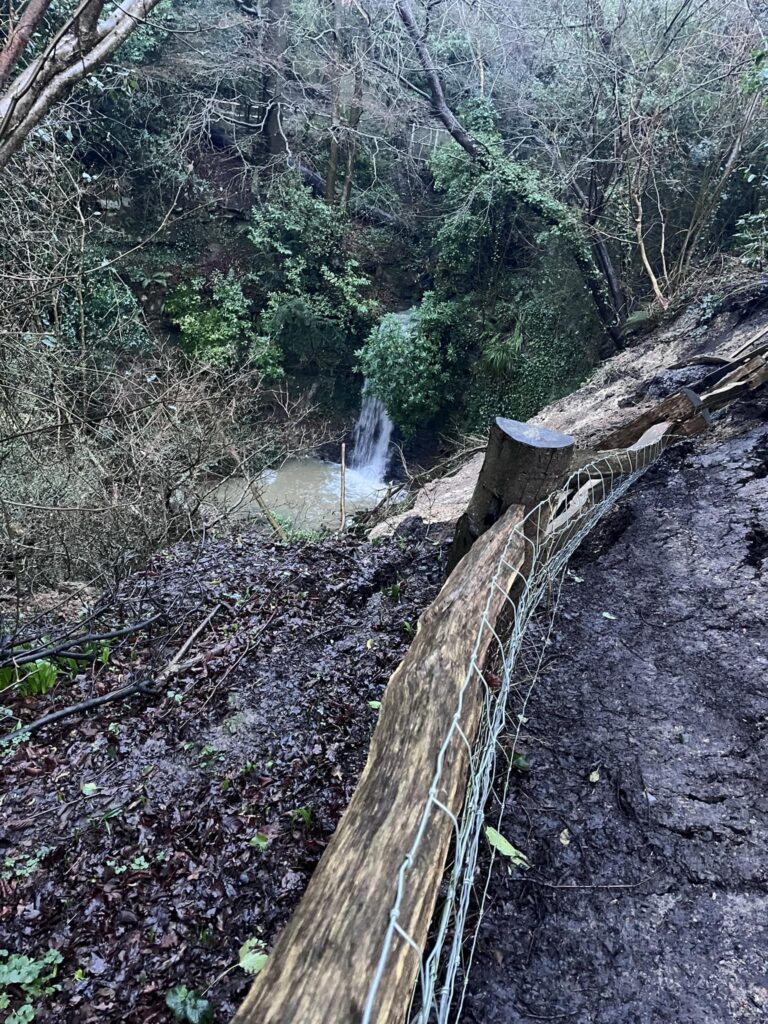
The Old Roar Ghyll landslip, which was followed shortly afterwards by landslides on West Hill Road and Caves Roads, was one of the largest to impact the town since the Ecclesbourne Glen landslide in 2013.
Although only two households were issued with EPOs and one with a warning, the economic impact of the landslide will be felt by many more residents in the years ahead. Up to 100 households will see significant increases in their insurance premiums. They are the lucky ones. Some insurance companies refuse cover for homes within 100 metres of a landslide. For others it is within 200 metres, and without insurance householders will struggle to mortgage, remortgage or sell their properties.
The longer the Old Roar Ghyll is left full of landslide debris and without shoring up its banks the bigger its impact is going to be on a growing number of residents.
Costs & responsibilities on residents
The unexpected focus on the role of residents in managing and bearing the cost of the impact was almost immediate. Just two days after the landslide started, Hastings BC issued us with letters stating that the landslide had originated on private land above the Ghyll and needed to be taken up with residents’ insurance providers. A condition of the EPOs is that we secure our properties and clean up and tidy the affected area. Several HBC officers and councillors visited the site in the days immediately after the landslide and witnessed its progress from the banks of the Ghyll towards our properties. The photos and videos made by residents concerning the cracks on the public path clearly evidence the direction of the moving earth. Although Hastings BC did not commission any investigation into the reasons for the landslide until April, its public notifications in February stated that the origin and cause were on privately-owned land. These statements were never retracted and we still live with the consequences.
In a similar fashion, the EPOs were issued on 21 February, on the basis of a visual assessment carried out by HBC housing officers. The EPO has huge financial implications beyond the immediate and obvious restriction of living in the properties. Residents were asked to carry out costly investigations to provide proof to HBC that the properties were safe to live in, as well as technical information about the properties’ foundations – information which was not a legal requirement when the properties were built and that HBC planning does not hold.
We were asked to access and provide information about pipes that run through our property, although none of them appear on any drainage or flow maps held by the water company or the local authority. In May, Southern Water commissioned pipe mapping of the area, specifically excluding the affected properties. We were told repeatedly that “they have no assets in the area”.
The Landslide Toolkit, recently published by the Council and the discussion at the HBC Cabinet meeting earlier this month, places the onus on residents to monitor and collect information about water pipes running under their properties, to provide information about previous events which might have affected soil stability, and to check and report on cracks and other signs of instability. However, what we have learnt to our cost is that such information is not readily available to residents either from the utility companies or from local authorities.
Similarly, there is no readily available public information about previous landslide events, and these rarely appear in standard conveyancing ground reports. For example, a landslide in the Ghyll, less than 10 metres away from the current landslide, which was repaired in 2007 did not appear on any of the conveyancing searches. There is no public information available on HBC or ESCC websites. We only know about this landslide because a neighbour raised it at a public meeting.

It is almost impossible to acquire such information. Freedom of Information Requests to both HBC and ESCC were time consuming and often turned down on the basis that no such information exists or is held and escalating complaints to the Ombudsman takes several months.
Residents do have access to important information but there is no system in place for them to collect, store or submit this vital data to local authorities and no requirement on councils to use the information. We have encountered severe resistance to accepting the value of the information we have. We were told repeatedly that photos and video evidence we have were just “in our opinion” and things which have happened in the past could not be considered because of lack of evidence.
Attempts to work with HBC and seek the necessary information and answers together over the past 7 months have failed due to lack of transparency, poor communication, unprofessional behaviour and failure of widely accepted good governance practices, such as fair treatment. Far from the community co-operation, which was proudly announced at the August Cabinet meeting, we have been treated as the problem.
The Old Roar Ghyll landslide exposed the inadequate and fragmented structure of local service provision, with HBC, ESCC, Southern Water, and UK Power Networks all independently involved, with no responsibility to share their information with each other or take action together. This is exacerbated by the years of poorly maintained public assets and the lack of adequate planning, information management and resilience governance within the area.
Rather than pointing fingers to residents and pretending that landslides like the Old Roar Ghyll are a private issue, to be addressed through individual action (e.g. not paving ones’ driveway) or home insurance, it is time to acknowledge these shortcomings and fill in the cracks.
Unless we learn from past mistakes we are doomed to repeat them. Rather than deflect responsibility, we would like to see Hastings BC carry out evaluation of necessary changes in planning and maintenance which could help prevent further landslides, identify hot spot areas where potential for landslide conditions might already exist and convene an open and transparent systemic mapping of information and evidence, which would allow a meaningful participation for residents.
Because the one thing more dangerous than a landslide, it turns out, is a local authority in denial of its role in the governance of this new frontline of climate change.
Dr. Ralitsa Hiteva is a Senior Research Fellow in Infrastructure and Innovation at the Science Policy Research Unit (SPRU) at the University of Sussex.

We hope you have enjoyed reading this article. The future of our volunteer led, non-profit publication would be far more secure with the aid of a small donation. You can also support local journalism by becoming a friend of HIP. It only takes a minute and we would be very grateful.

Leave a Reply