
The Forest Beneath the Waves
CHRIS WILLIAMS
Most people in Hastings know the sea from the shoreline. Surfers know it from the waves. Divers know it from below. But very few people realise that just offshore, beneath the surface of the English Channel, we have lost something extraordinary.

Historically, large kelp forests once stretched along parts of the Sussex coastline. These underwater forests supported fish, shellfish, crabs, seahorses and countless other species, while also helping to stabilise the seabed and absorb carbon from the atmosphere. Today, much of that ecosystem has disappeared.
Kelp is often described simply as seaweed, but it is much more than that. Kelp is a large brown algae that forms dense underwater forests in cold, nutrient-rich waters. Like forests on land, kelp forests create structure, shelter and food for entire ecosystems. Juvenile fish hide among the fronds, marine life feeds and breeds within them, and the whole environment becomes richer and more biodiverse.
INCREDIBLE ECOSYSTEMS
My own connection to the sea began long before the Hastings Kelp Project. I’ve spent most of my life surfing, diving and travelling around coastlines in Asia, New Zealand and the UK. Some of my earliest memories of underwater life came while snorkelling in Southeast Asia, where I first realised how incredible marine ecosystems could be. Over time, I also began noticing how much had changed – fewer fish, degraded habitats, and ecosystems under pressure.

That experience eventually led me into Environmental Science with the Open University and towards creating the Hastings Kelp Project.
The project is an independent community-led research initiative focused on understanding kelp ecology and exploring practical restoration methods here in Hastings. At its heart, it is about learning how kelp grows, what conditions it needs to thrive, and whether we can help support the recovery of these ecosystems along the Sussex coast.
We are currently developing a dedicated kelp research laboratory in Hastings with cultivation tanks, chilled seawater systems and environmental monitoring equipment. Working alongside divers, scientists and volunteers, we are experimenting with different approaches to growing local kelp species and studying their earliest life stages.
One of the many exciting areas of the project involves gametophytes, the microscopic reproductive stage of kelp. While mature kelp plants can grow several metres long, they begin life as tiny almost invisible organisms. By cultivating these early stages in controlled conditions, we hope to better understand how kelp develops and how future restoration projects could potentially be supported.
Although kelp restoration is still an emerging area of science in the UK, research around the world is showing just how important these ecosystems are. Healthy kelp forests provide habitat for marine life, improve biodiversity and may also play an important role in long-term carbon sequestration.
The decline of kelp along the Sussex coast is likely due to several pressures acting together over many years. Historical trawling activity, warming seas, poor water quality, storms and coastal runoff may all contribute to the loss of stable kelp habitats. Understanding those pressures – and how resilient kelp can be in changing conditions – is a major part of what we are trying to study.
FRONDS SWAY SILENTLY
For me personally, one of the most powerful experiences is diving through healthy kelp. It feels almost like entering an underwater woodland. The fronds sway silently with the movement of the sea, shafts of sunlight pass between them, and suddenly the underwater world feels alive again. Fish shelter within the forest and everything feels connected and dynamic.
That feeling is difficult to forget once you’ve experienced it.
But this project is not only about science. It is also about community. Hastings has an incredibly strong connection to the sea, and we want local people to feel involved in understanding and protecting what exists just offshore. Through beach days, volunteering, education and outreach, we are trying to make marine science something accessible and inspiring for the wider community.
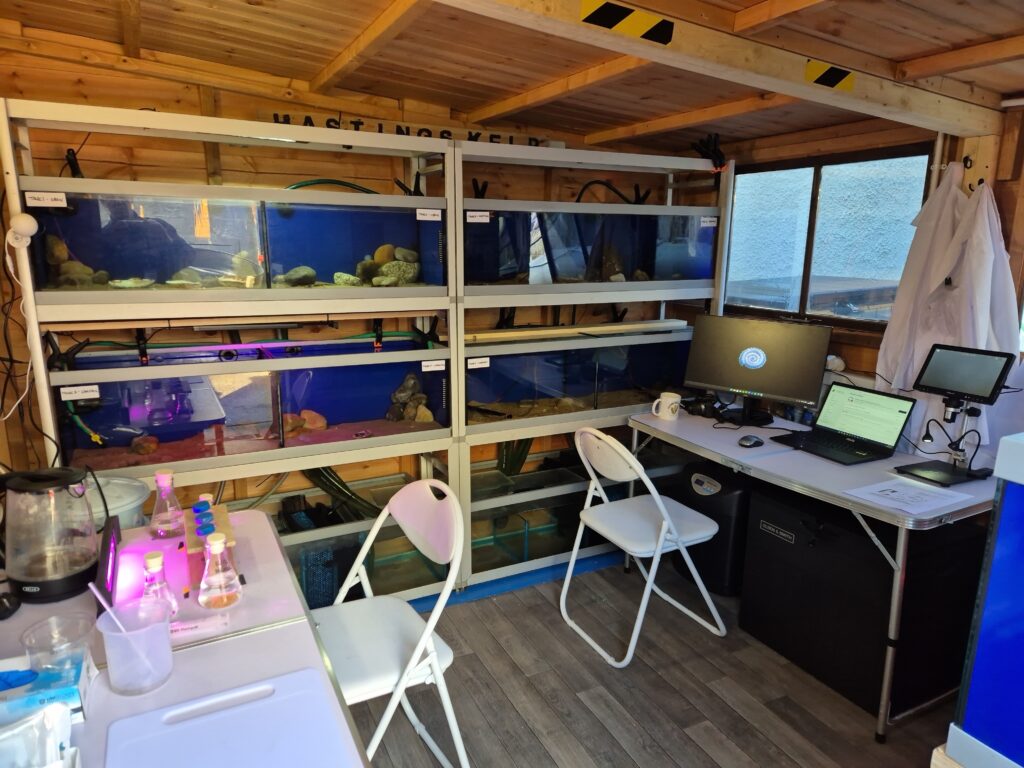
Kelp Research Laboratory
The Hastings Kelp Project has grown far beyond anything I originally imagined. What started as an idea has now become a growing network of divers, scientists, students and volunteers all contributing towards the same goal – learning more about our local marine environment and helping support its recovery.
Ultimately, this is about hope.
It is about reconnecting people with the underwater world on their doorstep and showing that even ecosystems that have been heavily damaged are not necessarily beyond recovery. With enough research, collaboration and local support, there is still a chance to help bring parts of these underwater forests back for future generations.
For more information visit hastingskelpproject.co.uk
We hope you have enjoyed reading this article. The future of our volunteer led, non-profit publication would be far more secure with the aid of a small donation. You can also support local journalism by becoming a friend of HIP. It only takes a minute and we would be very grateful.

Leave a Reply