
Sleepwalking to Catastrophe
We must stop economic growth fuelling ecological collapse before it really is too late argues Richard Price.
Hastings resident Peter Butchers has fished for prawns and mussels in the local area for fifty years. However, he says “Over the last ten years I have noticed a sharp decline in the mussel population, on the rock ledges at Bexhill, the Castle Rocks and Rock-a-Nore Hastings, through to Fairlight and Pett Cliff End. Rock ledges once covered with mussels are now completely barren.”
MISSING FISH
It’s not just shellfish that are disappearing. The small-scale fishing fleet of Hastings has always fished different species at different times of the year. John, who specialises in fishing for bass said: “The seasons are changing so badly. You have to fish for different things. There is no longer a cod season because we don’t get a winter.” He used to fish for cod from October right up until March and April. He said: “Now you virtually don’t see a single fish all winter. You don’t get the herrings anymore; you don’t get the sprats anymore, therefore you don’t get the cod anymore. No winter, no cod. The fish are changing.”
For twenty years I have walked the same route through Hastings Country Park every day and recorded birds. This is the first year that I have experienced severe drought and the first that I have not seen yellowhammers. Normally I see stonechats regularly in their habitual breeding territories. This year I only saw them briefly in April.

CIRCUMSTANTIAL EVIDENCE
These observations provide circumstantial rather than scientific evidence of how the climate is changing biodiversity. For scientists to prove that the prawns, mussels or fish have declined would require data from ecological monitoring programmes. Too few exist. The changes that Peter Butchers and fisherman John described are gradual but with increasing frequency and intensity of heat waves the impact upon biodiversity is likely to be more obvious and dramatic.
Initially, we will begin to notice that animals and plants we used to see every day are no longer there. As the catastrophe unfolds, the rate of change will speed up.
EXTREME WEATHER
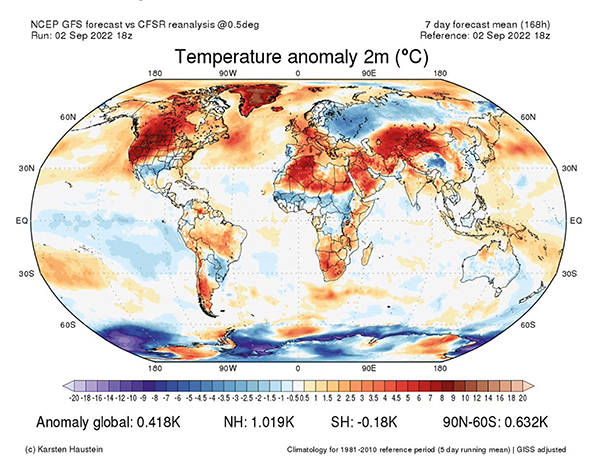
Record-breaking heat waves, droughts and wildfires will cause changes that are impossible to ignore. Plants and animals in the UK are not adapted to live in a savannah or desert. If they are lucky, they can survive a day at 40˚ Celsius but as heat waves become longer and more severe, they will have to survive several consecutive days of intense heat. Scientists are predicting that the heat waves will become more frequent and last longer. For example, in 2020 the met office produced a hypothetical weather forecast for 23 July 2050. The forecast was based on UK climate projections. The south of the country is projected to have temperatures of 39˚C to 43˚C for thirty consecutive days.
If emissions continue, entire species or groups of animals and plants will die before our very eyes. And, then there are wildfires. In the space of a few days entire habitats can burn down. At the moment the government is engaged in ‘soft climate change denial’ and they ignore scientists who predict more frequent and severe droughts. Members of Parliament say things such as, “we’ve had droughts before.” Or, “we’ve had heat waves before and then it rains.”
SOFT DENIAL

The UK government has a flagship project called Net Zero, which is their strategy for meeting the 2050 climate target. The strategy is failing and is the subject of a court action. The Climate Change Committee, which oversees progress towards Net Zero, has recently reported that the UK will not achieve its target by 2050 because there are important policy gaps. The UK High Court has told the government that its Net Zero strategy is unlawful for being too vague. The entire Net Zero policy is ‘soft denial’. Its transition to zero carbon emissions by 2050 will be far too late based on the scientific advice.
Scientists have stated that global warming of 3.2˚C will be hard to survive and that this level of increase will be difficult to prevent without moving away from growth-centric capitalism. Temperature rises of 3.2C are likely by 2090, possible by 2070 and plausible by 2050. Most animals and plants will perish and their habitats will be destroyed if the new average temperature on Earth rises to this extent.
TRANSFORMATIONAL CHANGE
The Intergovernmental Panel on Climate Change (IPCC) provides policymakers with regular scientific assessments on climate change, its implications, and potential future risks by publishing comprehensive assessment reports. More than 200 scientists read about 14,000 research papers to write each report. The IPCC is pretty freaked out by the current situation. Their recent report states that to avoid the predicted rise of 3.2°C, countries must halve their emissions by 2030. This means transformational changes are required. Energy, transport and industry, even buildings, will need to change to achieve it. The growth model of capitalism is unsustainable. A change such as the one outlined by the IPCC would require de-growth policies.
ECOLOGICAL STABILITY AND HUMAN WELLBEING
In 2018, 238 scientists called on the European Commission to abandon GDP growth and focus on human well-being and ecological stability instead. The following year more than 11,000 scientists from over 150 countries published a journal article calling on the world’s governments to shift from pursuing GDP growth and affluence towards sustaining ecosystems and improving wellbeing.
The effects of drought and extreme heat on wildlife can be catastrophic. There is a time-lag between data collection from the extreme heat event and the results of scientific research based upon it. We won’t have scientific evidence showing the effects of the current heat-wave for some time. But can we afford to wait?
A year ago, anyone predicting such severe conditions would have been labelled a climate doomist and ignored. Wildfires have raged across America as well as seventeen European and Mediterranean countries. China has had sixty-nine days of drought and the longest heat wave on record. Major European rivers, The Rhine, Po, Loire and Gaudiana have very low water levels affecting transport. The entire west and southwest United States is in the midst of a record megadrought.

While some parts of the World are suffering from extreme lack of rain others are experiencing a deluge. Pakistan has been hit by floods described by their government as “biblical” in scale. One-third of the country is currently submerged. The floods were preceded by temperatures rising to 50˚C and extreme rainfall. Recent scientific research has indicated that previously rare, record-breaking rainfall is now becoming more likely as a result of climate change. The events, causing flash flooding, landslides, destruction of property and food crops can occur due to the warming of the Earth’s atmosphere which is then able to hold more moisture. This then gets dumped during storms, causing flash flooding.
SLEEPWALKING TO CLIMATE CATASTROPHE
The UN says that the floods are a warning for the world to “stop sleepwalking towards climate change catastrophe. The current situation is an emergency. We need a political party that is not afraid to advocate strategies for de-growth and genuine sustainability. Unfortunately what we have is a party that merely pays lip service to environmental issues while practicing ‘soft denial’, cutting green subsidies and promoting policies that protect the interests of the fossil fuel industries rather than our destabilising environment.
We hope you have enjoyed reading this article. The future of our volunteer led, non-profit publication would be far more secure with the aid of a small donation. You can also support local journalism by becoming a friend of HIP. It only takes a minute and we would be very grateful.

Leave a Reply