
Nurturing Nature?
PHILIPPA BOGLE says the devastating release of plastic pellets by Southern Water at the end of 2025 has focused attention on another East Sussex beauty spot which is threatened by both plastic pollution and a controversial re-wilding scheme

Cuckmere River mouth and Seven Sisters
A decades-long debate about how best to manage the Cuckmere Haven nature reserve in East Sussex may soon be concluded. A planning application from The National Trust and Environment Agency to re-wild a large area of pastureland could not only change how the iconic landscape looks, but end footpath access to an area loved by locals and visitors alike.
The controversial plan involves breaching a Victorian embankment on the west side of Cuckmere and flooding an area used for grazing. It has divided opinion among those concerned about nature and raises the question: what are we actually willing to sacrifice in order to prioritise nature?
The National Trust (NT) hopes to recreate a rare coastal habitat for wildlife, and increase biodiversity, whilst alleviating flooding upriver. It plans to restore Chyngton Brooks – a 100 acre area reclaimed in 1846 – back to intertidal saltmarsh and mudflat. Objectors, however, are angry that the long-established and much-loved riverside footpath along the embankment would be lost, with a second path on the western edge flooded for half the year. Others wonder whether allowing the area to revert to nature is about saving money on costly coastal defences.
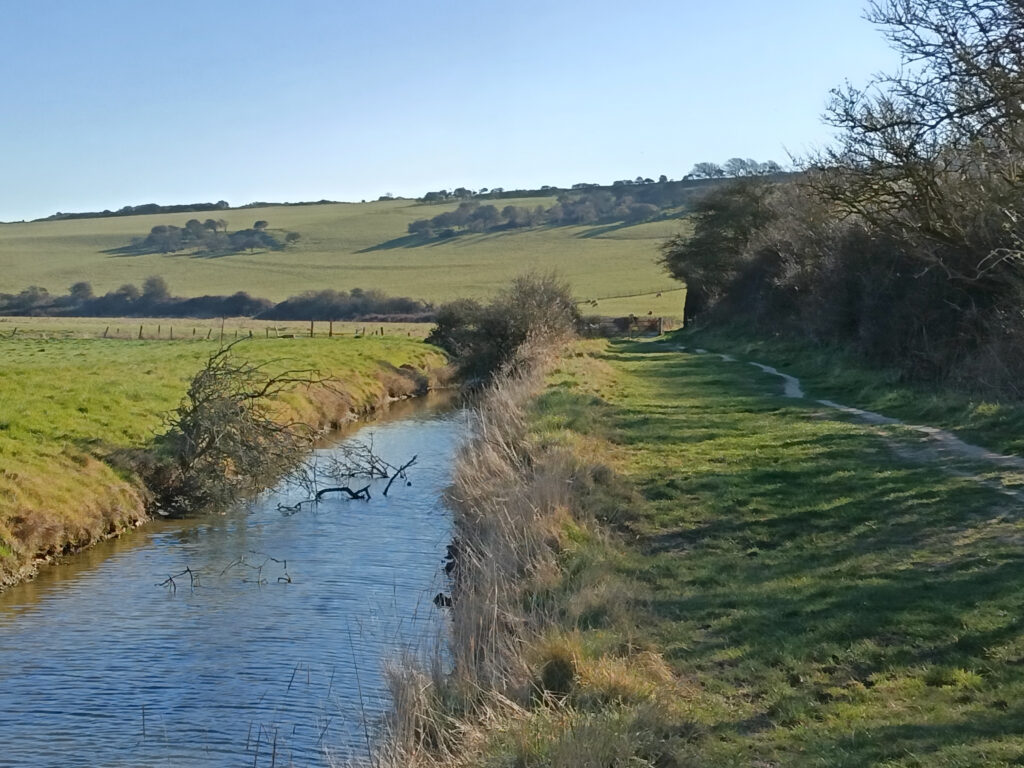
Chyngton Brooks Western footpath
BIO-BEADS BAKED IN
In light of Southern Water’s bio-bead spill, there is dawning public awareness that local nature reserves may not be as pristine as we think, with microplastic pollution prevalent along the coast. Given the urgent efforts of Sussex Wildlife Trust (SWT) to keep the beads out of Rye Harbour Reserve, it is ironic that at Cuckmere, just down the coast from Eastbourne where the spill originated, the NT is now looking to create a new saltmarsh which may have microplastic pollution baked in from the start.
Local volunteer Norm Warm, who has spent every weekend for six years clearing up around Cuckmere, says plastic pollution is nothing new. He estimates that volunteers have removed 16 tonnes of plastic to date. Microplastics are the most challenging to remove, especially from mudflat, and Norm is worried they will inevitably spread across the new saltmarsh on the tide.
Unnoticed by day-trippers, thousands of bio-beads and nurdles (pre-production plastic pellets), are already embedded in the mud and flotsam along Cuckmere River’s high-tide line. A 2022 survey by Strandliners found an average 1,028 bio-beads and 1,515 nurdles in a 0.25 square metre survey area. Norm has even found Bakelite, the earliest form of plastic, here.
He feels more should be done to acknowledge the problem by those responsible for Cuckmere including the NT and South Downs National Park. But they say it originates from the river and the sea, beyond their jurisdiction. Much plastic pollution comes from commercial shipping and fishing jetsam. Rural fly-tipping is also on the rise; locals recently removed 20 full binbags from the Cuckmere River.
STEPPING STONES FOR WILDLIFE
I asked Henri Brocklebank, Conservation Director for SWT, if there’s a contradiction trying to keep bio-beads out of one saltmarsh while allowing them to enter a new hitherto unpolluted one? However, she supports the NT’s project: “New saltmarshes create stepping stones for wildlife along the coast”, and says we should not hold off creating new habitats because water companies “haven’t got their act together.”
Saltmarshes provide vital habitats for birds and nurseries for fish and marine invertebrates and can absorb storm surges and act as carbon sinks. They have become increasingly rare in England, with over 85% lost since 1860. NT project manager, Amie Rai, did not say whether existing microplastics in the adjacent area had been surveyed, nor whether there are plans to prevent them entering the new saltmarsh but insists the project “does not introduce new materials or plastic sources”, and that preventing plastics entering the environment “is most effectively achieved through changes in production choices, design, and practices.”
FLOODING AND “MANAGED REALIGNMENT”
Cuckmere Haven is a complex area with many issues. Coastal erosion constantly threatens the iconic coastguard cottages. Despite residents’ campaigns, the Environment Agency (EA) stopped maintaining coastal defences several years ago but still monitors and clears longshore drift shingle from the river mouth to improve water flow. Alfriston, upriver, has suffered increasingly bad flooding in recent years, with 20 incidents in 2024 alone. Local groups have mobilised to dredge silt and repair embankments to protect homes and businesses.
DECADES OF DEBATE
The debate about how best to manage such issues has continued for decades. In 2001, the Cuckmere Estuary Partnership was formed by the NT, EA, East Sussex County Council and others to investigate ‘managed coastal realignment’ allowing the area to return to a tidal estuary. After years of consultation, environmental assessments and modelling, a planning application was submitted in October 2025. If permission is granted, the NT plans to implement the project by 2027 but the saltmarsh may take five years to establish itself.
The NT describes its plan as a “nature-based solution” to embrace rather than fight natural coastal erosion and the effects of climate change. Objectors point out that it may also be the cheapest option. The embankment which the NT plans to breach has, in practice, been left unmaintained for some time and is eroding with each tide. A natural breach could happen before a decision is even made on the footpath ‘Stopping Up Order’ which the NT intends to apply for in January 2026.
DIVERGING PATHS
The Open Spaces Society (OSS) is at odds with the NT over footpath loss at Cuckmere, despite the two sharing an historical founder. Octavia Hill, who started the NT in 1895, advocated public access to open spaces, highlighting another dilemma: is it more important to give people access to nature or preserve nature itself?
OSS’s Chris Smith, says the embankment footpath could be retained if alternative, slightly more expensive, plans for creating culverts or bridges were reconsidered: “The proposals for these heavily used paths are badly thought out. I urge people to object to the proposals and to ask the Trust to think again.” He is also concerned that another footpath at the western edge of the pasture which carries the King Charles III Coast Path and Vanguard Way will now be flooded for half the year. The NT is proposing to re-route it to a less scenic stretch higher up the field, reducing accessibility and amenity.
Locals, such as those living in coastguard cottages overlooking the Cuckmere, have a strong emotional tie to the landscape. Even the planning application acknowledges the footpath loss will “bear heavy in the hearts of those that have a fondness and connection with this area.” One respondent, Nigel Newton, wrote: “A riverside path and an elevated inland path are not interchangeable experiences.” He argues the path is “valued not only for its recreational function but also for its cultural and historic significance,” possibly being a 16th century smuggler’s route.
The marshland walk is a uniquely inspiring experience – an opportunity to commune with nature, bird-watch and an antidote to modern life. Many artists have been inspired by the area; Ravilious immortalised the river’s meanders in his watercolour of Cuckmere, displayed in Eastbourne’s Towner. The area attracts nearly 1 million visitors per year, with the Seven Sisters walk internationally popular for day-trippers – after featuring in films, TV shows, and even K-pop videos. Many artists have been inspired by the area.
Tourist hordes taking selfies is perhaps not what Octavia Hill had in mind when she championed access to green space for the masses, but it does raise a serious issue about balancing the needs of humans with those of nature. Of course, you must care about nature to want to save it. No one is arguing against the benefits of access to nature, but we may have to walk a bit further, get a bit muddier and miss out on that close encounter with an egret to ensure future generations exist.
Find out more
Planning application website for Chyngton Brooks project ref SDNP/25/04080/FUL:

planningpublicaccess.southdowns.gov.uk
National Trust
website for Chyngton Brooks project:
www.nationaltrust.org.uk/visit/sussex/cuckmere-valley/restoring-chyngton-brooks-project
National Trust strategy www.nationaltrust.org.uk/who-we-are/our-strategy
Alfriston Clergy House www.nationaltrust.org.uk/visit/sussex/alfriston-clergy-house
Sussex Wildlife Trust
Open Spaces Society
www.oss.org.uk/about-us/our-history/
BHASS Explore (Beachy Head and Seven Sisters Extreme Plastic Object Removal) with Norm Warm: cleanups every Saturday and Sunday in Cuckmere Haven and around Seven Sisters facebook.com/bhassexplore
Strandliners surveys
www.strandliners.org/surveys/cuckmere-haven/
www.nurdlehunt.org.uk/the-solution.html
“Bin the Beads” – Petition to ban bio-beads started by Helena Dollimore MP: www.helenadollimore.com/binthebeads
Write to Helena Dollimore MP requesting she lobbies for the re-nationalisation of water companies: [email protected] – quote your name and address.
Cuckmere Haven SOS group
www.cuckmerehavensos.org/campaign
Reading & learning:
Marine plastic pollution:
www.sas.org.uk/plastic-pollution/plastic-pollution-facts-figures/
www.mcsuk.org/news/how-to-reduce-ocean-plastic-pollution/
· The Shaping of the Sussex Landscape by Peter Brandon, Sussex Guide, Snake River Press
· Is a River Alive? by Robert McFarlane
· Feral: Searching for Enchantment on the Frontiers of Rewilding by George Monbiot
· Wilding: The Return of Nature to a British Farm by Isabella Tree
Eric Ravilious Collection at The Towner Gallery Eastbourne
Tues to Sun and Bank Holiday Mons, Free
www.townereastbourne.org.uk/whats-on/the-ravilious-collection
Hastings Museum for geology and palaeontology
www.hmag.org.uk/explore/our-collections/natural-history/palaeontology/
www.hmag.org.uk/explore/our-collections/natural-history/geology/
We hope you have enjoyed reading this article. The future of our volunteer led, non-profit publication would be far more secure with the aid of a small donation. You can also support local journalism by becoming a friend of HIP. It only takes a minute and we would be very grateful.

Leave a Reply