
Climate Plagues
DAVID EP DENNIS
Over the course of history across the world, there have been terrible outbreaks of diseases, and the local climate plays a part in spreading sickness. Science can now tell us what causes these diseases and, hopefully, how they can be prevented or cured. In medieval times, the causes of Black Death bubonic plague, Dengue Fever, Cholera, Typhus and Malaria were a mystery. People who became ill were said to be ‘elf-shot’. Nowadays we all have a responsibility to monitor and conserve our environment and to report certain infections.
LOCAL PLAGUES
Denge Marsh is a part of Romney Marsh in Kent. Its north-west boundary is the town of Lydd; to the south-east is Denge Beach and Dungeness. The area was one of the earliest parts in the region to be reclaimed, recorded in a charter of A.D. 744. Drainage dykes, known locally as sewers, were built to reclaim land and help remove mosquitoes that cause Dengue and Malaria. ‘Denge’ has the meaning ‘to beat’ or ‘strike’ in the Norwegian language, a little like ‘elf-shot’.
In medieval times, Romney Marsh farmers and drainage workers suffered from ‘Marsh fever’ that had a malarial feel as the area was plagued with Aedes mosquitos. Symptoms of deadly Dengue Fever include high fever, headache, muscle and joint pain, and a characteristic skin rash. On 11th December 2023, the BBC (British Broadcasting Corporation) explained that climate change was developing rapidly, with an increased chance of mosquito-borne Dengue fever coming back to England. This viral disease is currently prevalent in tropical and subtropical regions of the world, being transmitted through the bite of infected mosquitoes. One defence is to ensure you do not have any open-surface buckets or bins of stagnant water in your garden, where mosquitoes could breed.
BLACK DEATH
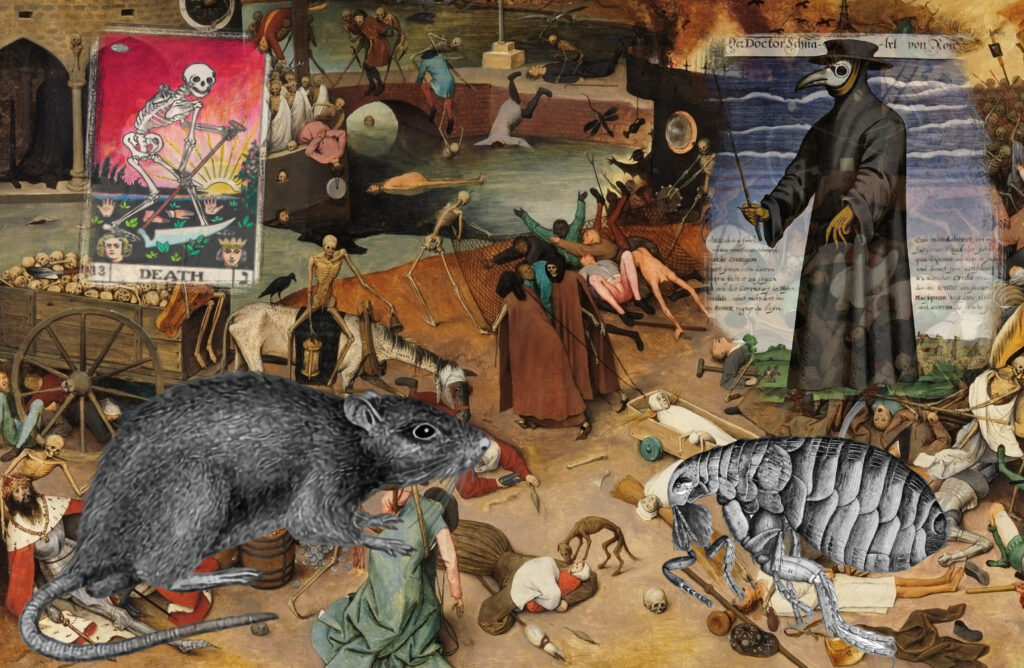
The Black Death, caused by the Yersinia pestis bacteria injected by fleabite gave people a truly wretched death with groin ‘buboes’, vomiting, ghastly headaches and swollen tongues. Those who were dying in agony found their skin developing black patches. This awful disease came to England from Gascony via a ship sailing into Weymouth in June 1348. Although the Romans had developed sewers and ways to remove waste, these techniques were soon forgotten. During the medieval period in Rye, a large wooden tower was built stretching out over the sea and from this was cast human waste. Our sea fronts now have an echo of that crisis. The Environment Agency is monitoring all 15,000 sea outlets and conducting a criminal investigation to discover which companies are allowing sewage into the sea illegally.
The first major bubonic plague of 1348 led to the death of one third of the entire population of England (2 million) and one third of the population of Europe (25 million). In England, when the remaining peasants realised that they were desperately needed by the gentry to revive ruined agriculture, they asked for more money and this eventually led to the Peasant’s Revolt.

After King Henry VIII died in 1547, Hastings suffered from plague outbreaks in 1563, 1590, and 1597, but enough people survived to carry on the work of the Cinque Ports and the fishing industry.
GREAT PLAGUE
In the Great Plague of 1665-1666, Sussex was still a truly filthy place with open drains, animal and human dung waste, and sewage carts attracting bacterially infected rats. The summer of 1665 was exceptionally warm, and by September across England, seven thousand people were dying each week. King Charles II and Parliament fled from London to Oxford. As rich people travelled, they helped to spread the disease. In February, as the temperature dropped sharply, the king and parliament returned to the capital. It seemed that the ‘evil spirits’ that caused plague were afraid of the cold. Rats and the fleas upon them seemed to be normal for the times. The specific plague bacterium was not discovered until 1894 by Alexandre Yersin.
THE PLAGUE SHIP
In 1822, rumours spread in the Newenden area that a Viking ship had been found. Local people knew that Vikings had raided Appledore with 250 longships in 897 CE, overwintering and causing havoc across southern England. They were eventually defeated by King Alfred.
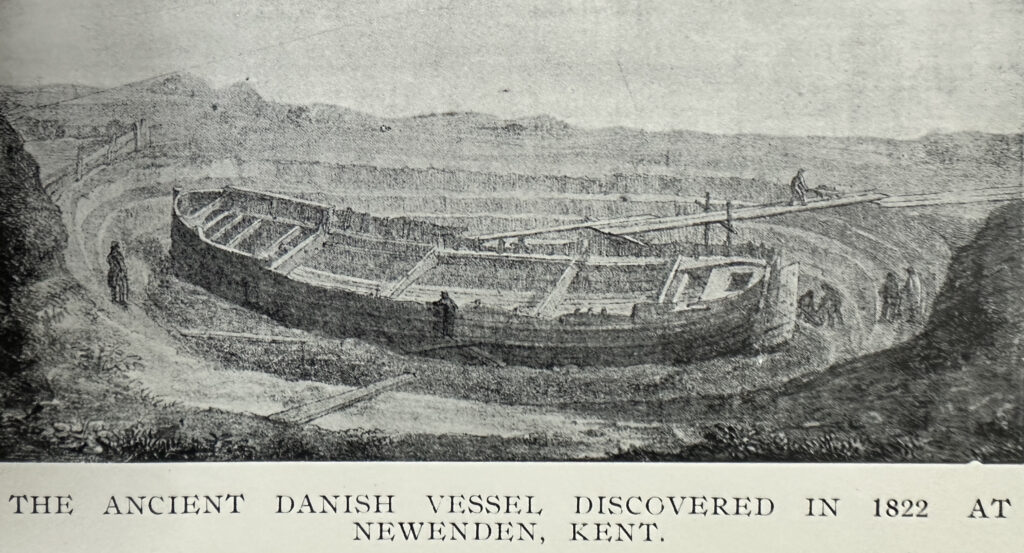
Back in 1822, anything found in Sussex or Kent, made of wood and looking long and narrow, was seen as either a remnant of the Norman invasion- since Duke William had massacred the citizens of Old Romney on 20th October 1066 in retaliation for their killing of his longship crew on 28th September of the same year – or could be part of the great fleet of Viking longships that came to Appledore. This so-called ‘Viking Ship’ was 63 feet and 8 inches in length and 15 feet in breadth. After being taken to London and exhibited for some time, it was broken up and tea caddies and boxes were made with it.
Kent Archives Summary states: “About 1822, the remains of an ancient ship were found by accident in the former bed of the Rother near Maytham Wharf, W. of the Isle of Oxney on the Kent side of the boundary with Sussex. The vessel was clinker-built from oak, but not of British origin. When the vessel was refloated, the remains of a small boat were found about 16 feet from the stern. Earthenware pots and glazed tiles set up as a hearth were found in the after cabin of the larger vessel, and there were bones: a human skull, that of a man with several sound teeth and the bones of an adult, another skull, that of a child with several small child’s bones, the skull of a dog, the skull and horns of a goat or sheep and the lower jaw of a boar with its teeth and tusk.”
It was not Viking but probably Dutch, becoming derelict prior to 1623 because at that date, a complete stop was made to the navigation of the Appledore Channel. It is suggested that the crew might have been plague victims, accounting for human remains, and that the vessel was left, so was comparatively intact, blocking the river navigation channel.
As climate change bites, so do we need to be aware of the dangers of insect-borne diseases.
We hope you have enjoyed reading this article. The future of our volunteer led, non-profit publication would be far more secure with the aid of a small donation. You can also support local journalism by becoming a friend of HIP. It only takes a minute and we would be very grateful.

Leave a Reply