
Who Runs our Schools?
Our new education correspondent, CALLUM THOMSON, a former Hastings teacher, considers the debate between Academy and Local Authority schools.
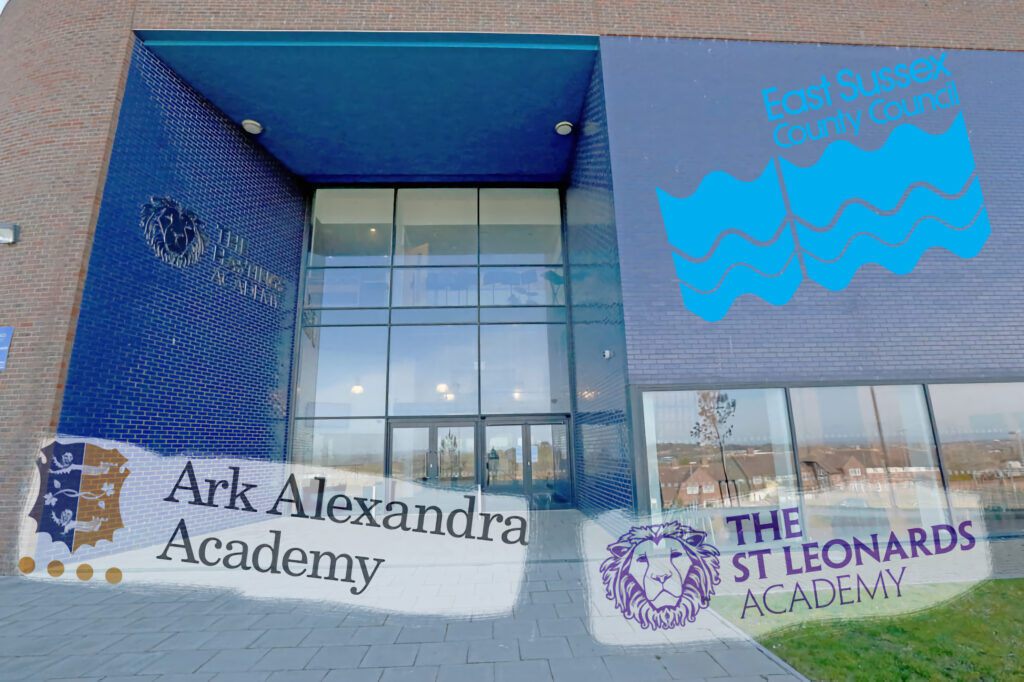
Academies are state-funded, non-fee-paying schools which are independent of local authorities. Maintained schools are schools which receive funding and oversight from the local authority.
Nationally, academies make up 80% of secondary schools, 40% of primary schools and 44% of special schools. There is a similar picture in Hastings. Of 20 primary schools here, 15 are academies and five are maintained. Of the five secondary schools locally, four are academies. The three largest schools, all academies, Hastings Academy, Ark Alexandra Academy, and St Leonard’s Academy, teach 95% of secondary school students in Hastings.
Some of the key differences between academies and maintained schools relate to their organisational structure at the top. Academies are run by ‘trusts’. These are education charities which are funded directly by the Department for Education (DfE). There are two kinds: single-academy trusts – SATs, or multi-academy trusts – MATs. Nearly 90% of academies are run by MATS and, in 2022, the government set a date of 2030 for all schools to be part of, or in the process of joining, a MAT.
Multi-academy trusts are run by two groups: the members, and the board of trustees. The members’ primary responsibility is to hold the trustees to account. Trustees have a more hands-on role, responsible for the legal, financial and strategic performance of the trust. The trustees then generally appoint a local governing body which, alongside the headteacher, is responsible for the day-to-day running of each school.

HASTINGS’ ACADEMIES
Locally, Ark Alexandra Academy is part of the Ark Schools MAT, which runs 39 schools across the UK. Hastings and St Leonards Academies are part of the University of Brighton (UoB) MAT, which runs 15 schools.
Maintained schools are overseen by the local authority, which is responsible for performance and can intervene in their management and governance. Each school has a board of governors responsible for overseeing financial performance and appointing the headteacher. Significantly, the local authority nominates a representative to sit on each governing board, giving it an active presence in individual schools, connecting residents of each community with the leadership of their schools.
The relationship between local government and academies is quite different. Although the government advises local authorities to seek positive relationships with academies, there is no statutory obligation for any link to exist. Where a local authority has concerns about academy performance, it must raise them directly with the national Department for Education.
Josh Smedley, former representative for the Teachers Union NASWAT at Ark Alexandra, says: “After academisation, humanity, community and collegiality are quite often replaced by cold, faceless hierarchies. Many decisions for Hastings’ children are being taken by people based in London, Birmingham or Brighton who have no connection to or understanding of the town.”
The argument for academies was that Local Authorities had become bogged down in bureaucracy and were slow to innovate. Academies would be in a position to empower the best and the brightest educators. As academies have a much greater say in the curriculum they teach and in pay and conditions for staff, they would be able to quickly implement the latest education research.
LACK OF TRANSPARENCY
There is of course the flip side to this absence of red tape – a lack of transparency and due process. A report by the House of Commons Public Accounts Committee expressed concerns that academy trusts were “using public money to pay excessive salaries”, noting the difference between the average annual salary of an academy headteacher (£92,000) and an LA maintained school headteacher (£88,000), and finding more than a hundred instances of trustees being employed on salaries in excess of £150,000, which they declared “unjustifiably high”. The London School of Economics, in a separate report, noted that MAT accounts, while having to be signed off by an external auditor, “do not provide a detailed account of how public money is spent”, and can “easily mask the financial decisions made by individual academies”. They have also reported on the ability for MATs to buy goods and services through ‘related parties’, parties with whom the trustees may have a personal connection. In 2015-16, deals of this kind were worth a total of £120 million.
The performance of academies is monitored by civil servants, named Regional Directors, who are explicitly tasked with intervening in underperforming schools, and hastening the transition of struggling maintained schools to academies. Yet some are concerned about the power Regional Directors wield, saying this represents a massive centralisation of power to the DfE, via unelected civil servants who operate without public scrutiny or democratic oversight.

There is also a convincing accusation that, despite academies being created in order to empower headteachers and respond to bespoke local interests, actually, when part of a MAT, single academies are disempowered. As the MAT holds the agreement with the government, single academies within it are not free-standing legal entities and are beholden to orders from above.
PARENTAL INVOLVEMENT
This raises the question of parental involvement and their inability to affect the practices of their schools. The government explicitly denies this. On their academies myth-busting.gov page, they say it is untrue that “academies won’t be accountable to parents” and that they “want parents to be more involved in their child’s education – not less”. They continue: “Whereas one-size-fits-all approaches dictated from County Hall gives an impression of local control, in fact, it’s academy headteachers and governing bodies that hold direct relationships with the parents they serve and have the power to be much more responsive to their communities.”
The government says that they want to “enable academies to move from a model where parents are elected for means of representation, to one where they are chosen for their expertise”. Again this follows their meritocratic reasoning that the best and the brightest should be in charge, not parents or councillors who may end up in an important leadership role by dint of legislation. But where maintained schools must, by law, have at least two parents on the governing board, academies have no such obligation.
The debate between academies and maintained schools could be seen as a classic political division. To the left, councils provide a much needed democratic and community-oriented safeguard against mechanical, corporate management. To the right, councils are stodgy and prevent change.
The government insists academies are “empowering the frontline and moving control away from bureaucrats to improve school performance, holding them to account for the results they achieve, and to much stricter standards of financial propriety than we ever have with local authority schools.”
EMPOWERING THE FRONTLINE
The ideological choice is between a large-scale, liberated, market-driven pursuit of school improvement. Or a system stewarded by local government, democratically accountable but with a slower and more deliberative, committee-driven process.
With MATs, the people in charge determine how the school is run. Yes, MATs are free to elect a governing board containing no parents, and make important decisions with no public consultation, but that does not necessarily mean they will. Successive governments have built an education system that relies on contrived market pressures to incentivise – or terrify – schools to improve. There seems little doubt that Ark is committed to improving their schools in Hastings. Equally true, I am sure, for UoB Academy Trust. Perhaps ultimately, the question transcends local specifics and reflects an age-old political division between state or market, regulation or choice, or even Left and Right.
We hope you have enjoyed reading this article. The future of our volunteer led, non-profit publication would be far more secure with the aid of a small donation. You can also support local journalism by becoming a friend of HIP. It only takes a minute and we would be very grateful.


Leave a Reply