
Let Nature be your Teacher
CHRIS WATKINS
When I met Elliot Riley he showed me round his sunny suburban garden in Bexhill, which itself has grown unusually wild. He told me about the plants there, their traditional uses, the history of their names and how they helped improve the soil’s condition. He has a habit of picking up everyday greenery, plants more often removed as weeds, and offering them to you as an unexpected snack. He speaks with confidence and enthusiasm about his work at St Leonard’s Academy, where he is building and planting a ‘Food Forest’, to provide a long-lasting, self-sustaining organic food source for the school and help transform waste products into a source of fertility.
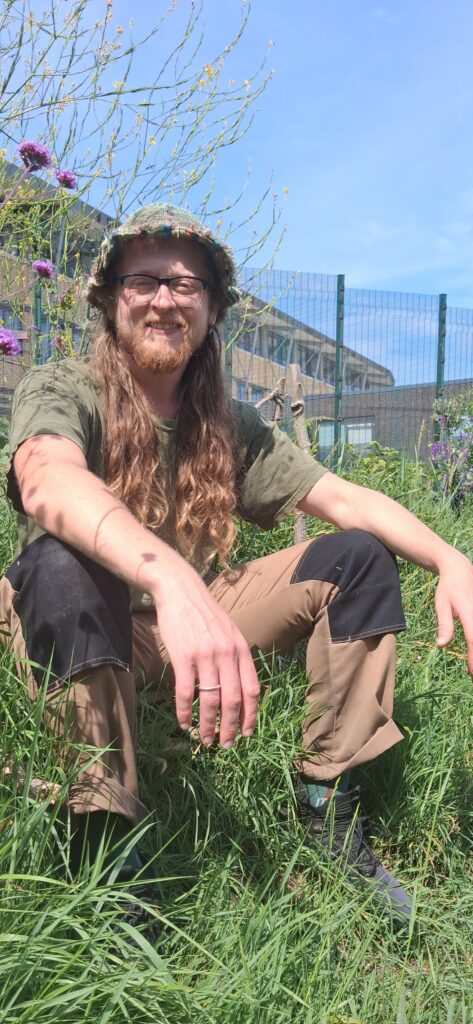
“We are directly teaching students the skills to reduce our reliance on imported, oil-driven food; growing your own, harvesting rainwater, transforming waste into fertile soil and back into nourishment.” Elliot tells me that during his lessons the children learn how to improve the water retention of soil, which reduces the impact of our cycles of flood and drought, and how plants put atmospheric carbon back into the ground. “We’re creating the opportunity to talk about community, bring the varied skills of different students and members of the wider community into our project. Schools are intended to prepare students for the future. For any school which aims to do this, I believe teaching their children how to grow food is an obligation.”
His enthusiasm is certainly contagious. A small garden with a few raised beds had already been started on the site but Elliot approached the school with a plan that would teach children to re-engage with nature whilst helping pupils struggling in a mainstream environment to rebalance their emotions and find a valuable outlet for their energy. Elliot explained what his pupils do during lessons. This includes sowing seeds, caring for seedlings, transplanting, watering, using companion plants such as clover for nitrogen fixation and garlic for pest repellence, selective weeding, making high quality compost, building ‘lasagna’ beds which layer waste materials rather than soil and, as he puts it, “breaking up bricks of mushroom-inoculated sawdust which acts as a useful mulch whilst producing oyster mushrooms when it rains”. It also involves painting signs and building fences and dead-hedges. The list is long, busy and rewarding.
Elliot’s early story is one of transformative opportunities. Raised in Bexhill and “well-looked after” at Little Common Primary, family connections helped him successfully apply to Christ’s Hospital School in Horsham. From there he earned another scholarship to study at AC Grayling’s New College of the Humanities in North London. After three years of History and Philosophy he was left uncertain what would come next. Then the Covid lockdown hit just as he was graduating. What he felt during that time was the people’s exclusion from land ownership and inability to provide for themselves, as well as the impact of industrial farming on our planet. He explains “That pausing in the global supply chain showed us how much we were reliant on it and how fragile it was.”

After lockdown he began to learn more about permaculture, a form of regenerative agriculture that focuses on working with natural ecosystems to be self-sufficient, produce no waste and regenerate the soil. Soon he was introduced to the work of The Human Hive and travelled to work at their school in the Dominican Republic. There his first project was helping to build a food forest on the site. “Within a matter of weeks I saw this barren, dirty, derelict space absorbing rainwater, producing stupid amounts of food, creating a place where kids could not only take the food scraps but also get out a load of energy and sit in nature. It just worked. I thought: ‘This is absolute genius’ – it was what the planet needed.”

By the time he returned home, Elliot was convinced he needed to find a way to practise permaculture education in the UK and, since he had no land of his own it occurred to him that schools “with their abundant land and their need for emotional support systems” would be the easiest way forward, benefitting the school, the eco-system and pupils themselves. “It’s a win-win-win scenario, which is what permaculture is built on.” Through working with other established practitioners, he was eventually invited to help develop the project at St Leonards Academy, which he now co-ordinates under the name Future Growth. This kind of work is far from commonplace, but listening to Elliott talk it’s easy to see why the school has embraced his vision, providing significant space, financial investment and support to the project, which has already gained local recognition as well as an imminent Level 5 RHS School Gardening certification. Elliot’s organisation Off-Set Food Forests, which you can find on various socials and Patreon, is also in the process of developing similar projects in other Primary and Secondary schools in the area – to train new practitioners and grow a new generation of permaculture gardeners.
Future Growth at St Leonards Academy was part of the Edible Open Gardens scheme on 28 June. To help support the initiative visit: patreon.com/offsetfoodforests
We hope you have enjoyed reading this article. The future of our volunteer led, non-profit publication would be far more secure with the aid of a small donation. You can also support local journalism by becoming a friend of HIP. It only takes a minute and we would be very grateful.

Leave a Reply