
Book Festival Patrons Gather for Symposium
MERLIN BETTS
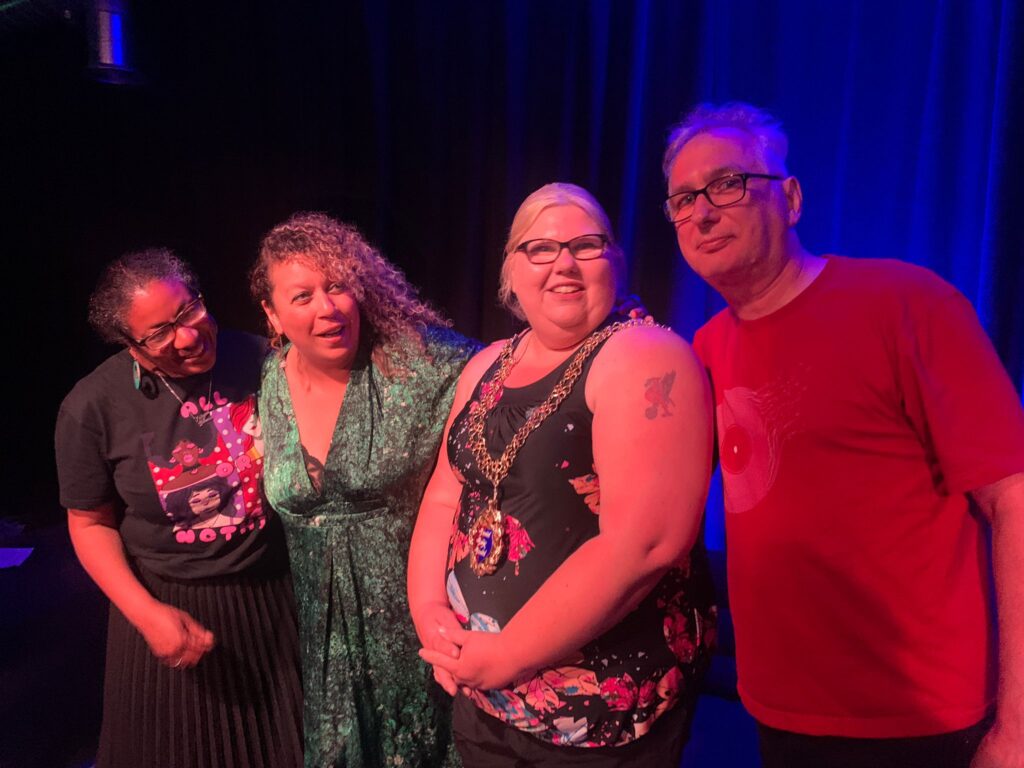
Or a soiree, a presentation, even just a poetry reading with Q+A to finish. On Wednesday June 14, Hastings Book Festival hosted its triumvirate of patrons – Salena Godden, Patrice Lawrence and Henry Normal – at Hastings’ own Observer Building (OB). The OB’s downstairs function room has only recently been adapted to hold these kind of events, and is now equipped with stage, chairs, theatrical curtains and, most importantly, a bar. Probably some kind of advanced lighting system and sound rig too. The sound rig mostly worked.
While I like a book and have been known to write a poem, I’m not HIP’s main point of contact with the literary world i.e. this isn’t my usual gig. I’ve become one of these Hastings characters who mooch around the arts crowd searching for every cup of free red wine I can get my grape-stained hands on, and the OB seemed a likely surrogate vintner.
So I was very disappointed when we had to pay for our drinks. However, strange personal characteristics of the reviewer aside, it was a wonderful evening of highest quality performance and uplifting (but honest) humanity.
After we’d settled down in our seats, the patrons steadily emerged from our number, casual as you please, to give their presentations. It was no living room, but their manner – and their excited energy – gave the space that homely feel, like we were sat at a kitchen table listening to our wisest and funniest relatives reflect on the world, and make their familiar insightful postulations.
As the event progressed, each patron seemed to learn from the others’ style, feeding each performance into the next and creating a very natural flow as their unique characteristics sparkled in unison. But given the constraints of review format and writing this unnecessarily close to deadline, I’m not sure I can replicate that flow on the page.
Patrice Lawrence
Patrice mainly writes for children but, as she was quick to remind us, there’s no reason to consider that a lesser form of creative practice – in fact, writing for children provides a rare freedom to build worlds without the restrictions sometimes placed on fiction by a limited adult imagination.
Children’s books can be particularly transgressive and powerful, and many of us will have a memory of some early favourite book from childhood that went on to form part of our lives to this day. Although admittedly, the literacy rate is appalling in various parts of Hastings, and so maybe not everyone will have such a fond recollection of young literature – something we desperately need to work on.
Patrice lives in Hastings now but was born in Brighton, and learned to read from age three – always very keen on the written word. She discussed her recent book Granny Came Here on the Empire Windrush, in which young Ava has to dress up as someone she admires for school assembly. She asks her Granny for advice, and begins to realise that her nan has quite an admirable tale to tell.
Patrice and Salena both talked about growing up with very few books that spoke to their experience of the world, and their identity. It’s only very recently that we’ve moved away from patriarchy being the norm in literature, and in the West we still seem to be struggling with the idea that you can’t bleach the world white. Patrice is making a vital step forward in changing that negative culture from the ground up – at the earliest stage of our lives when we’re most impressionable, and often when we’re most open-minded to others’ experiences… until we’re taught by our adults that that’s bad.
She moved on to readings from her book Elemental Detectives, taking a look at the magic and power of creative imagination. In fantasy, in sci-fi, in children’s books, you don’t have to present the world as the scorching crust of evil that it usually seems to be, you can rewrite it as its best self.

Patrice also recalled how she accidentally started writing by doing books for young adults, and how when she was younger that genre didn’t even exist. For much of our literary history, the young haven’t had the opportunity to be young – they’ve just been thrown into the gaping moloch maw of their adult caretakers. But for a while now that’s been changing for the better.
Henry Normal
“This is a poem written for every single one of you, in particular.”
If you don’t know his name, you’ll know his work, and we already have an excellent interview with him on our website, under Normal Not Normal. He’s “produced and co-written some of the landmark comedy shows of the last thirty years, including Mrs Merton, The Royle Family, Gavin and Stacey, The Mighty Boosh and much of Steve Coogan’s output, including the immortal Alan Partridge” and now he’s over in Fairlight, carrying on his accidental theme of living next to nudist beaches.
Apart from what I’d describe as a pretty tight stand-up performance or set of ad-libs – I can’t always tell with these things – he read poems from The Escape Plan, which features cover art painted by his autistic son, Johnny Carroll. Generally he managed to be ‘normal’ in such a perfect way that it became abnormal. If you want to know what it was like, you can look up him on BBC Sounds, or go to bbc.co.uk/sounds/brand/b09rwvwt.
In the Q+A, Henry and the panel reminisced about how a library card used to feel like something special. A secret agent ID, or a sci-fi keycard. Clearly in the modern age of screens and computing, that particular experience is becoming more of a rarity, though I suppose you can now play games where you are a secret agent collecting sci-fi keycards. Is that better or worse for the imagination? I’m not entirely sure.
Asked about inspirational literary figures, Henry named Alan Sillitoe, saying, ‘It’s better to lose by your own standards than win by someone else’s,’ which we should probably recite every fortnight as HIP goes to print. Though maybe there’s a more optimistic version lurking somewhere.
Salena Godden

Now, as it happens I know Salena through Hastings original and Brighton poet and songwriter, Oli Spleen, so I rocked up to the evening with her and Mr Spleen after a quick drink in the Dripping Well. And of course that meant reminiscences about the Tubman days – the very pub between the OB and Dripping Well which spawned HIP from an anarchists’ casual afternoon.
It’s still sitting there now, unused, since it was closed. I’m a bit young to have had a drink in the Tubman (I only got to Hastings about six years ago in a blind haze of magical fog), but its influence has bled through a lot of our most intriguing luminaries. We were soon joined by Salena’s mum and her amazing sister Jo – in fact they were probably there already – as the evening got underway.
Salena had recently performed in the landmark Windrush 75 concert at the Albert Hall, organised to mark the anniversary of the Empire Windrush reaching British shores and to “capture the breadth of musical influence which the Windrush generation has had on British culture over the last 75 years.” You can read her take on the night here: salenagodden.co.uk/2023/06
A proper Hastings local, Salena spent many of her formative young years in this town, drinking gin and cider under the pier or, as she recalled, on the little street just next to the OB, which would be just behind the stage she stood on to address us. She’s about to re-release Springfield Road, her memoir of those days, revised and under a new title. Perhaps the book’s metamorphosis suggests that, despite the town’s flaws, she still considers Hastings a homely and increasingly happy place to be a part of.
She read selections from her book Mrs Death Mrs Death, “Spoiler alert: we will all die in the end… This book may be used for mild to moderate relief from pain,” as well as her poetry collection Pessimism is for Lightweights, all of which were delivered with magnificent power and dynamism.
In the Q+A she resisted attempts to be nailed down on questions of form, maintaining a sense of free-flowing creative freedom rather than harsh academic format. As the group reflected on how they made their success in writing, Salena summarised their conclusion, “You’ll do a thing, and then the world will tell you what you are.”
In other words, there’s no recipe to success, no secret prodigious talent you have to study for; you just have to be yourself, and maybe be yourself loudly, and hope that you’re then hailed as a success to be touted by publishers and promoters, or otherwise find yourself recruited by fellow-travellers with funding for their projects that just grow and grow. It’s not an exact science. It’s increasingly personal.
I hope all this has got you excited for what’s to come from Hastings Book Festival in the autumn. You can expect an announcement about this year’s plans in early July. And don’t forget, the deadline for their short story and poetry competitions is July 14 at 10pm! Head to their website to submit your material hastingsbookfest.org/competitions.
We hope you have enjoyed reading this article. The future of our volunteer led, non-profit publication would be far more secure with the aid of a small donation. You can also support local journalism by becoming a friend of HIP. It only takes a minute and we would be very grateful.

Leave a Reply