
Where are the Blue Plaques?
DR HILDA KEAN, FRHistS, historian, and retired Dean of Ruskin College, Oxford on how we honour and remember people in Hastings.
This May, including the May Day celebrations held in Warrior Square, we recalled various political pasts and remembered progressive people.
Statues of the past

The statue of Queen Victoria, by London sculptor Francis John Williamson, is still extant. Having created 15 monumental statues of her across the world, Williamson erected in 1902, not an original, but a replica, costing 750 guineas. As the mayor, Capt. Colvile, stated in 1901,“it would not only beautify and improve the square – but was likely to increase the value of the houses.” The freeholders had wanted marble,“as lighter and brighter,” rather than bronze – but bronze was chosen.The council explained, “It will be lodged on a pedestal of massive red granite, because it is the best material for withstanding the sea air.” Debate around change occurred over the years – and it was agreed that it should to be kept in 1927 since,“the gardens would become a dump for garbage and a happy hunting ground for all the mongrels in the district.”
This somewhat contrasts with Prince Albert’s statue by Edwin Stirling, the 19th century sculptor, who died in 1867. He produced just one statue of Albert, who died in 1861, and several different statues in Liverpool. Although now appropriately displayed outside Hastings Town Hall, the marble seems to have resulted in the statue ending up in worse condition than the later bronze Queen Victoria.

Back in 1933 – perhaps creating the tradition of the later use of traffic cones on Victoria’s head – a specific trick by two undergraduates occurred. Somewhat euphemistically, “a bedroom utensil has been placed in the hand of the statue, and toilet rolls were hanging from her head.” Within 90 minutes they were arrested and later fined 20/- (£1 ) each.
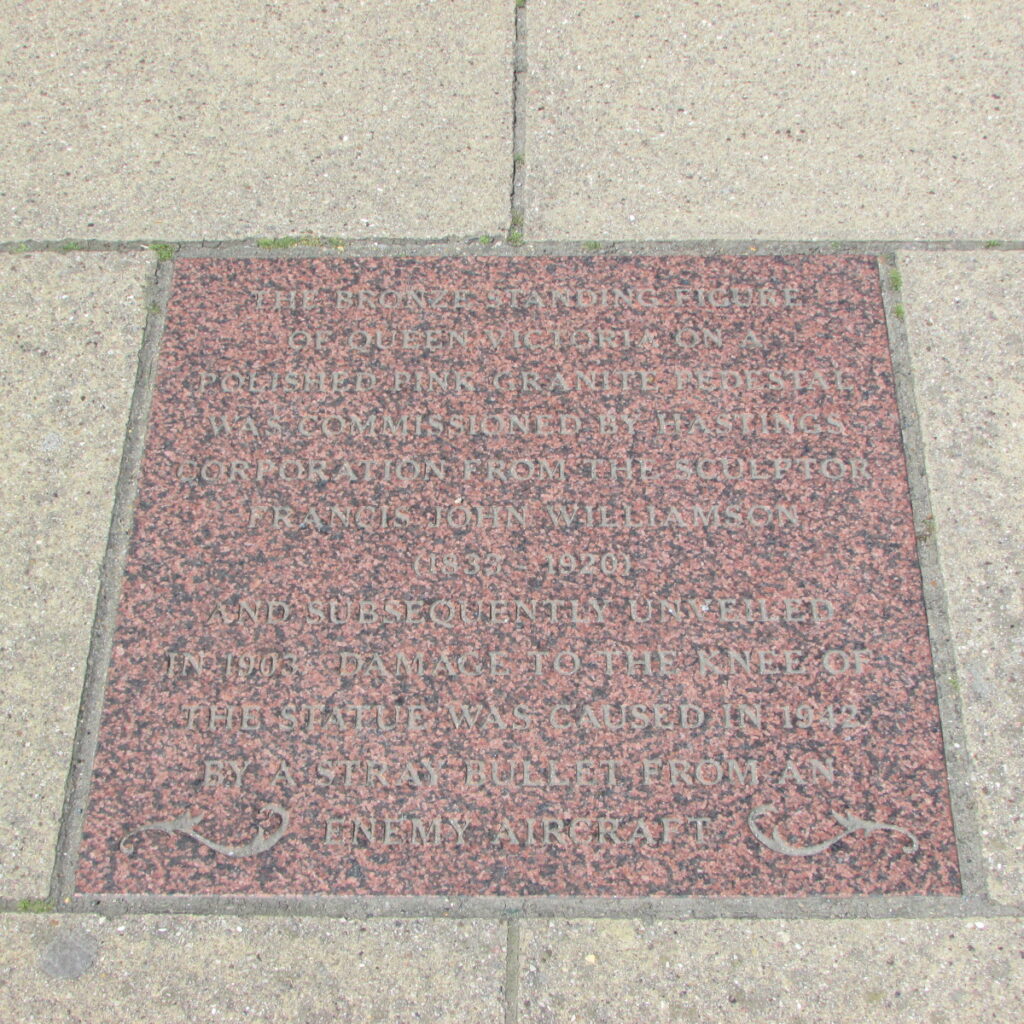
In the second world war Victoria was still there on the widened pavement – with the Home Guard nearby with a searchlight on the square. As Haydon Luke’s book, Fairlight, reveals, from September 1940 much hostile bombing occurred along the coast. And, specifically in 1942, it caused damage to the statue.
Later, seagull deposits often covered the statue. When it was cleaned this century, a bullet hole was finally seen, explained as coming from a ME109 Messerschmidt fighter plane. When Jeremy Birch was council leader, a new clear plaque was also inserted on the ground explaining action from a “stray bullet” – upwards on her side.
The statue is just one aspect of past times locally. People’s awareness of retaining the past should be maintained. As Bernard McGinley has recently reminded Hastings Online Times readers, there were many former St Leonards residents who deserve to be recalled in a celebratory event. But also, there are many more past, and politically active people who have never been remembered – even through a plaque on their former homes.
Missing plaques of women of the 20th century
Site of Hastings and St Leonards Tax Resistance League
Dora Montefiore for example. She was not merely a suffrage activist and a member of the Social Democratic Federation (SDF but an internationalist active in Australia and South Africa. In 1906, she had famously barricaded her house and put up a banner reading, “women should vote for the laws they obey and the taxes they pay”. She also lived for years in her Edwin Road home in Clive Vale where she died in 1933. Yet there is no plaque.
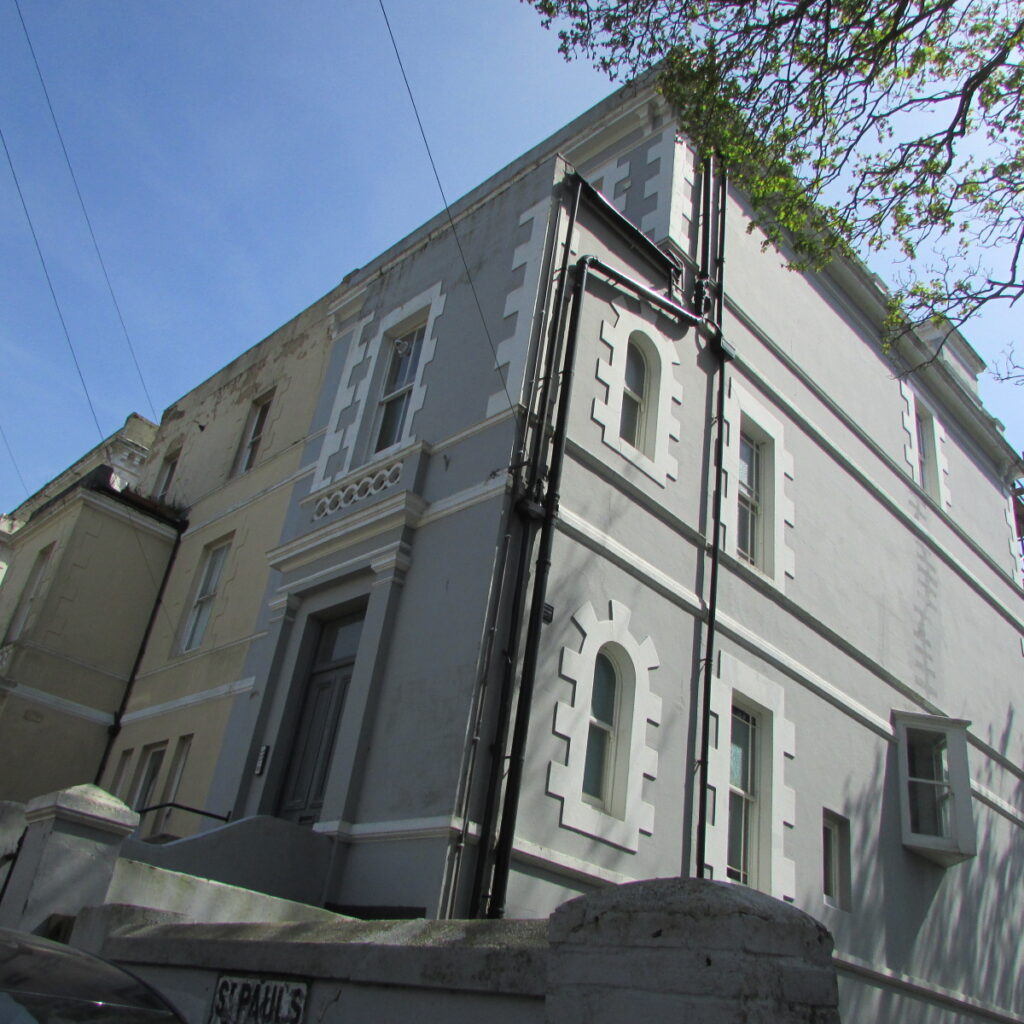
Other women, specifically in Hastings and St Leonards Tax Resistance League (HSTRL) also undertook tax resistance. This included organiser, Isabella Darent Harrison who, “barricaded her other house refusing admission to Inland Revenue officials in May 1912”. Then tax officials undertook forcible entry and goods were seized. She lived in St Paul’s Place, up on Church Road. Again, there is no plaque about the event or her presence.

Eleanor Marx, a daughter of Karl Marx, is often recalled elsewhere. In the first May Day demonstration in 1890 in London’s Hyde Park she spoke and quoted Shelley, nowadays recalled as, “Ye are many – they are few”. We probably forget that as Tussy, her childhood name, she visited, and stayed in, Havelock Road in Hastings, with her sister Laura, noting, “the bathing is so jolly and the waves and winds and weather!” Who now notices her past presence in the street?
In later years, many activists and students have studied the important writing of the Welsh academic Marxist, Raymond Williams, who died in 1988. His many books included the edited May Day, where he discussed, “the broader labour movement with a sense of its socialist traditions and potential”. When working in adult education he was in Hastings (before going to work at Cambridge University).With his family – and his dog – he lived at 44, St Helen’s Road – overlooking Alexandra Park. Despite the proposal, previously raised with councillors, by The Raymond Williams Society locally, no plaque has been created.
And then there is the forgetting of people of the 21st century
In this century people still need to be remembered and recognised in public spaces through local plaques. In 2020 Stuart Christie died. He was an anarchist, jailed in Spain for an attempt to assassinate Franco and later also acquitted of being a member of the Angry Brigade in the 1970s. As Nick Terdre recently well explained, he had lived for some years in Hastings with his wife, daughter and three dogs. Here he protected archival material, and drafted his engaging book, Granny Made me an Anarchist. No plaque here either.
Jeremy Birch, the late Labour council leader, had specifically defended the Victoria statue and ensured there was a plaque including the bullet attack. He sadly died in 2015. His wife, Louise Carlyle, created a great book: Remembering Jeremy Birch, – and there is a commemorative garden in Alexandra Park. Yet no plaque explains to people, wandering local streets, who he was in former years.
Yet there are at least two plaques recording Robert Tressell
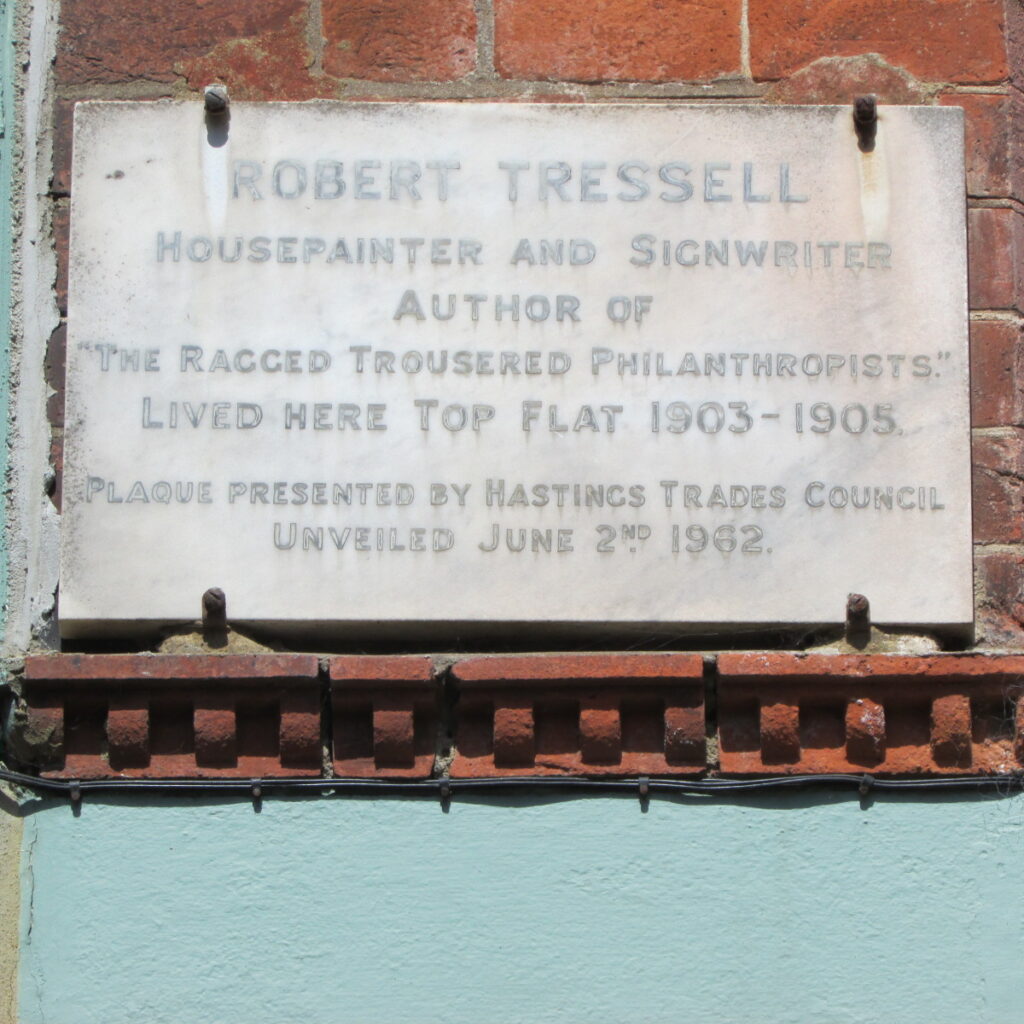
It’s true that people, particularly those involved in past politics, are recorded in written books and articles but not explicitly seen displayed outside, on either former homes, or sites of their political activity. Some plaques have been erected to Robert Tressell, (Robert Noonan), the writer of The Ragged Trousered Philanthropists. Hastings Trades Council fund raised, and erected, a plaque in Milward Road, during the TUC Annual Congress of Trades Councils in 1962, where Tressell had lived, (the view from which he described at the end of his book). Indeed, another plaque to Tressell in London Road was paid for by the council in 1999. Unveiled by Michael Foster, the new Hastings and Rye Labour MP, whose first words when winning the seat were drawn from Tressell, when he said, “Mugsborough finally has its first Labour MP.”
Whether there are current, or future MPs, or councillors of different stands, as local people we still need to remember, and be able to show to future generations, the progressive actions conducted – and acknowledged – in Hastings and St Leonards.

For more from Hilda Kean,
see hildakean.com. The Bernard McGinley article in Hastings Online Times mentioned can
be seen at hastingsonlinetimes.co.uk, seach 200 years of St Leonards.
We hope you have enjoyed reading this article. The future of our volunteer led, non-profit publication would be far more secure with the aid of a small donation. You can also support local journalism by becoming a friend of HIP. It only takes a minute and we would be very grateful.

Leave a Reply