
We Just Want to Swim in the Sea!
DAVID EP DENNIS, a regular contributor and local historian who has recently been made ‘Bexhill Wild Domesday project manager.’ looks at our problems with seaswimming.
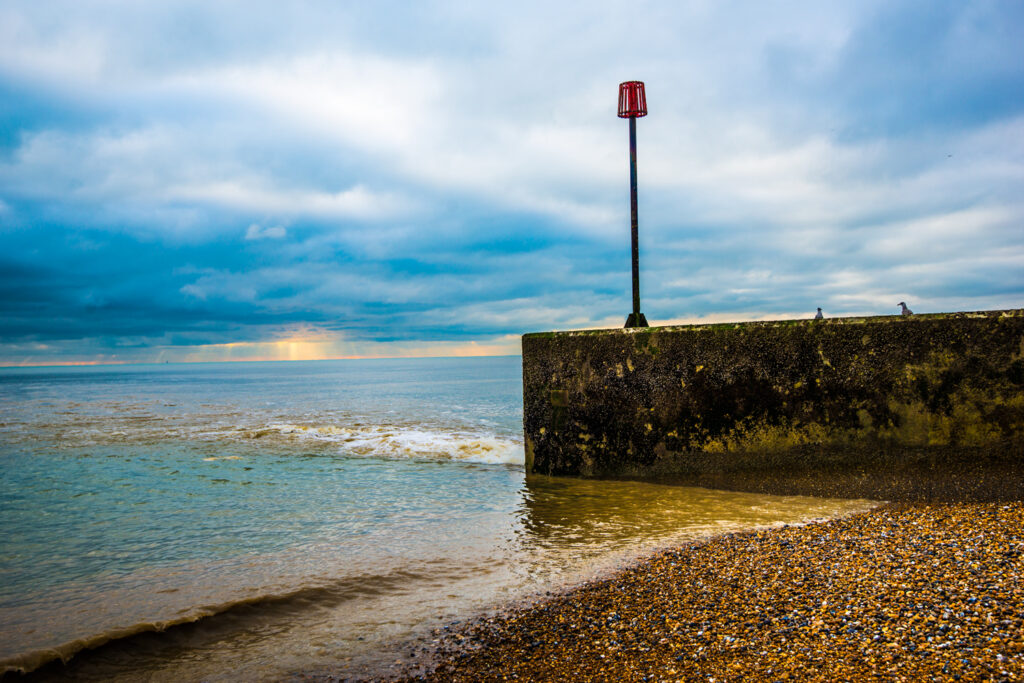
The seas around the UK are the warmest they have ever been for thousands of years, say the European Space Agency (ESA) scientists, so will more people want to take a dip – and if they do, what will they find? I found some alarming facts!
For at least 100 years there have been concerns about sewage pollution in Hastings and Bexhill-on-Sea; there have also been many concerns in the last few years about pollution of sea water along our beaches and immediate sea area. Is this a recent concern? Back in the post-war era of the 1950s and ‘60s the sea at places like Galley Hill and Bexhill seafront was frequently awash with poisonous bacteria, oil, dead seabirds, unprocessed faeces and used contraceptives. From personal memory, I can confirm that local families and visitors at St Leonards’ Bo Peep beach used to swim in this highly polluted water, thinking it ‘normal.’
Gradually, as legislation demanded improvements, water companies made some changes, but even now the situation is unsatisfactory. It is salutary to learn how the current dual purpose outflow system was forced on the people of Bexhill by uncaring officials at government and local levels.
The people of Bexhill were the first in Britain to protest about sewage in the sea

Much of the current Bexhill sewage system was installed in 1884 and there are newspaper articles of the time reporting that the town had a ‘stench’ about it. However, the most important development occurred in 1934, in which the people of Bexhill were essentially tricked into accepting a floodwater overflow system right in the middle of their key swimming area and linked to the main sewer system.
This is how it happened as reported in the Daily Herald of Monday August 20 1934.

The newspaper explained that ‘the whole question of sewage disposal around the coast of Britain is being raised in a striking fashion by the Bexhill, Cooden and District Protection Association (BCDPA). This is an organisation specially formed with £3,000.00 capital (now worth £173,185.00) and an office in London to fight the new drain which it claims will have the effect of distributing sewage along the foreshore.’
The Herald went on to explain that: ‘Never before has this question, which affects the pleasure of millions of holidaymakers all round Britain been so raised.’
The BCDPA sent a letter to the Ministry of Health opposing the Bexhill Sewer Scheme, but the town’s population were tricked because the public inquiry required before planning consent could be given was barely advertised, so no notice was given to ratepayers who lived along the Bexhill and Cooden seafront. Within this ‘public’ inquiry, assurances were given that the scheme was only for a stormwater overflow outfall and would NOT be connected to the sewer system – and therefore there would be NO discharge of sewage. But this was lies.
Because the notice given of the public planning inquiry was so poor, only ONE ratepayer attended the inquiry, and that person ‘raised many justified questions’.
However, as The Herald reported: ‘The Bexhill town clerk said, ‘You may ask but you won’t get an answer. I am just about tired of your questions about this matter!’

The newspaper article continued with the statement that, ‘although the outfall was in the middle of a two-mile stretch of prime bathing water and next to the swimming areas for a large school for girls and a smaller school for boys, the Ministry of Health approved the scheme and the attempt by the BCDPA failed.’
Later, an unnamed Bexhill council official admitted that the pipe was connected to the sewer system but would only carry raw sewage when heavy storms made this necessary. Due to this duplicity, this is the situation we find ourselves in today. In fact, as you will read below, there are now between 11 and 15 pipes onto the beach and no-one is completely sure why.
Oil Pollution
On top of raw sewage discharge, our towns also suffer from oil pollution.
On Saturday August 15, 1925, the Bexhill-on-Sea Chronicle reported intense dissatisfaction with oil pollution from tankers. The oil companies themselves said that they agreed: ‘not only is it polluting – but look at how much money we are losing through wastage into the sea.’
Throughout the 1920s and 1930s there were many reports of dead oil covered seabirds washed ashore. Almost every year, this was complained about until some international regulations about oil in the sea were proposed in 1955. However, the situation did not improve because nations did not discipline their shipping companies and they continued to wash out their tanks mid-Channel.
You can read here the report by the Birmingham Daily Post of August 11 1967:
‘Thousands of holidaymakers were treated for oil on their skin and clothes yesterday, as the oil slicks floating off the South Coast for three days washed on to beaches in Sussex. Throughout the day, gangs of council workmen toiled with shovels and detergent to clear the mess left by the morning tide -24 hours after the town clerk of Eastbourne, Mr. F. H. Busby, claimed the oil reports had been grossly exaggerated.’

However, the newspaper reporter continued: ‘At Bexhill, beach inspector Mr. John Cruickshank said: “more than 3,000 holidaymakers were treated at a special decontamination centre for clothing and skin polluted by oil.” Councillor Chris Read, chairman of Bexhill Publicity Committee, described the oil pollution – believed to be from a tanker washing out mid-Channel.
He said: “Already this year we have paid out more than £1,000 (now £14,865.00) to clear our beaches. Now this little lot will cost us up to the £2,000 mark (now £29,730.00). It is quite wrong for us to be singled out to pay this money for other people’s misdeeds, and I will call on the town council to ask the ministry for a government grant.”’
In Hastings, cleansing stations were also set up along the seafront. and deputy borough e engineer, Mr. C Cowlin, put the cost of clearing the beaches at several thousand pounds. At Eastbourne, oil narrowed the span of beach which could be used by sunbathers. Hundreds of children had oil all over their bodies. and more than 200 people called at the pier first aid hut for help. The afternoon tide brought more oil along the coast but not as much as the previous tide. At Bexhill workmen tried spraying the oil with detergent as it lay on the water close in. A council official said: ”We will be on the beach at first light tomorrow to see what the next high tide has brought – in many places the oil has lodged in pebbles and is likely to be dislodged over a period of days with each tide.’
Seawater quality is checked by the Environment Agency (EA) weekly from May to September. Therefore, anyone who wants to swim outside those times has no means of knowing the state of the sea’s cleanliness along our shoreline. It may be that more sampling is necessary. As global warming bites, so the EA say, ‘that intense heat like this can kill fish and other sea life, sometimes on a huge scale.’
See the Environment Agency checks for Bexhill here: environment.data.gov.uk/bwq/profiles/profile.html?_search=Bexhill&site=ukj2205-14200
WE APOLOGISE
In our June 28th edition of HIP we published this article about Sea Water Bathing problems. In this article, somehow, the text became corrupted or inadvertently added to with the incorrect interpretation.
Our writer David EP Dennis did NOT say in his original article that sewage and drinking water were in the same pipe. However, that is what was published which led to criticism of the article in a subsequent letter.
However, what David actually sent us has been corrected in this article above, namely:
Gradually, as legislation demanded improvements, water companies made some changes, but even now the situation is unsatisfactory. It is salutary to learn how the current dual purpose outflow system was forced on the people of Bexhill by uncaring officials at government and local levels.
We can only apologise to David and to our reader, Peter, for this glitch in our normal high-quality standards. Do please continue to alert us to any problems or inaccuracies.
We hope you have enjoyed reading this article. The future of our volunteer led, non-profit publication would be far more secure with the aid of a small donation. You can also support local journalism by becoming a friend of HIP. It only takes a minute and we would be very grateful.

Regarding Mr. DENNIS article, having designed a number of housing estates I’m confused by his reference to drinking water and sewage water being is conveyed through the same pipe.
In my experience the design and construction specifications are totaly different for these two purposes.
I assume he is referring to the common practice, for many years now, to separate foul sewage which needs treatment before discharging from rain water from property roofs which can be safely discharge to local warercourses.
The advantage of this two pipe layout is that it removes the problem of the sewerage system being overloaded with rain water as happens with the old combined system used previously. One problem has proved to be builders illegally connecting toilets etc to the rainwater systems offen because it was cheaper than doing the job properly. I believe SW and HBC are tracking down such connections and requiring the property owners to correct these missconnections.
I to can remember the 1950s and 1960s when untreated sewage was discharge direct to the sea at Rock-a-Nore and several outalls along the coast.
It was therefore a great improvement when Southern Water completed the £50 million local bathing water improvement scheme in 1999 see https://historymap.info/Southern_Water_Storm_Drain. This resulted in sewage from both Hastings and Bexhill being piped to Bulverhythe for full treatment before discharging through the long sea outfall. This scheme also included the construction of a one mile large diameter tunnel from Alexander Park to Warrior Sq with a number of smaller tunnel to intercept all those locations where the old combined sewers overflowed into local streams. This provided storage during storms thus removing the discharge of contaminated stream water onto the beaches, the stored water being treated as capacity became available at the treatment plant.
I’m sure there must have been many articles in the local press in the 1990 bearing in mind the disruption caused by the works right across our towns.
Thus while I’m a bit old for sea swimming I have no problem with a bit of padding.
Please see correction and apology above.