
The Hastings Variation
To mark the upcoming Hastings International Chess Congress, John Bostock explores the fascinating connections between Hastings and chess.
You may have seen the excellent Netflix series, The Queens Gambit, in which troubled orphan and chess prodigy, Beth Harman, fights her way from adversity and drug addiction to become the greatest chess player in the world. Full of heartache, drama, triumph over the odds, and, of course, plenty of chess. Mind you, the chess action was mainly of people staring intently at a chess board and then suddenly making an astounding winning move, causing their opponent to walk off in a huff.
For those who have a picture of chess played by nerdy males in moth-eaten sweaters, it would have been a revelation. Chess turns out to be sexy after all; who would have guessed?

Promotional poster for The Queen’s Gambit, Netflix
The Hastings Christmas Chess Congress
In Episode 6 Beth mentioned a game at the Hastings Christmas Chess Congress held in Falaise Hall, White Rock Gardens. The astounding truth is that St Leonards has been one the great destinations for the world’s chess players, held in some of Hastings’ most iconic buildings. The celebrated 1895 Hastings Chess Congress took place here, and Hastings’ resident, Vera Menchik, was one of the greatest women’s chess players of all-time.

The history of chess in Hastings dates back to 1880s, when local chess enthusiasts and professionals started a tournament which quickly grew into a yearly event and culminated in the famous Hastings chess tournament of 1895, which attracted the greatest chess players from around the world at that
time and was the first ‘super-tournament’. Garry Kasparov, arguably one of the greatest
chess players of all time, called the 1895 Hastings Chess Congress the greatest chess tournament of
19th century.
The Brassey Institute
The Congress was held in one of the great iconic buildings of Hastings, the Brassey Institute, designed and built in 1879 by the Architect Walter Liberty Vernon for Thomas Brassey, when he was Liberal MP for Hastings. Built in the Gothic Revival style, specifically in the Venetian Gothic style, it is not difficult to imagine gliding past this building in a gondola on the Grand Canal in Venice.
The Brassey Institute was originally the School of Science and Art, together with a free Public Library and Museum. Now the Hastings Public Library, it suffered years of neglect before a major refurbishment in 2016-18 restored the magnificent building to its original splendour.
The International Hastings Chess Congress
Following on from the tournament of 1895, Hastings has hosted a yearly International Chess Congress, which continues to this day and has attracted the greatest from across the world of chess. In fact, every chess world champion before Garry Kasparov (with the exception of Bobby Fischer) has played at Hastings. It was the Congress that everyone wanted to be a part of.


Menchik had two wins against Max Euwe (pictured in 1945), the World Champion from 1935–37, in four tournament games. For this reason, Euwe was one of the players named “president” of the Vera Menchik Club.
CREDIT: Theo van Haren Noman / Anefo Wikicommons
Vera Menchik
In the 1920s the amazing Vera Menchik appeared in this rarefied world of international chess. Arguably the greatest female chess player of all time, she was a resident of St Leonards on Sea. Outside chess circles, she is almost unknown in Hastings and St Leonards, but it is time she joined the Hastings and St Leonards ‘Hall of Fame’.
Menchik was a refugee from Russia and Czechoslovakia and arrived in England at the age of 16 without a word of English. Her father was Russian and her mother, Olga, was half English and following the breakdown of her parents marriage, she moved to St Leonards on Sea, where her grandmother lived at 13, St John’s Road, near Warrior Square station.
Decades before the fictional Beth Harman arrived on the scene, Vera was encountering misogyny and discrimination in the male dominated world of chess. Many men ridiculed her. At the start of one tournament in 1929 the Viennese master Albert Becker proposed that any male player whom Menchik defeated in tournament play should be granted membership of the Vera Menchik Club. However, the last laugh was on Becker, when he became the first member of the club, followed by dozens of the world’s top male players. Vera would not be cowed by all this ridicule, and, prior to one tournament, she declared that she was looking forward “to drinking some men’s blood”.

After Menchik won the 1926 London Girls’ Championship, she gave a 13-board simultaneous exhibition at the event
CREDIT: Agence Rol/Bibliothèque nationale de France
Vera’s father had taught her chess at the age of nine and at the age of 21, in 1927, she became the Women’s World Champion, which had been established that year. She then held that title for the next 17 years in a row, an amazing achievement, ended only by her untimely death in 1944.
This year the New York Times published Overlooked, a series of obituaries about remarkable people whose deaths had previously been overlooked. They featured here: Overlooked no more: Vera Menchik. It is surely time she was honoured with her own blue plaque on the family house at 13 St John’s Road.
The Hastings Variation of the Queen’s Gambit Declined
The full title of ‘The Hastings Variation’ is ‘The Hastings Variation of the Queen’s Gambit Declined‘, which takes its name from the game between Victor Berger and George Thomas in Hastings Town Hall at Christmas 1926.
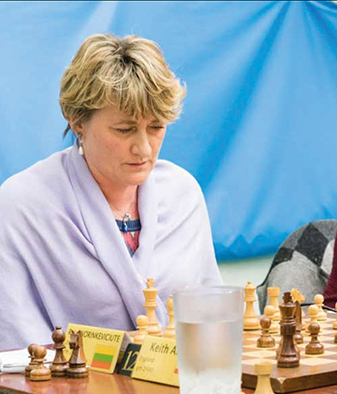
Rasa-Norinkeviciute competes in Hastings
CREDIT: Brendan O’Gorman
Between 1931 to 1964 the Hastings Chess Congress was held at the White Rock Pavilion (now the White Rock Theatre). Constructed in 1927, it is built in a curious mixture of styles, part Art Deco and part Spanish Colonial, not to everybody’s taste, but somehow it all seems to come together. An interesting aspect of the building, the ceramic roundels – reminiscent, perhaps, of chess pieces – were designed by the celebrated sculptor Gilbert Bayes and made in the Doulton factory. They represent ‘Drama, Romance, Adventure and Terpsichore’ (the muse of dancing). Sitting there next to the White Rock Hotel and opposite the pier, on the border between Hastings and St Leonards, it is a true Hastings landmark.
Hastings continues to be an important international destination for the world’s chess players and the Hastings Chess Congress is still thriving, with the 96th tournament being held this year in December.
Not just the birthplace of TV…
Chess originated in India over 1500 years ago, worked its way into Persia and then onto the Muslim World. It arrived in Southern Europe in the 8th to 9th centuries, following the Moorish conquest of Spain, before working its way up to Scandinavia. And when was chess introduced to Britain? Some people say it arrived around 1013 with the Danish invasion, which may well be true, but it arrived in a significant way with the Normans in 1066 and so, it could be argued, that the birthplace of British chess is Hastings. It is a romantic notion and one that I shall continue to cling to, until proved otherwise.
• Re-printed from John Bostock’s personal blog Life on the Edge
• In case it puts you in mind to play a game contact the Hastings Chess Club www.hastingschess.club
We hope you have enjoyed reading this article. The future of our volunteer led, non-profit publication would be far more secure with the aid of a small donation. You can also support local journalism by becoming a friend of HIP. It only takes a minute and we would be very grateful.

Leave a Reply