
Jin Jiyan Azadi – International Women’s Day
KAY GREEN is a local writer, trades union activist and a feminist.
In recent years, because of the anniversary of the Suffragettes’ first victory in 2018 (when some women won the vote), many of us have come to associate International Women’s Day with re-enactments of the suffragettes’ parades and corporate and political virtue-messages. The parades are tremendous fun and the one held in Hastings in 2018 was linked to performances and events to encourage women into standing as council candidates. Women’s Voice and other groups work hard at that. There is, or should be, far more to International Women’s Day than the right to vote. But the vote, and engaging in politics directly, is a good place to start.
WHY WE NEED MORE WOMEN IN POLITICS
Only 36% of British women were able to continue working full time alongside their caring responsibilities during the pandemic, compared to 66% of men (Guardian March 2021). Because women are the vast majority in service jobs that the trade unions call the five Cs, cleaning, catering, cashiering, clerical and caring, they faced disproportionate risk in work, and also in the home. Many jobs with majority female staff share disproportionately low wages and long, variable hours.
The situation since lockdown has gone from difficult to desperate for many women. The cost of daily life has soared: notably fuel, food and housing, with inflation adding to the pain of collapsing, underfunded services. As Sharon Graham, General Secretary of Unite, said recently, if you push people to the point where they just can’t make ends meet, they have nothing to lose – they will come together, and they will fight back.
That’s why I was so pleased to see that Hastings Women’s Voice’s IWD event this year includes trade union speakers Antonia Berelson (RCN) and Bella Fashola (RMT). Over half the UK workforce is female, including a large majority of ‘key workers’. Thankfully, the trade unions have not been a male preserve for a long time. Leaving aside early female organisers (and historians generally do leave them aside), all the trade union confederations in the UK are currently led by women, as are the biggest industrial trade unions, Unite and UNISON. Well over half the total union membership in the country is female.
Much has been done by and for women through trade union work, but there is much still to do. One in every 20 working mothers is made redundant during pregnancy; female PPE is still absent from many workplaces; injustices in pay and pensions, such as the WASPI women’s campaign are still unresolved; and the conviction rate for rape and domestic violence is so low it doesn’t register as a deterrent.
WHAT DO WOMEN NEED?
I’m a feminist, and as such I subscribe to the radical notion that “women are human”. We need all the things all humans need, for ourselves and our families. We have a particular responsibility for birthing the world’s children, and women’s jobs in the community and the home disproportionately mean women are the primary carers for the young, the old and the sick. That’s exactly why women need a welfare state. We need decent pensions and universal health care, and we need better support for carers, paid and unpaid.
And we do need secure homes – in the double sense of being tenants of the landlord or the bank, as well as having control of our own lockable doors. Physical security and economic security.
We need better awareness of the dangers of violence, and better ideas about how to address it. The majority of violence that women and girls suffer is at the hands of men and often in their own homes.
RAISE YOUR FEMINISM TO THE GLOBAL CHALLENGE
Andrea Dworkin once said: “Feminism is for all women, not just the women you like.” It’s a good rule to stick by in these times when what all of us, everywhere, need above everything is a coming together of people willing to do whatever it takes to end poverty, stop wars, stop the destruction of the climate, and to stop all the forces of division that so often drive wedges into perceived differences of sex, race and class – forces that prevent humans realising that basically, we all need the same things. If International Women’s Day can help with that task, then let’s go for it.

JIN JIYAN AZADI

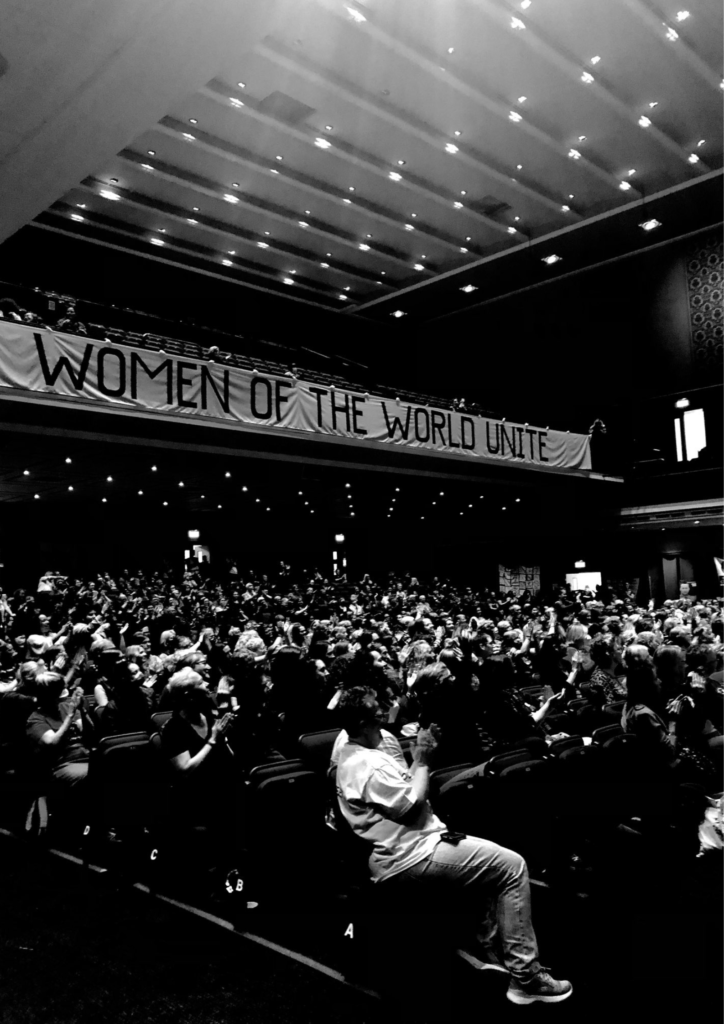
1,600 women including speakers from 75 countries gathered at FiLiA, Europe’s biggest women’s conference, in Cardiff, October 2022. On the way in, many snapped a piece of graffiti at the railway station. Women’s social media pages became adorned with the Kurdish: Jin Jiyan Azadi “women, life, freedom”. Originated as a call of support amongst the Rojava women, it then became a call to women in Iran and other places taking part in the hijab rebellions. From the FiLiA meeting in Cardiff, those words coursed around the UK wherever women were working to support women in other countries and our own, working to defend themselves and each other against violence, poverty, war and oppression.
Local – national – international. All of that is what International Women’s Day is really about. So, as it happens, are all the other days of the year.
Check out womens-voice.org.uk or Hastings women’s Voice on social media for the full range of IWD events in Hastings.
We hope you have enjoyed reading this article. The future of our volunteer led, non-profit publication would be far more secure with the aid of a small donation. You can also support local journalism by becoming a friend of HIP. It only takes a minute and we would be very grateful.

Leave a Reply