
Christina Rossetti’s Hastings
RYAN ORMONDE, a poet who divides his time between Hastings and London, explores Christina Rossetti’s Hastings.

In his classic novel Lanark, Alasdair Gray has a character say of Glasgow: ‘If a city hasn’t been used by an artist, not even the inhabitants live there imaginatively’. The same could be said of a town like Hastings. Fictionalised by Robert Tressell as ‘Mugsborough’ in his Socialist novel, The Ragged-Trousered Philanthropists, Hastings has had an otherwise sparse representation in literature. Although its name is famous for its historical significance, Hastings itself seems somewhat overlooked, so it’s a pleasant surprise to find a love letter to the town among the writings of a great author.
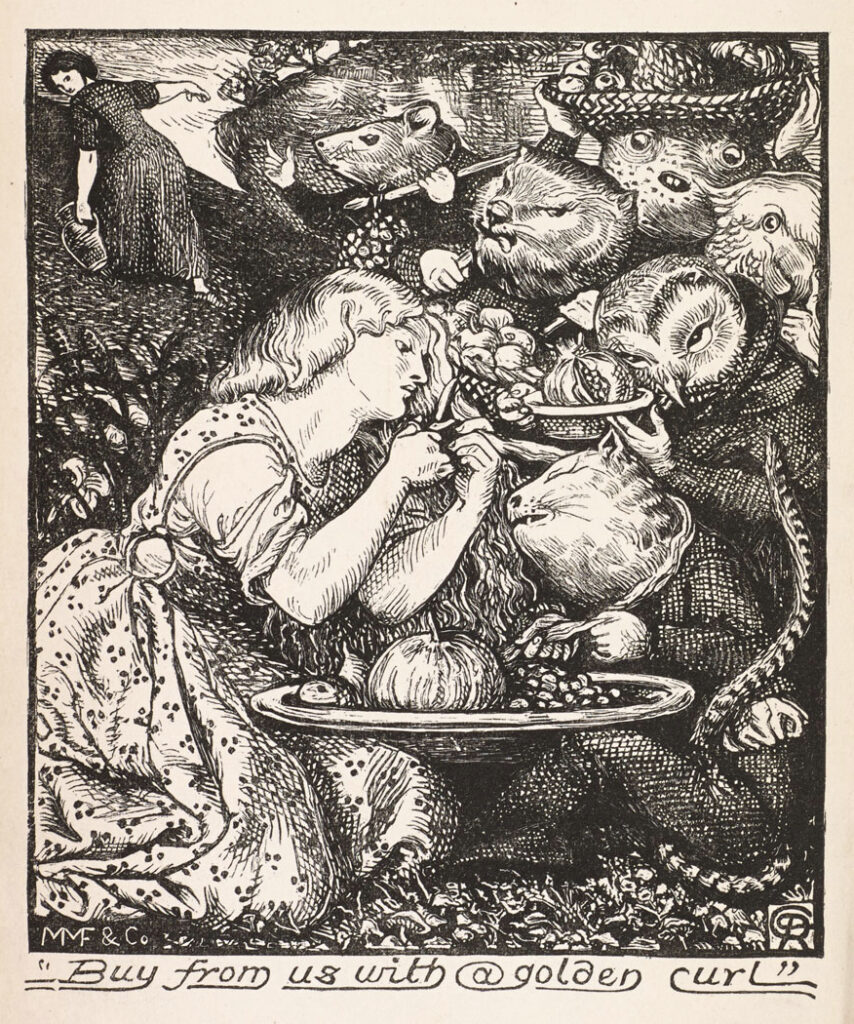
Christina Rossetti visited Hastings on several occasions and stayed here for the winter of 1864-5 while recovering from a respiratory infection. Renowned for her poetic works including Remember (often read out at funerals), In the Bleak Midwinter (set to music for the popular Christmas carol) and the bewitching Goblin Market, in 1867 Rossetti published a story set in Hastings Old Town, entitled The Waves of This Troublesome World.
The story provides an intriguing insight into Victorian Hastings as refracted through the imagination of one of the most celebrated writers of the age. It is a period in history that is often remembered as the town’s most opulent and fashionable era, a haven of health and amusement for well-to-do visitors. Though Rossetti’s attachment to Hastings is certainly a product of this culture, her interest here is in the lives of working-class residents, as represented by the family of a fisherman.

The story begins: ‘Perhaps there is no pleasanter watering-place in England where to spend the fine summer months than Hastings, on the Sussex coast.’ Rossetti describes the fish market ‘where traffic is briskly plied, and maybe haggling rages; where bare-legged children dodge in and out between the stalls; where now and then a travelling show – dwarf, giant, or what not – arrests for brief days its wanderings.’
Soon after that, Rossetti turns her attention to ‘the many parties of health or pleasure-seekers which throng the beach. Boys and girls picking up shells, pebbles and star-fishes, or raising hands and wooden spades a sand fortress, encircled by a moat full of sea-water, and crowned by a twig of seaweed as a flag; mothers and elder sisters reading or working beneath shady hats, whilst after bathing their long hair dries in the sun and wind. Hard by rock at their moorings bannered pleasure boats, with blue jerseyed oarsmen or white sails; and if the weather is oppressively hot and sunny, a gaily-coloured canopy is reared on light poles, for the protection of voyagers. When the tide is high, a plank or a long step suffices; but at low water, as the shore is flat, boatmen have frequently to carry children, and even women, across the broad stretch of wet sands to and from the vessels.’

Later in the story, a child is sent on an errand from her home on Tackleway. She first takes a letter to the post office and then ‘to a various-smelling shop in one of the back streets, where she ran glibly through the accustomed list of articles: “Half a pound of butter, a pound of sugar, two pennyworth of treacle (for Harry), a quartern loaf, a quarter of a pound of three-and-fourpenny tea, and two rashers of bacon,” […] She packed all carefully in her little basket, counted the change from her crown-piece, chirped to a poor imprisoned lark, which could catch not one glimpse of sky from his nail in the shop, stroked her old friend the black cat, and started for Mrs Smith’s smart establishment in the High Street.’
A while later, the child’s aunt goes on a walk from Ore back to Tackleway: ‘A long round led her to the field-path, beset by fence and gates: on the right, where the West Hill slopes towards the town, hay-making was going on with a pleasant smell. Scarcely a breath of wind stirred: and when for a few minutes she sat on a wayside bench to cool herself, she noticed how a subtle exhalation rising from the heated ground became perceptible where it slightly altered the appearance of objects seen through it.’ Later, there is a description of a cure for her persistent cough: ‘this soothing jelly was made by boiling down a whitish seaweed (the carrageen, or Irish Moss), which washes up in abundance on the Hastings coast, and adding a little sugar and lemon-juice to render it palatable.’
Another walk, this time over the East Hill, brings with it ‘the scent of a hayfield, the sweetness of dog-roses and honeysuckle, the fragrance of thyme beneath their feet; there were chirpings in the hedges, scattered skylarks in the air, a murmur of waves; there was blue sky above their heads, bright living green and golden sunshine around them, glittering sea far down below the cliff, flowers in the grass and about the hedges, butterflies here, there, and everywhere.’

At the climax of the story, two children fall victim to high tide when they fall asleep on a rock shaped like an armchair. ‘During their sleep a thick brown fog had risen from the ground like smoke; it hid the cliff, and even the rocks and shingle at a very few yards’ distance: only Jane could make out the sea distinctly, because the tide was rising; waves were foaming, breaking, roaring, close at hand amongst the huge stones; not a moment must be lost in escaping for their lives.’
Once again, it is the natural environments of Hastings – the hills, the cliffs and the beach – that seem to exert their powers most forcefully in Rossetti’s writing. Do we recognise her version of the town? Does her emphasis on certain features – the plentiful sand, the abundant Irish moss, tell us something about her particular interest and imaginative fancy or reveal to us signals of natural change? Writing that is specific to place has the potential to make us look anew and perhaps to help us recover what was thought to be lost or devalued.
The story is essentially a tale of Christian morality, and Rossetti makes reference to both St Clement’s and All Saints’ churches in the Old Town. It was at St Clement’s that her brother Dante Gabriel Rossetti married Lizzie Siddall in 1860, both of them artists, Rossetti, one of the founders of the Pre-Raphaelite movement and Siddall was often the subject of his work. While his connection with Hastings is perhaps more widely known, it is his sister Christina Rossetti who leaves us with these lovingly rendered glimpses into its past, her singular contribution to the ongoing imaginative life of Hastings.

We hope you have enjoyed reading this article. The future of our volunteer led, non-profit publication would be far more secure with the aid of a small donation. You can also support local journalism by becoming a friend of HIP. It only takes a minute and we would be very grateful.

Leave a Reply