
2066 Virtual City: The World’s First Inland Seaside
In the wake of a climate crisis architect KEN DAVIS imagines a new urban centre connecting Hastings, Battle and Bexhill
This vision, this idea, this plan is overwhelmingly positive. It dismisses the problems of the past and the all too often reactive approach of our bureaucratically-bound planning system. It recognises that innovation and new collaborative approaches will be needed to create liveable urban areas if we are to cope with the increasing risks of inland and coastal flooding. But this is also a discussion document for everyone to engage with.

It has long been a purely political construct that Rother District Council wraps around Hastings Borough Council and, if you put this together with the likely effects of serious flooding over the next generation and changes in working, shopping, and population growth, it becomes clear that a new, more cohesive and forward-looking urban centre is needed. If those pressures and trends are combined with the powerful history of 1066 Country, and the long held desire to build a 1066 Visitor Centre (but just where do we put it?), then the place and justification for that becomes clear.
It is a well established fact in geo-economics that once urban areas reach populations of a quarter to a third of a million (the combined towns already have a population of around 150, 000) they start to generate their own internal economies, and thus, there is far less need to commute long distances for work or pleasure. Walking and cycling to work become much more realistic as do the greater numbers of people! Our nearest comparator is Brighton and Hove, a conjoined city, which has a population of around 280,000 people.
A Virtual City
The Wilting area, to the north-west of Hastings, lies toward the head of a valley about equi-distance (5km or 3 miles) from Hastings and Bexhill town centre and from Battle. It is on the train line to London (the coastal line will soon be flooded at Bulverhythe), and benefits from not only amazing views down the valley, but also good road connections. It is the site identified by the urban regeneration design team for Barcelona (MBM) as a ‘hill village,’ when they advised HBC on possible expansion areas for the town some 20 plus years ago – a study left on the shelf.

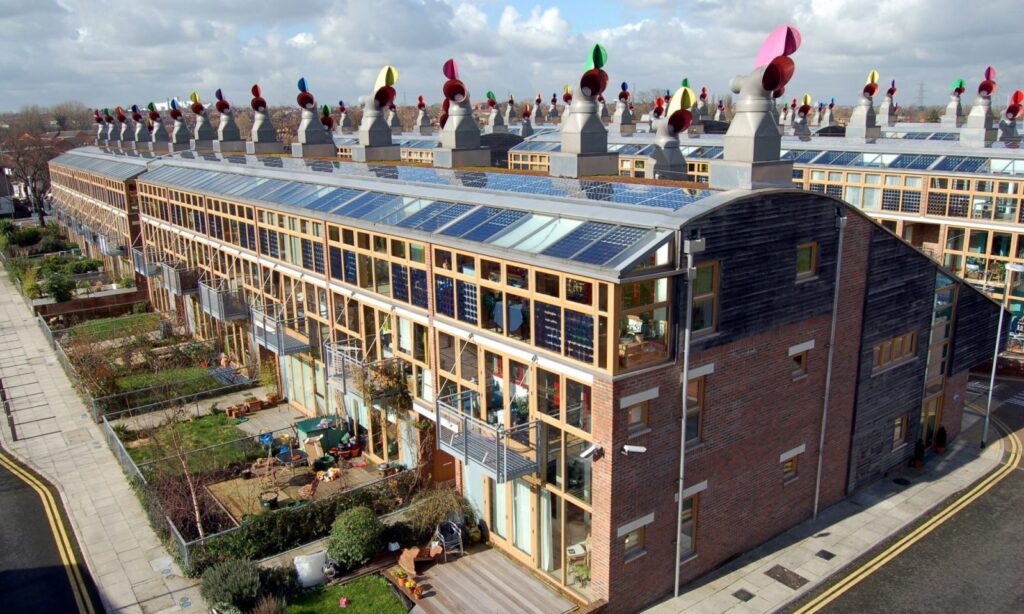
BedZED, the UK’s first major zero-carbon community, 7 years on
At its inception, the place ‘2066’ will be a virtual city because it will be a sustainable transport hub for visitors to the area. A large car park (covered with solar panels of course) will be set out between greenery, where people from outside the area will leave their cars and travel by electric shuttle bus to either the Edwardian town of Bexhill, the medieval and Victorian town of Hastings, or where the Battle itself took place. The 1066 Centre will give visitors direction and purpose and, of course, will use virtual reality! But it will also be virtual in that its new and relocated people – those affected by flooding and landslips – will work in different and more sustainable ways; a genuine interplay between commerce and a variety of leisure uses where largely only mixed-use development is allowed. And it will be virtual because it will develop slowly as the coastal strip and the lower sections of valleys (Queens Road to the park and The Bourne) become inlets once more, and the A259 along the coast becomes unusable. Perhaps the very first thing will be to move Hastings Town Hall or better still, have a three winged barn-like structure to represent all three towns?
“Well, what about Rye?”, I hear you ask. Rye has always been an outlier and will become even more so when it floods and becomes an island within a couple of generations; even more of an attraction than now! But, since the Brede and Rother valleys will also flood it will be possible to reach around the north of Hastings and even once again to Bodiam Castle by boat from Rye. While at Glyne Gap, once the road and railway are no more, there will be an inlet to a new Bulverhythe harbour, lying behind the present Bexhill Road. Galley Hill, sustainable for many years yet, will carry a large wind turbine incorporating a viewing tower. If these sorts of tourist offerings are combined with a Centre Parcs type of holiday destination based around the worked out gypsum mines (remember Indiana Jones) then the 1066/2066 tourism offer could be amazing!

The Sun Ship in Vauban, Freiburg
INNOVATION AS SOLUTION
The form of this new city will not be centric in the normal sense, like places that grow over long time- scales which often have crammed centres, but will instead be polycentric, as it will include Bexhill, St Leonards, Battle and Hastings. Their suburbs, such as Ore and Sidley, as well as the smaller settlements between, will also be included. The aim, though, is not to fill those gaps (Crowhurst will remain a distinctive village), but to reflect the visionary and innovative nature of 2066, which will pick up on lessons from places as diverse as Vienna (for its public housing), Freiburg im Breisgau (for its sustainability), and yes, even the UK (BedZed in Sutton for example). All new buildings will be built to Passivhaus or higher standards. There will be only one shop to meet immediate needs as more might draw trade from existing centres, and all developments will be as autonomous as possible, including the treatment of sewage on site, just as the Freiburg suburb of Vauban has done for many years.
Finally, the existing towns must adapt and innovate too. This means more efficient use of existing land (for example intensification of employment areas and development on presently under-used public land), a reimagining of the most run-down and dilapidated buildings, and especially a tightening on shopping districts and streets.
This vision, though, is not THE vision for the area but rather serves to demonstrate that it is vision, innovation, and proactivity which are needed to fight off the usual complacent thinking of so much planning. “It isn’t broken, so don’t fix it” will not do in an age of declared climate emergency, so join the debate!
Ken Davis is a member of the Hastings Urban Design Group
We hope you have enjoyed reading this article. The future of our volunteer led, non-profit publication would be far more secure with the aid of a small donation. You can also support local journalism by becoming a friend of HIP. It only takes a minute and we would be very grateful.

Leave a Reply