
The Blind Girl at Pett Level
This year, the town celebrates Edward Lear who lived part of his life here. But not everyone knows about Lear’s connection with the Pre-Raphaelite brotherhood; according to Sarah Lodge author of Inventing Edward Lear, “he voluntarily joined the Pre-Raphaelite Brotherhood, calling William Holman Hunt his ‘daddy’, Thomas Woolner his ‘uncle,’ and (naughtily) John Everett Millais his ‘aunt’.” The Pre-Raphaelites themselves had close connections with Hastings, Fairlight and Pett Level. Here, GILL METCALFE tells the story of The Blind Girl by Millais.
This story, although based on fact, should be read as Creative Nonfiction.
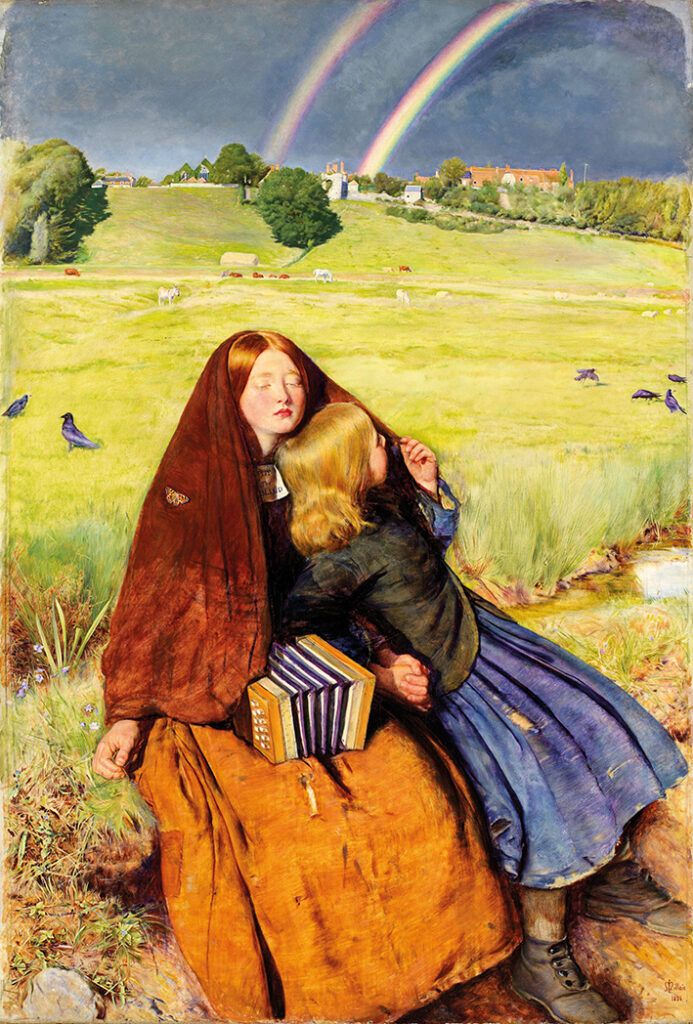
The Blind Girl by John Everett Millais
PICTURE: Birmingham Museum and Art Gallery
In 1854, Sir John Everett Millais set up his easel at Pett Level. He had painted there many times before whilst visiting Pre-Raphaelite friends in Hastings and Fairlight, Rye and Winchelsea. It was in Winchelsea that he noticed a very beautiful girl standing in front of the church with a younger child; both were dressed in worn and patched clothes, and the older girl was playing a musical instrument, singing with a clear untrained voice. Round her neck was a strip of white linen with the words, “Pity the Blind”. Millais was moved almost to tears by their beauty and simplicity. He gave the child a shilling.
Two days later he was travelling along Pett Level by the sea when he came across the couple again, resting against the low sea wall*. The child told him that they were walking from Winchelsea to Hastings. Millais immediately saw an opportunity: here was the most inspirational subject for a painting, the two figures exactly as they were, the blind girl and her companion, and in the distance a view of Winchelsea town contrasting with vividly sunlit grasslands in the foreground.

Cattle grazed peacefully, and rooks were busy gleaning; poverty and blindness offset by the beauty of nature – a perfect Pre-Raphaelite subject encompassing emotion and atmosphere! Already the sky was darkening behind the sunlit town, a double rainbow appearing. Would they pose for him? He would of course pay them if they agreed. The blind girl nodded, and the child laughed, realising their good fortune.
Millais immediately whisked out his sketch book and completed a quick impression, noting in watercolour light and dark, brilliance and shadow, and the possibilities of a satisfying pyramidal composition formed by the grouping. Casting an eye on the darkening sky and rainbow, he worked quickly; Millais hated getting wet. As for his models, if he considered them at all, he would think that they were “used to it.”
As they sat there the blind girl drew her shawl partly around her little sister protectively. Her other hand played with a blade of grass, whilst her concertina lay on her lap. She didn’t know that an orange, brown and white butterfly, matching the colours of her ragged clothes, had alighted on her shawl. Nor was she aware of the double rainbow behind, over the distant landscape.
The artist rewarded them handsomely, adding some sugared almonds for the child. He packed up his easel, then hurried back to Winchelsea to make a detailed oil painting of the subject. The two girls set off cheerfully towards Fairlight, hoping their boots, already worn through and stuffed with cardboard, would last the journey.
Millais completed the picture in time for the Royal Academy exhibition where it was greeted with rapture by both critics and public. Crowds clustered round, wondering at the exquisite detail, and the poignancy of the subject. Viewers are left with many questions unanswered – had Millais painted it to draw attention to the plight of the poor, the contrasts in society stirring consciences? Was it a sentimental piece prompting an imagined story as were so many Victorian paintings? Was it steeped in allegory and hidden meaning? Or was it simply one of the artist’s finest works, painted to satisfy his own self-image?
*A new sea wall has replaced the earlier one, but the view is almost exactly as it was when The Blind Girl was painted in 1854. High tides often came up to the wall, and the road to Winchelsea would become almost impassable.
We hope you have enjoyed reading this article. The future of our volunteer led, non-profit publication would be far more secure with the aid of a small donation. You can also support local journalism by becoming a friend of HIP. It only takes a minute and we would be very grateful.


the blind girl was not where you say it is
Winchelsea stands on a hill the bling girl was drawn
by a ditch which is still there
it is where I live Winchelsea is in the background
Waterbridge place is where it was drawn