
Souls o’ the Drowned
Gareth Stevens visits a new exhibition with strong maritime undercurrents at the De La Warr.
Can’t You See the Sea Changing? features work produced over the last 14 years by Zineb Sedira. The exhibition takes up both of the DLWP’s gallery spaces over the ground and first floors, and is the first show of the artist’s work in the UK in over 10 years. It follows on from her much lauded exhibition, Dreams Have No Titles, which received a ‘Special Mention’ from the jury at this year’s Venice Biennale.
Sedira has always been inspired by her identity as a woman with a singular personal geography – she was born in Algeria and says: “My parents migrated from Algeria to France by boat in the 60s, then I migrated from Paris to London by boat in the 80s.” The sea has always been both a key conduit and analogy for her nuanced ideas about the folly of nationalism and what it means to migrate. This exhibition subtly uses all that is maritime to ponder notions to do with natural geographical boundaries, and the reasons why people risk all to cross them. Her polyphonic way of using portraits, landscapes, language and archival research, means that the overall impact of her oeuvre is much greater than the sum of its parts. The profundity of her work emerges from her non-literal and non-specific use of metaphor to talk to us at a deep, subconscious, almost mythic level.
CREDIT: Thierry Bal
This is a powerful method as it cuts a swathe through the relative opinions about globalisation and changing patterns of migration. It asserts that we are all bound, and yet separated by the sea, and anchors us to a much more contemplative realm. Whilst oceans are consistently beautiful, they are never consistent in form, and the way Sedira has innovatively combined disparate media, carved up and juxtaposed traditional approaches to contemporary art is analogous with 21st century ways of existing and new multiculturalism.

If there is such a thing as a curator’s rulebook, it has been well and truly thrown out of the south facing glazed facade of the De La Warr Pavilion during the planning of this major exhibition.
CREDIT: Thierry Bal
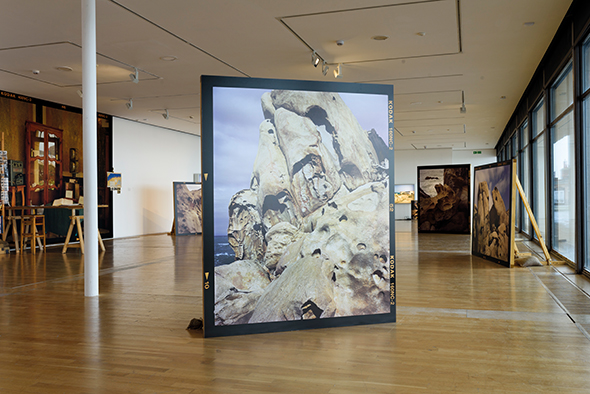
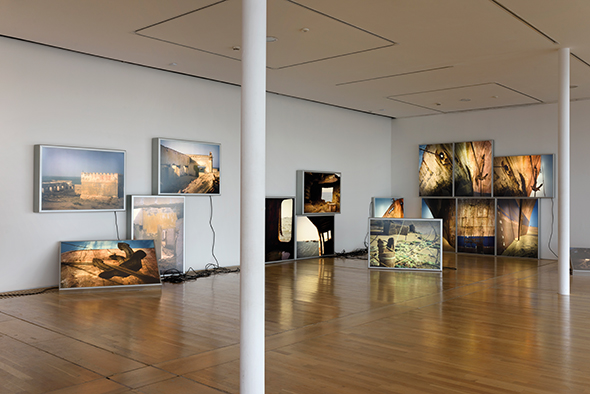
As well as interspersed large photographs that you can file past one after the other, there are recreated sections of her Brixton studio which contain collected maritime objects of all kinds, and large stand-alone images held upright by roughly hewn timber frames weighted with large sandbags. There is an unexpected asymmetry to the way the ground floor room is arranged, which invites a variety of ways of engaging. At times you are led to consume the artist’s works sequentially along a wall and at others you walk around them, view them from different angles and can see them from behind. Large conspicuously cabled light boxes are laid across the floor at different angles. Viewed collectively, the ensemble of illuminated photographs looks informal and almost slipshod, but cleverly it forces the viewer to adjust their position when trying to fully appreciate each image separately. This feeds into the underlying notion that memory, history and lived experience intertwine but rarely combine to give the full picture.
I love the way that the whole ground floor gallery is, in itself a complete installation, but having said that the large-scale photographs work supremely well individually. Some of the most arrestingly beautiful images are those of rock forms Sedira found at Cap Sigli Lighthouse in Algeria. These rocks are the hard interface between sea and land. They have been carved by erosion over millennia and again I found them to be a hugely insightful and intense way of expressing ideas about time, history and the way postcolonial upheavals have affected the psyche and identity of those forced to migrate.
Whilst the ground floor gallery works triumphantly well, the darkened room on the first floor is less effective and I found it personally disconcerting. It is dark enough to be uninviting and the various mounted video screens seemed to me to be out of scale with the dimensions of the space, and thus difficult to engage with.
Nonetheless, all in all, a magnificent show.
• Can’t You See the Sea Changing? Zineb Sedira is at the DLWP until 8 January 2023. www.dlwp.com

We hope you have enjoyed reading this article. The future of our volunteer led, non-profit publication would be far more secure with the aid of a small donation. You can also support local journalism by becoming a friend of HIP. It only takes a minute and we would be very grateful.

Leave a Reply