
Sing Everything You See, or Vice-Versa:
Sono-Electro Goes Large
VICTORIA KINGHAM
‘Sound art’ is one of those artistic concepts which has been in circulation much longer than most casual audiences would believe. The idea of making sound form an integral part of an installation probably began in the 1910s when the Futurists, who loved the sound of industry (and War, until some of them died in it) built noise machines to replicate the clatter and boom of their world. Dada artist Marcel Duchamp (the guy whose Urinal, presented in a 1915 exhibition, probably helped to change the definition of Art) also composed a piece where three voices sang notes pulled arbitrarily from a hat. This led up to early John Cage and his 4’33” of Silence in 1955, and certain visual artists – particularly in America, who used electronic media to explore the space around them. A century ago, the invention of recorded sound was comparatively recent, so the integration of sound was new, and definitely a challenge, in the realisation of an idea.
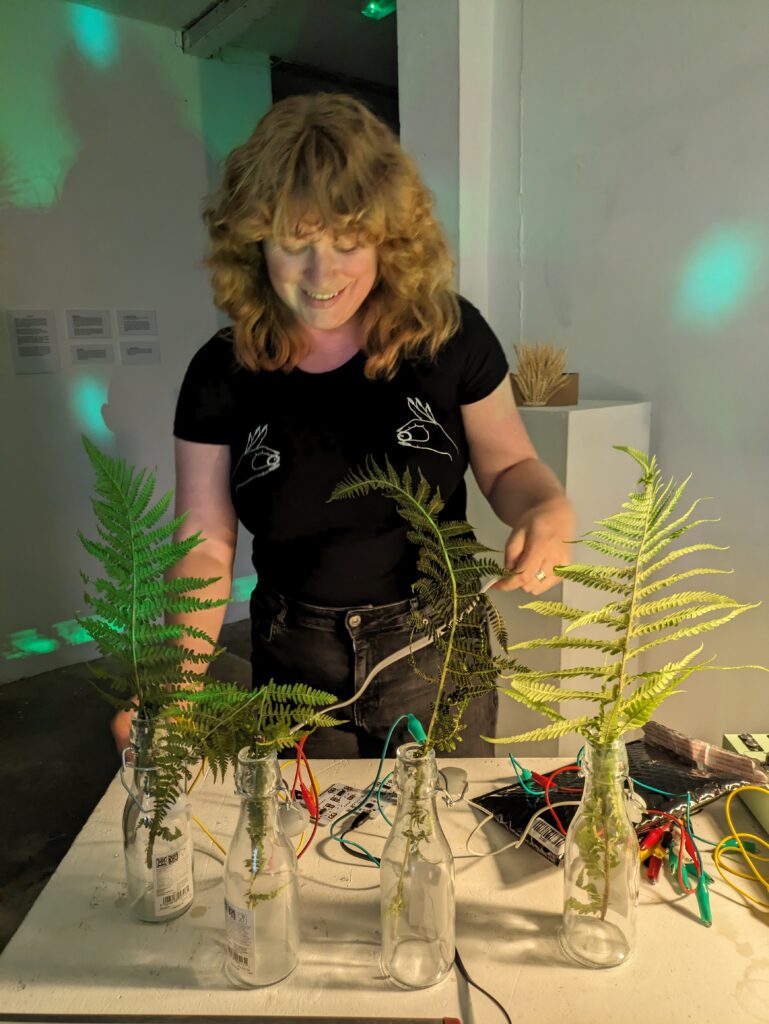
Artist Isobel Anderson using plants to conduct voltage to produce music from synthesisers – plants making music!
So far, so historical. Cut to the present day and the making of sound, the inclusion of sound in sculpture and art installations is almost a commonplace. For those growing up with instant auditory availability (any old laptop or phone is now able to produce and manipulate any kind of sound) it is something they take for granted. Coming from the background of an earlier generation of computer technology, I do not. I think back to the late 80s and 90s and how difficult it was, for example, to find a decent piece of software that would read out text or enable the partially-sighted to use any kind of screen. Voice recognition was clunkily in its infancy, as was translation software, and Robotics was still just the stuff of academic conferences. Now that we can have an Alexa in any corner or a doorbell that we can speak to from New Zealand (just to say we aren’t in, and can they leave the parcel next door please) and instant music composition application programs (lots of them – Sibelius First is one, Noteflight, Magic Score) and talk to Duolingo, the general concept of sound creation in everyday life is necessarily different. It improves and progresses apace.
THE IDEA
James Wilkie defines himself as a sound artist. He has worked commercially, producing suitable sensory experiences for high-end companies such as Bentley Motors and John Lewis, while simultaneously teaching and running independent workshops. He has now brought his expertise down to Hastings, and together with audio-producer Lucia Scazzocchio he has founded a Festival called Sono Electro. Last year this new venture lasted a couple of days. Wilkie’s idea originated in an offer of Electro Studios in Seaside Road for a project of his own, which he then turned into a small sound art weekend event, echoing and augmenting his recent Brighton Festival experience. This year it has expanded to a properly-funded two-week enterprise, helped on by a successful application for a slice of this year’s Arts Council pie. Full details of this ambitious project may be found at the web address indicated at the end of this article.

Wilkie’s own process in the commercial environment is to think about the values endemic to a particular company or organisation, and how they might translate into sound. Applying this idea more socially, he aims to form a musical dialogue, asking the question, how is this sound going to bring people together? He shares ideas, using a guitar or computerised sound, and hopes to inspire people’s curiosity. His festival offers new ways of doing this, building his audio-processing skills and ideas. He is particularly interested in encouraging local artists to explore sound and create for themselves artistic opportunities beyond what they may already have considered. There is a stylophone workshop for example, where young artist Orson Coupland shares his skills, a family installation by Benjamin Phillips, a curated listening session by Radio Commons, various workshops for children and/or young people, an improvised radio performance by Anthony Moore and Ed Baxter, and a self-generating art work created by ZeroH. Just a few among many other fascinating, interactive, and instructive events.
This promises to be one of the most engaging and unusual activities in the plethora of events that comprises this year’s Coastal Currents Festival. Head along with all the family, to Electro Studios.
Tickets and Programme is the official site: https://sono-electro.co.uk/
Instagram: https://www.instagram.com/sono.electro/
We hope you have enjoyed reading this article. The future of our volunteer led, non-profit publication would be far more secure with the aid of a small donation. You can also support local journalism by becoming a friend of HIP. It only takes a minute and we would be very grateful.

Dear H.I.P.,
Thank you so much for writing and sharing this wonderful article!
Please follow these links for the tickets, programme, and more about Sono-Electro:
Tickets and Programme is the official site:
https://sono-electro.co.uk/
Instagram:
https://www.instagram.com/sono.electro/
Looking forward to seeing you at our incredible festival!