
RESEARCH & Development
GARETH STEVENS talks to Anthony Elliott whose exhibition, RESEARCH, is currently being held at The blackShed Gallery.
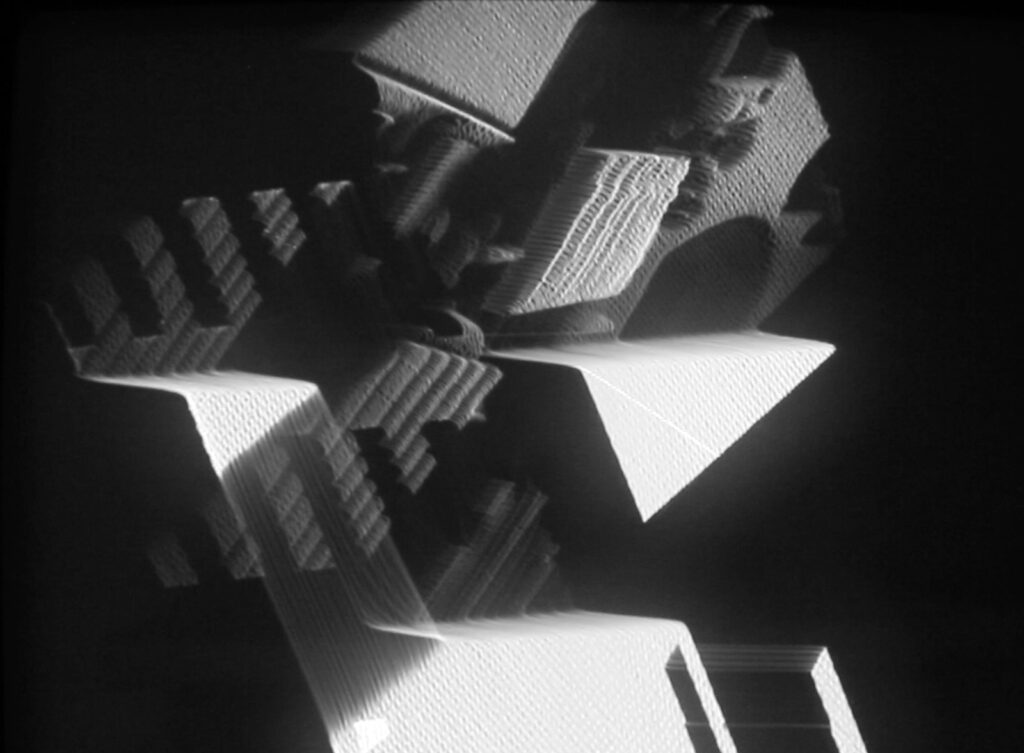
Sometimes, you come across art that has no recognisable precedent and that defies any easy categorization. Despite featuring work in a dizzying, and arguably unrelated, range of media, Anthony Elliott insists that it is essentially “all about sculpture”. More than that, he is very much occupied with process, experimentation and research. Visiting the show, I am immediately struck by the elements of the work that don’t immediately look like ‘Art’. Whether it be the framed technical drawings, or the intricate electronic circuit boards mounted on a plinth behind an acrylic case, it becomes clear that both Elliott and the gallery don’t live by the rules.
Based in Bexhill, Anthony Elliott is not unaccustomed to both national and international recognition. He recently received the Giga Hertz Award at ZKM Music and Acoustics in Germany for installation development, collaborated with Magz Hall in Yorkshire Sculpture Park on Tree Radio, which has been nominated for the British Composer Awards, and delivered workshops in the Victoria and Albert Museum with Radio Mind.
Elliott tells me that he initially made the unlikely leap from sculpture to electronics (he studied at Camberwell), through an aesthetic route: “I loved the look of circuit boards, they reminded me of leaves – the way they appear transparent when you hold them up to sunlight.” While he was constructing sculptures that sought to explore the overlap between technology and organic forms, from pre-existing electronic components, people started asking: “Do they work?” Hence his practical foray into electronics was born.
The central piece in the exhibition is a video animation with an accompanied self-composed soundtrack. It is hard to believe that this work is wholly analogue and has been completed without any recourse to proprietary software: “With the punch of analogue the effect is instantaneous. There is no lag – it is instinctive and immediate,” says Elliott. As he speaks I began to see that his process is very similar to that of dub reggae producers from the early Studio One days. Like them, he builds his own (sound) systems, has invented his own video version of a ‘reggae box’ and then remixes film clips and waveforms via an oscillator through direct manipulation by turning dials and pushing fader switches.

Reprocessing and developing the animations of the experimental animator John Whitney, the British film and video artist Malcolm Le Grice, and the more recent work of the Japanese/British artist Lilah Fowler, Elliott’s video RESEARCH pays homage to antecedent work. At the same time it extrudes it, stretches it, rotates it to an extent that almost erases all direct references (they are there – but mixed). These are juxtaposed versions and Elliott is carrying on their work in ways that show he is more influenced by, and interested in, these artists’ processes as much as in the original signals that he has electronically sculpted in different ways.
And so we come down to process again. Each stage of Elliott’s creative struggle has outputs that are Art. The technical drawings, which look like engineers’ manufacturing plans, are produced by chance throws of a dice. The records of this are tabulated at the bottom right of each work and look like cutting lists. The circuit boards used to process signals and video inputs have become artworks in themselves. It is as if Elliott is trying to sculpt his work from the ether of chance and sine waves. He seems to want to control, exquisitely, the technology which produces his work, but at the same time to retain improvisation and serendipity.
It was a challenging and fascinating experience talking with the alchemist Anthony Elliott.
Anthony Elliott : RESEARCH runs until 16 September. For more information go to theblackshedgallery.org.uk and elliottart.co.uk
We hope you have enjoyed reading this article. The future of our volunteer led, non-profit publication would be far more secure with the aid of a small donation. You can also support local journalism by becoming a friend of HIP. It only takes a minute and we would be very grateful.

Leave a Reply