
Repairing Vintage Audio Gear
JUDE MONTAGUE
Recently, Hastings Independent Press featured a Supersound amplifier that was bought by Montague Armstrong and manufactured on Kings Road, St Leonards-on-Sea. It still worked – amazingly for a prototype from the 1960s – but needed at least a service to iron out its kinks and straighten out unwanted distortion and get the tremolo working. The right kind of expertise for vintage equipment is hard to find. Fortunately, Justin Ellis, who has had a long-term love affair with electronics and mechanics, also lives in Hastings. He brought the amplifier back to almost-mint condition as a labour of love, working on the exterior as well as the electronic interior, even fixing the carry handles. He returned it to us in splendid condition.

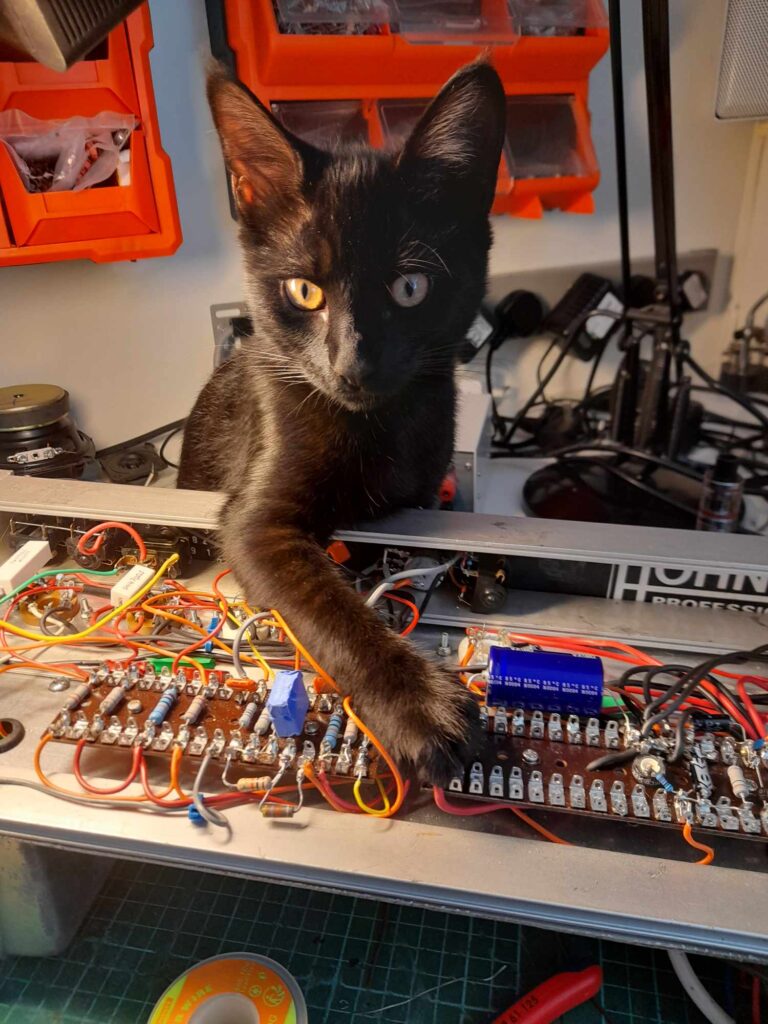
A cat on a hot late 60s Shure Vocal Master PA amp,
Maybe there is a reason that drifters, music lovers, and music makers have washed up in this seaside town connected to the development of audio-visual equipment. The manufacturing community (including Supersound with their connection to electric guitar pioneer Jim Burns) have also been drawn here. Vox Sound Limited moved to the town in 1971, settling their factory on the Ponswood estate after the original Vox brand passed to different owners in the late 1960s. It is one hundred years since John Logie Baird was experimenting with mechanical television in his bedroom and local workshops, beginning the transmission of live visual information down the radio waves.
To commemorate the anniversary of Baird’s original Televisor, I am helping to publicise past and present makers’ tales. As a writer interested in British maverick engineering ingenuity, I feel lucky that so much information is now available online, as enthusiasts contribute to special interest forums. New finds are coming to light all the time. It is important that these crafts are not only remembered but that they continue to be practised in whatever way possible. This is not an easy task in current times, in what feels like the last leg of a long era of deindustrialisation.
ELECTRONIC FIDDLING MAKES BEAUTIFUL SOUND
I asked Justin Ellis some questions about his work fixing amplifiers and his love for vintage equipment. He has spent around twenty years fixing audio equipment although he has spent nearly all his life doing what he calls ‘fiddling’ with mechanical things, basic electronics, and various projects. It is the mix of craftsmanship and practical technology that draws him to the audio gear of the 1960s (and beyond), which he thinks just looks and sounds better.
During the late 60s and early 70s, the relationship between sound and technology powered a new generation of equipment. Electrified music offered opportunities to manufacture beautiful and functional objects that were also repairable. They still can be repaired by a dedicated and earnest fiddler who is confident enough to get their hands dirty. Justin says, “pretty much all the materials, fittings and components can be bought for a vintage repair and restoration project, from the High Street hardware shop to online electrical outlets and the odd specialist seller. Occasionally a little hunting is required for the more elusive and specific parts – especially if you’re the attention to detail sort.”

Amplifiers offer the extra attraction of exterior restoration. There are many beautiful finishes to the enclosures: firms would pick their own cloth and their own style, create their own designs. A member of the family might have drawn the logos by hand, and parts ended up being made locally by whoever had the skills, as businesses shared skills and even personnel, perhaps poaching them.
Justin has a few regular customers who own incredible collections of vintage audio gear and he is always keeping an eye out for salvageable, broken or partially working vintage audio equipment for overall projects. But it’s a challenge for any specialist in this area nowadays to deal with the amount of good but unserviced equipment. Many of these wonderful items are easily purchasable on eBay (although getting hold of them might be more difficult due to their weight and cumbersome nature) but many have problems and they can accumulate in a back room, stacking up in an ever-lengthening queue. It is even possible to learn to fix them from the ‘how to’ videos easily accessible on YouTube. Luckily there are some generous experts out there and Justin has his valve wizard pal Alan Vale to call up when he needs a new angle on things. It takes time and patience as well as expertise to get them into good working order. Perhaps we should club together and get a workshop at the Ponswood estate for a community repair shop! Anyone want to help fundraise/organise?
THE POWER OF ELECTRONIC INNOVATION
From the British Invasion bands of the 1960s to the Garage bands from the US and the UK who took riff-based tunesmithery into a punkier, more brutal sound, pop and rock has been powered (literally) by these innovations. If you want to see performers using the vintage gear locally you can pop into The Fratcave at The Pig music venue on Hastings seafront where bands who use authentic equipment to produce these kinds of sounds are invited to play.
Suddenly, there is a threat to Justin’s peaceful studio and its inhabitants. A playful kitten has entered the Ellis household with its enticing dangling cables and speaker cloth screaming out to be scratched and ripped, boxes and cabinets offering cosy sleep spaces and all those bits that roll about in the workplace. Justin happily reports, “I was repairing the exterior covering of a bass cabinet recently, which involved rotating the unit every so often to expose each side for the work of making good. The pussycat had crawled into it at an early stage, deciding he enjoyed being plopped over 90 degrees every ten minutes rather than find a new hole to go to.” Cats are an inventor’s choice of pet, giving company in a home laboratory. Logie Baird appreciated them even while they interfered with his wires and Nipkow discs.
I ask Justin what figures stand out from the 1960s British music manufacturing scene. He picks out a few of the ‘eccentric’ technical risk-takers. These include musician, inventor, and entrepreneur, Charlie Watkins (Watkins Electronic Music), Peter Walker (QUAD Electroacoustics), Dick Denney (Jennings Musical Industries/VOX), and Clive Sinclair (Sinclair). Sinclair is a personal favourite, not so much for audio excellence, but a true goofball obsessed with miniaturisation. A producer of cost-effective DIY audio kits and models giving both children and adults the opportunity to get hands-on with this stuff, building and experimenting . . . and learning through mistakes. Let’s not mention the Sinclair C5!
I’m looking for any stories relating to invention or manufacture locally. Do please contact me, Jude Montague via [email protected], mentioning the topic.
We hope you have enjoyed reading this article. The future of our volunteer led, non-profit publication would be far more secure with the aid of a small donation. You can also support local journalism by becoming a friend of HIP. It only takes a minute and we would be very grateful.

Leave a Reply