
Put the Kettle on, Grab a Biscuit and Pop on the TV
TOBY BULA-EDGE
I like to imagine that when John Logie Baird invented the television exactly a century ago, it was a bit like Frankenstein and his monster – in a gothic building, sparks of electricity flying, and Baird shouting: “It’s live!” The reality, however, was a bit different.
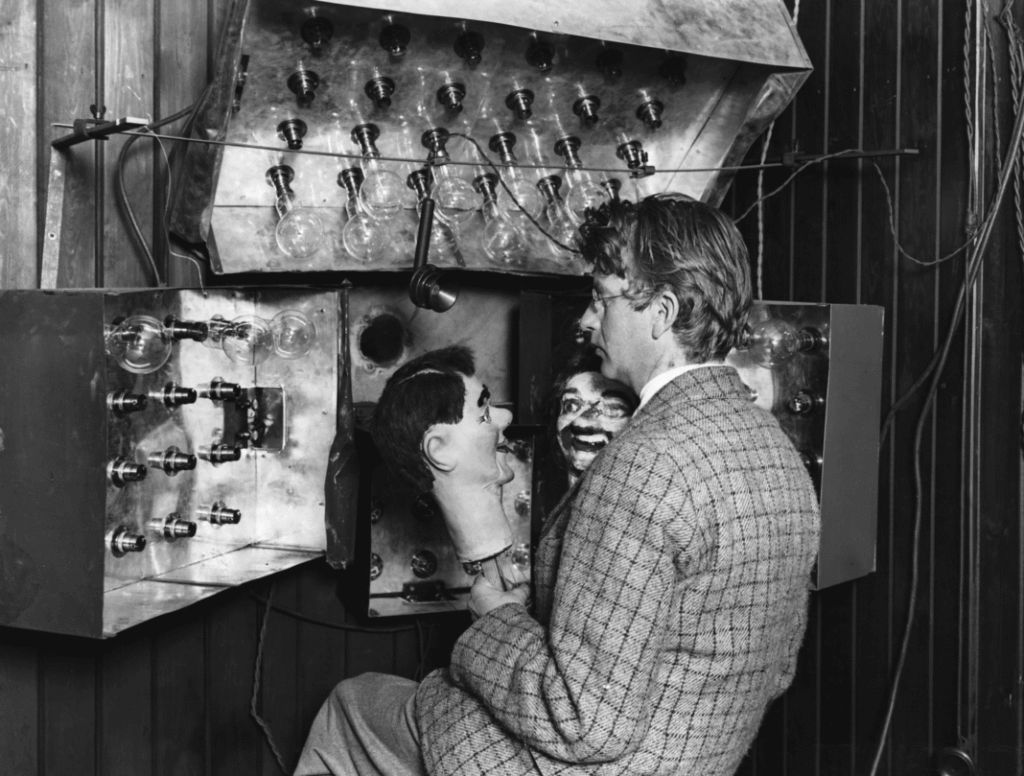
WHO WAS JOHN LOGIE BAIRD?
Talking to Martin Dickie, leader of the Hastings Television Museum Project, I sense that Baird’s success was highly improbable. Born in Helensburgh and educated at the University of Glasgow, Baird was unlike other inventors of the time, such as the inventors of the plane or car. Instead, he was, as Martin said, “a single individual working largely without funding, and largely outside the scientific establishment.”
Perhaps not the crazed Frankenstein then, but still an eccentric with a “wicked sense of humour.” Before Baird even got to work on the television, “he’d tried his hand at Caribbean jam, thermal undersocks and glass razor blades.”
How then, did he get from Caribbean jam to the television? As Martin explains, “there were some fairly well-funded experiments with picture transmission taking place in the United States in the mid-1920s, but Baird was convinced he could do it better, even though his equipment was rudimentary.”
He moved to Hastings in 1923 due to ill health – hoping the sea air would help him recover (there was probably less sewage in it then). In his memoir, Baird says: “Hastings saved my life.” With a projector in a biscuit tin and an electric motor balanced on a coffin at his workshop on 8 Queen’s Road, he invented television.

When he electrocuted himself with 2,000 volts, burning his hands and ripping a hole in his trousers, his landlord told him to move out. From there he moved to London, where he carried out the first public demonstration, along with his business partner Oliver Hutchinson, to members of the Royal Institution in Soho.
From this, Baird went on to form Baird Television Limited, having formed good connections with journalists and funders – allowing him to further develop the technology. 1928 saw the first successful broadcast across the Atlantic. Martin explained that then “the BBC showed interest and began experimental broadcasts in 1929.”
However, in 1935, the BBC adopted Marconi-EMI’s electronic system – as opposed to Baird’s mechanical system – which relied “less on unwieldy spinning discs and more on electron beams and circuits, and was deemed to have a clearer picture.”
But it would be silly to discount Baird as a failure. He was anything but, being the first to give birth to the idea and then overcome “a multitude of obstacles to make it a reality.”
Hastings, as well, has quite a claim to the invention: “one of Baird’s key brainwaves took place on the coastal hike between Hastings and Fairlight. The proof of concept was laid out, and the first image was transmitted privately, above Queen’s Arcade,” says Martin.
To commemorate then, let’s look at some of the things TV has given us over the years, as well as what it may give us in the future. (I don’t mean square eyes).

PAST PRESENT AND FUTURE
The telly, best viewed (in my opinion) with a cup of tea and a biscuit tin full of biscuits, has given us many wonderful moments. It has made us laugh, cry… and traumatised us, think, Mr Blobby, Mr Noseybonk, the villains from The Numberjacks, and the original ‘Bungle’ from Rainbow.
Since the BBC’s first broadcast almost 90 years ago, in November 1936, there’s been comedy (Rising Damp, The Young Ones, Such Brave Girls), soaps and drama (Coronation Street, Eastenders, Inspector Morse), and a new game show seemingly launching every week.
There’s been great adverts (a gorilla playing drums, Gary Lineker eating his weight in crisps, and the PG tips chimps) as well as great theme tunes; children’s television being a particular bonanza for catchy music: Bod, Postman Pat, Paddington Bear, The Wombles and Mr Benn.
However, this is merely scraping the surface of television – I’ve not even mentioned Doctor Who and, of course, Basil Brush. But why is television so popular? I asked Dr Lavinia Brydon, Senior Lecturer in Film at the University of Kent.
“There’s a huge variety of different types of television programmes which helps to keep attracting and sustaining audiences. And I think the fact that it’s flexible and has shifted from broadcast into streaming has also helped,” she said.
Broadcast TV, which has seen the hits listed above, is potentially becoming a thing of the past. We are now in the world of streaming services – there are almost as many as there are game shows – and ‘prestige TV’, which blurs the lines between TV and film. “When there’s hour or one-hour-15-minute episodes, the aesthetics are ones that belong in the cinema: the way we watch them, the fact some of these are actually exhibited in cinemas, especially if they’re stand-alone TV dramas or the premiere of a new season.”
In the industry itself, Dr Brydon adds, “there’s also now a blurring of boundaries between film and TV production with more opportunities opening up – especially for groups that are traditionally marginalised within the film industry.” Although, she makes an important note that more can still be done.
Streaming has also changed the way we engage with TV. In broadcast telly, there’s a flow of shows and adverts. One moment you’re watching Bargain Hunt, then you’re watching the News, and then you’re changing the channel to something cheerier, like an advert for life insurance or cremations. But “streaming has taken out that distinction of we flow from one item to another,” with us now watching what we want when we want. In recent years, however, streaming has picked up the tradition of making people wait for the next episode rather than letting them binge-watch to their heart’s desire.
Social media has also had an effect. Not only is it a potential distraction – leading to production companies tailoring their shows to a changing attention span – but it’s being used by production companies to advertise and even upload shows. The BBC has recently announced plans to make shows for YouTube.
So, is TV as we know it going to disappear? Will the future see TV ending up in Baird’s electric-motor-supporting coffin? Dr Brydon doesn’t think so: “It migrates, it’s watched in different ways, on different platforms; but it still exists. It might be hard to state what makes it specific. But we end up trying not to back ourselves into a corner to say one thing makes it specific: it’s a variety of a few things that coalesce together to make us recognise it’s television as opposed to film or as opposed to another form of social media.”
This is not ‘The Death of TV’ then, just another change – like the BBC’s change from Baird’s to Marconi-EMI’s system. It may be a different kind of TV, a different system, but it always goes back to the same man: John Logie Baird.
We hope you have enjoyed reading this article. The future of our volunteer led, non-profit publication would be far more secure with the aid of a small donation. You can also support local journalism by becoming a friend of HIP. It only takes a minute and we would be very grateful.

Leave a Reply