
Prehistoric Graffiti
KENT BARKER
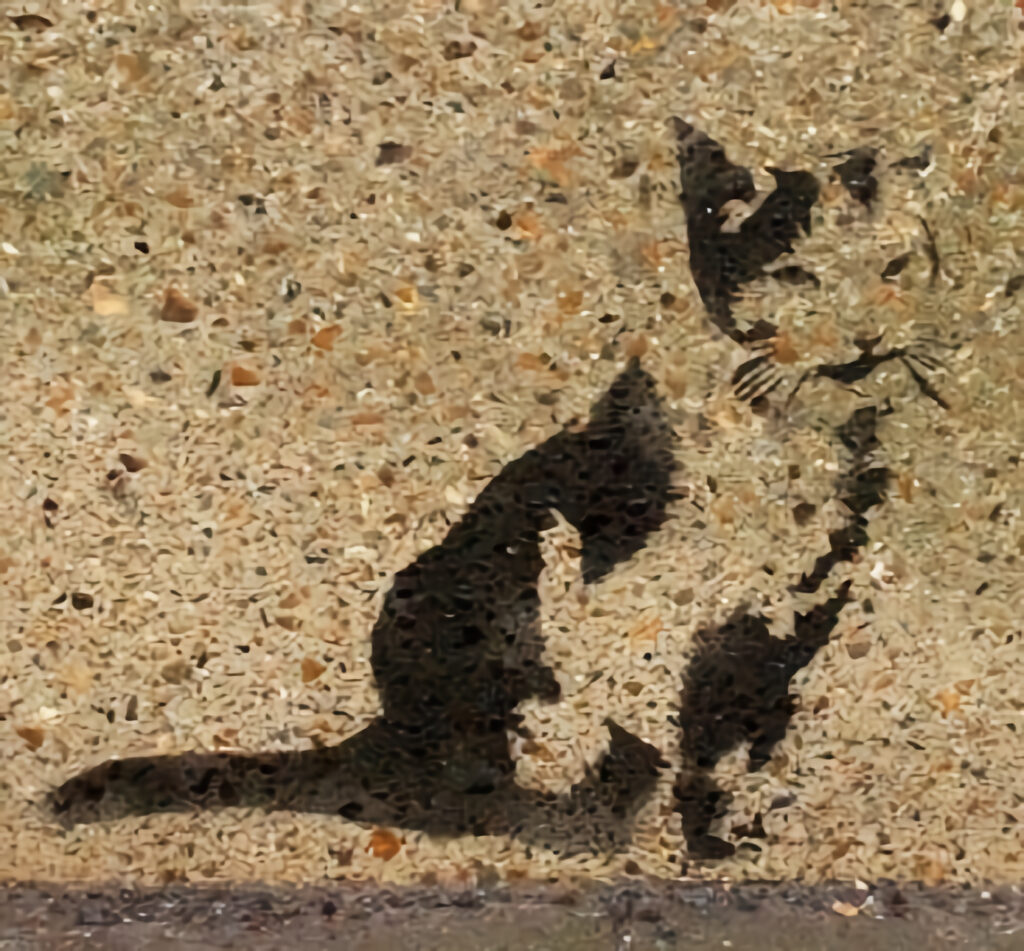
You might think that the use of stencils by street artists is a relatively modern phenomenon. Just look around Hastings and see our Banksys or Stewys, or the mystery cat pictures, and you can see how effective the process is. But it seems that these artists have been ‘borrowing’ a method pioneered at least 20,000 years ago. And since, as far as we know, they didn’t have spray cans back then, they had to develop a new method of transferring paint onto a wall.

Prehistoric art has been discovered in some 350 caves in France and Spain. The oldest is believed to be the Chauvet Cave, in the Ardèche in southwestern France, with figurative paintings dating back to the Upper Palaeolithic Ice Age, around 32,000 years ago. They are certainly older than the most famous site – Lascaux in the Dordogne – whose 600 consummately beautiful wall paintings and engravings are a mere 17,000 years old. However, like the majority of the caves these two are both closed to the public to preserve the artefacts.

If you do want to visit one of the few that remains open, try Pech Merle, about 30 kilometres east of the French town of Cahors. It’s one of the experiences of a lifetime. Even if there were no prehistoric paintings to see, these caves are fantastic in themselves. Millions of years before bears, humans, or artists arrived, a river ran underground through an area of limestone rock, carving out 1.5 kilometres of meandering caverns with stalagmites and stalactites. The occasional huge boulder is deposited at a rakish angle, making it look more like a film set than a grotto, and roots of trees descend from the ceiling.
Our ancestors had to avoid cave bears (who left claw marks on the walls) as they explored narrow passages and vast caverns by the light of the most rudimentary of candles. And this was the only illumination available by which they could paint. But over the course of several centuries, different generations produced sophisticated and incredibly lifelike images of single colour: spotted horses, bovids, reindeer, woolly mammoths and … human hands.

It would seem that the hands were probably done later – a mere 19,000 years ago – while the main paintings date back around 28,000-29,000 years. To put this into some sort of context, the battle of Hastings was just 1,000 years ago, the Christian or Common era started 2,000 years ago; the Neolithic farmstead Knap of Howar on Orkney – the oldest preserved standing building in northern Europe – is about 3,500 years old, and Stonehenge was started 5,000 years ago. So the artists of Pech Merle were crawling through the caves with flickering candles, carrying bowls of pigment two dozen millennia before Stonehenge or the Pyramids of Giza were even started.
Pigments are the clue to palaeolithic graffiti. They were made from minerals such as limonite and hematite, red ochre, yellow ochre and umber, often mined some distance from the caves. For the spots on the horses and for the hands, the powder or powders were blown from the mouth onto the wall. Possibly the earliest form of spray-painting. It’s why the stencils are in negative. The artist placed her hand on the wall and blew the coloured dust over it, leaving just the outline when she removed her hand. And how do we know it was a woman? According to the experts, by its relatively small size. What those archaeologists don’t explain is how there are so many handprints, added nine or ten thousand years after the original painting.
Is it possible that the 12 black or red hand images were the equivalent of early tags? Could a teenager have snuck into the caves and liberally added her mark to the old masters? The only slight problem with this explanation is that similar hand prints are found in dozens of other caves, including several hundred at the (aptly named) Cueva de las Manos at Santa Cruz in Argentina. It may be stretching credulity to suggest some early form of social media communication reaching over thousands of miles and tens of thousands of years.
The technique of blowing paint was also used on Pech Merle’s most iconic wall painting, the Spotted Horses – around which the handprints were added. The panel is large – 3.6 metres long – and also contains the representation of a red fish, probably a sturgeon. The two horses are stunning in their simplicity, the outlines just a few continuous strokes. The artist has even used the shape of the rock to delineate one of the horse’s heads. Then the spots were blown onto the wall.
All in all, it is an exhibition not to be missed. But you may need to hurry. An official at the site told us that it was unlikely that it would remain open to the public for many more years. Even with limited visitor numbers and durations, the fear is that these extraordinarily ancient paintings may be starting to degrade.
See: en.pechmerle.com for more information and to book your visit.
We hope you have enjoyed reading this article. The future of our volunteer led, non-profit publication would be far more secure with the aid of a small donation. You can also support local journalism by becoming a friend of HIP. It only takes a minute and we would be very grateful.


Leave a Reply