
Ploughing the Salt Sea
PATRICK KEALEY on Bev Lee Harling’s powerful performance at The Stables

“It takes a whole community to make a show”, says performer Bev Lee Harling to the audience, as she takes her well-deserved bow at the end of her bravura solo show, Ploughing the Salt Sea. Premiering at the Stables Theatre, it’s a sort of one-woman distant cousin to Dylan Thomas’s Under Milk Wood. It treads a fine line between a lament for and a celebration of, the close-knit fishing community in Hastings she hails from – “not so much a fishing town with a drinking problem as a drinking town with a fishing problem” as she remarks early on – where the womenfolk raced to catch their husbands back from the sea on payday, not out of love but to head them off before they drank all their wages away at one of the many local pubs. Details like this give the show its heft and authenticity. It is a fascinating trawl through one family’s history that reveals the insular life of an entire community and its vanished and vanishing traditions.
MUSICAL TEXTURES
What makes a good solo show? I would say it is to do with how well a performer can welcome an audience fully inside the imaginative world they’re creating. Harling is a multi-talented singer-songwriter and gifted musician: in her debut as an actor, her ability to build an unforced, easy rapport with her audience through years of gigging pays dividends. She has us in the palm of her hand from the moment she announces her arrival, at the back of the auditorium, playing a traditional folk song. The musical textures in the show are rich and layered – recorded soundscapes (Frank Moon, sound design) and use of live percussive rhythms along with songs both traditional or original and self-penned, are cleverly threaded throughout the unfolding family tale to evoke powerful atmospheres. Harling can casually pick up a tiny violin to pluck a melancholy tune out of thin air or strum a balalaika-type mandolin to underscore the action, or sit and draw chords out of a small harmonium in the spirit of a revivalist meeting in a Welsh chapel.
NARRATIVE STRENGTH
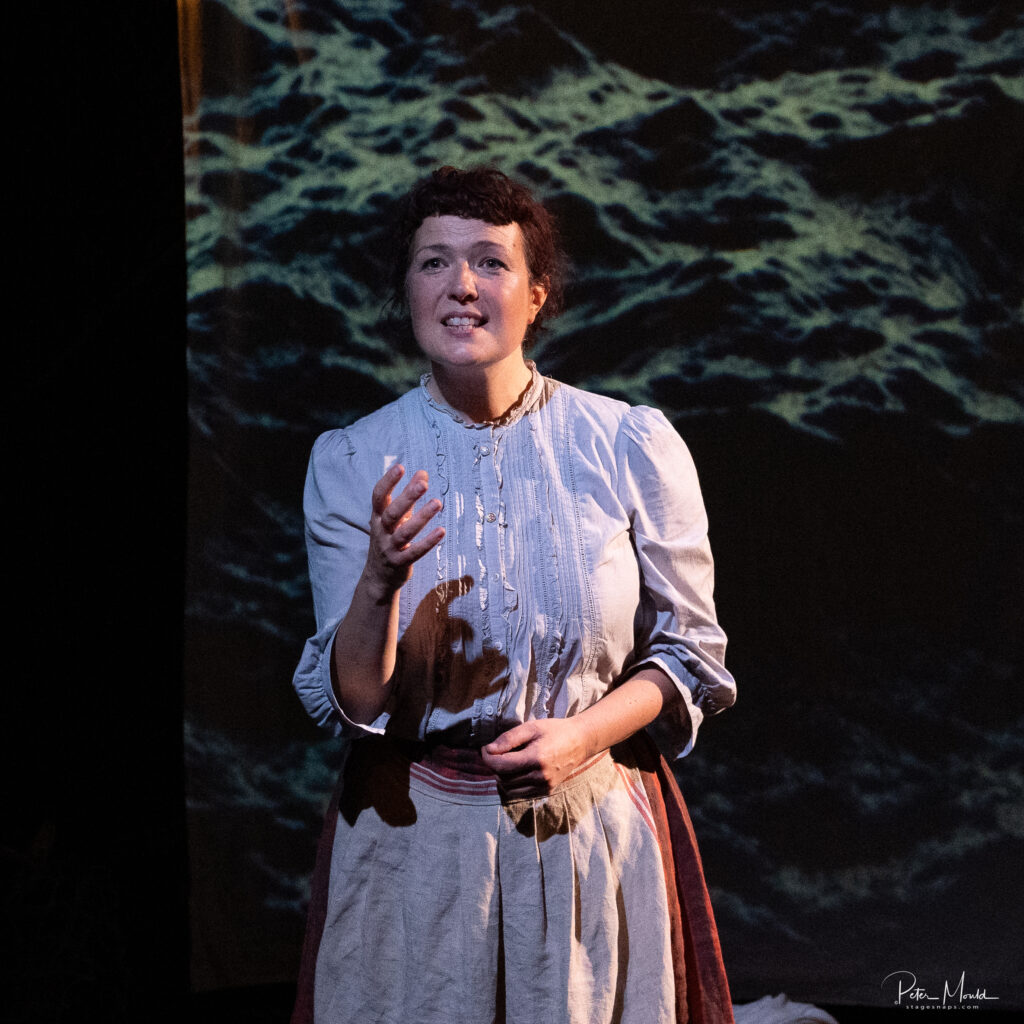
Meanwhile, as an actor, Harling and her director Mo Cohen wisely play to her performance strength, namely a warm conversational narrative style. She has a disarming vulnerability along with charm to spare, which perfectly sets up the necessary tone of intimacy for the personal family history she goes on to reveal. In devising her show she has understood that the more personal the detail, the more universal the resonance for an audience.
Ploughing The Salt Sea is a tale of ancestry, hidden and finally brought to light, principally explored through the life story of Harling’s mother and grandparents. The narrative is fragmented and occasionally confusing (a family tree in the programme would not go amiss). But while that could be seen as a weakness, it also accurately reflects the piecemeal way the young Bev and her later adult self discovers truths about her family. When her natural childhood curiosity is deflected by her mother’s fiercely guarded, cagey responses, the scenes enacting these conversations are cleverly done. Her mother’s awkwardness is explicitly revealed in the way her knife slams down hard on her chopping board. Every so often scene transitions lack a certain fluidity, always a challenge for solo shows where performers are also their own stage managers. But this is a small quibble, and practice and familiarity with her material will improve that aspect.
MATRIARCHAL POWER
In tracing a unique lineage, Bev Lee Harling also pays tribute to the matriarchy of proud tough women she originates from. Tales of the public washhouse lie at the heart of their social world. “I come from women” she sings near the close “from illegitimate shame, from making do, from secrets and words”. The show’s core themes are laid bare here. It is only right and fitting that the wash house does feature so strongly since it is her family’s dirty laundry finally getting aired out on the washing line. A backdrop of fishing nets and suspended angular sails onto which is projected abstract video of stormy seas and fuzzy family snapshots, makes for an elegant minimalist set design from Simon Daw, beautifully lit by the Stables’ resident lighting designer, Jonathan Richardson.
TRAGEDY, COMEDY, LOVE
The show balances the comic and the tragic beautifully, often within the same scene. For instance, there is a shocking and truly hilarious sequence relating to the death of her grandfather George, who after the sudden death of his wife (her grandmother) chooses to cohabit with Mrs Hum, a shady pub landlady. As she impersonates the dreaded Mrs Hum, Harling wittily plays a tinkling ditty on a row of glasses set out like drinks on a bar to form a homemade xylophone, confiding her murderous intent with all the glee of a villainess from a Victorian melodrama. And in a sequence of brilliant physical choreography by Arthur Pita that plays like a speeded-up silent film comedy and which could have been subtitled a woman’s work,’ she acts out a sort of mad housewife’s dance of daily domestic drudgery. As she scrubs, cooks, sweeps, and cleans her only reward is to be presented with a constant eruption of squalling babies, each one emerging from an animated household dishcloth.
Overall, the show works as a creative act of love. It is not only a love song to her own family, charged with humour and honesty, clear-eyed and unsentimental, skilfully told with great wit and affection, but tells the tale of a town and a time gone by. To research the show, she gathered reminiscences from community elders, a number of them now in their eighties and nineties, as well as her ageing father. And what could have been a dramatised misery memoir in less sensitive hands is instead a work of alchemy. Bev Lee Harling has managed to transform the raw material of the past into a vividly satisfying theatrical ritual that both honours her ancestors and exorcises the repressed shame that sits at the heart of her family history. Divested of its sorrows and losses, it’s transformed instead into a celebration of mostly female resilience and endurance in the face of constant adversity. It also serves as social history and a vital reminder of the enduring power and necessity of community in the increasingly deracinated society of the digital age.
We hope you have enjoyed reading this article. The future of our volunteer led, non-profit publication would be far more secure with the aid of a small donation. You can also support local journalism by becoming a friend of HIP. It only takes a minute and we would be very grateful.

Leave a Reply