
Painting and the Market
A personal view by Robin Holtom
When I was training in painting, a common rebuke was that our work was ‘illustrational’ rather than ‘painterly’. Painters were expected to produce much larger decorative works – paintings that would look good in a museum or a boardroom rather than a domestic living room. Constable faced the same pressures to produce “six-footers” for the RA summer show with which wealthy patrons might decorate their country houses.
In the 1950s and 60s the Central Intelligence Agency made well documented efforts to promote brash, large scale and spectacular American painting. Smaller scale work to hang on the wall of your home was relegated to provincial galleries, museums, and open studios. I spent a couple of valuable years offering my work on the Bayswater Road where I learnt the fundamentals of the market. Selling art has little to do with the merit of the work itself and much to do with fashion and presentation.
Horses Running through Water
The best-selling artist there offered thickly painted oils – horses running through water and birds of prey – in shiny frames. His customers were rich Arabs or Americans whose cars would pull up and wait for him to load the boot with paintings at £500 cash per item. We less successful artists, comforted ourselves, rather forlornly, referring to his works as ‘braille paintings’ that only the blind could really appreciate.
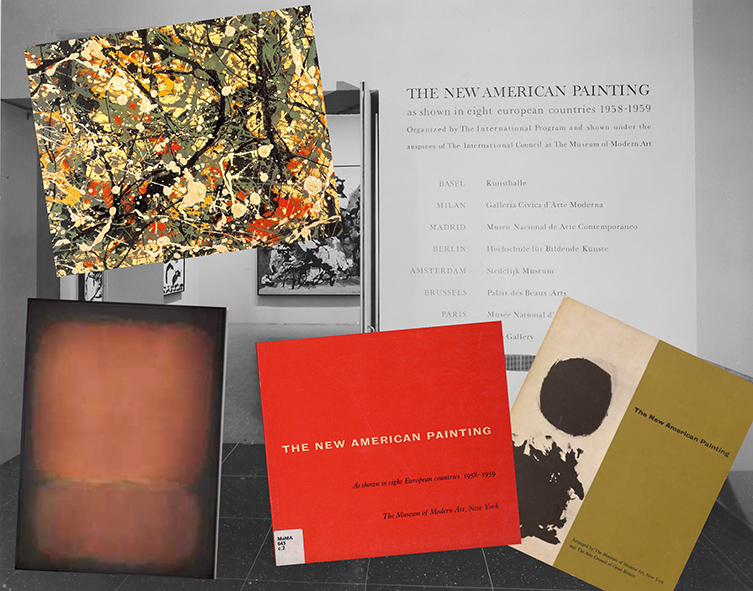
Jackson Pollock and Mark Chagall were among artists included in the New American Painting Exhibition
About this time I took my portfolio to Harrods. The picture buyer said I was quite a good painter but the difficulty was they didn’t really sell paintings. “What we sell in Harrods is wall furniture.” It was valuable advice. My career since has been marked by this failure to manufacture consistent wall furniture – whether for art centres, art fairs or London galleries. When I decided to earn my living from a less hazardous method – running residential painting courses – I said of one: “painting is a verb not a noun.” The process always seemed more interesting to me than the finished object. The priority of process over product had probably been established in me during 10 years as an art therapist.
Pretentious chancers
When I look at particularly mystifying objects in elegant galleries, with elaborate artist statements accompanying them, I am surprised to find myself joining the ranks of the Philistines. I often conclude that these artists are pretentious chancers staring up their own backsides. Yet such galleries are designed by the best architects and serve an important purpose for their municipal sponsors, not unlike that of medieval cathedrals. Cathedrals and churches competed with one another to acquire relics of saints and become centres for pilgrimage – sources of pride and profit for their town and local citizenry. The modern equivalent of these relics are works of art. In medieval times of course, some minor pilgrimage centres had to be satisfied merely with an alleged foreskin of Jesus, just as some provincial galleries before long may find themselves satisfied by one of Tracey Emin’s used condoms. You understand I am sceptical of this aspect of the business.
The difficulty for me arises when there is leakage between two functions – a gallery and a church. What happens then is art galleries develop a kind of priesthood known as curators. Like priests, curators presume to teach the truth about their subject. When I trained, no one for a moment considered curators might be products of art schools. Now every painting requires a label to direct how it should be ‘read’ – a disturbing lack of confidence among artists to let their work stand on merit.
Never happy bedfellows
I am not exaggerating this problem of confidence. Churches and cathedrals in England were once systematically vandalised – their stained glass, paintings and sculpture destroyed to establish the power of the ‘word’ over the ‘image’. I suspect that our visual imagination still suffers from this four centuries later – our comfort zone is ‘illustration’ and ‘storytelling paintings’.

Markets and art are never happy bedfellows. Price is distorted by considerations unrelated to value. In spite of our modest achievements in the visual arts, London has long been a major centre for the commercial art market. Oscar Wilde quipped that the English “know the price of everything and the value of nothing.” West End galleries refer to their artists as a ‘stable’. Painters are runners in a race that a few rich collectors can gamble on. This art market is a kind of casino. Sometimes, nowadays, even a way of laundering money. It is a long way from the reality of artists’ lives. When Degas heard that one of his paintings had sold at auction for four times what he had received for it, he replied, “the champion racehorse is happy with his bag of oats.”
“Wisdom is bought and sold in that desolate market where no man goes and the price is all that a man has,” Blake, perhaps a truly archetypal artist, wrote these salutary words having been many times on the sharp end of the art market.
• Robin Holtom is an artist living in St Leonards www.robinholtom.art Instagram @robinholtom
Art and the CIA
As part of a secret post-war pro-US propaganda campaign, the Central Intelligence Agency persuaded art foundations and museums to organise special events and exhibitions promoting American art, especially Abstract Expressionism.
It was funnelled through a new arts agency created by the CIA named the Congress for Cultural Freedom (CCF), developed in 1950 and not revealed as a CIA project until the mid 60s.
The apogee of the operation was the 1958/9 New American Painting exhibition which toured eight European countries including Britain. Initially the Tate deemed it too expensive to mount but an American ‘philanthropist’ suddenly appeared to underwrite the cost. Historians say the funds came from the CCF/CIA.
We hope you have enjoyed reading this article. The future of our volunteer led, non-profit publication would be far more secure with the aid of a small donation. You can also support local journalism by becoming a friend of HIP. It only takes a minute and we would be very grateful.

Leave a Reply