
HIP REVIEW
Let me be beside the seaside
Kent Barker reviews the summer exhibition at the Hastings Contemporary
Does anyone NOT have vivid childhood memories of visits to the beach? Images stuck fast – sand and sea, sun and skies, buckets and spades, ice cream and candyfloss. Artists are not exempt. Many have drawn copiously from this well. Hastings is proud to have attracted painters of the calibre of JMW Turner to its shore. His Fish Market on the Sands from 1824 sits on the cusp of the town’s metamorphosis from tiny fishing port to fashionable bathing resort.
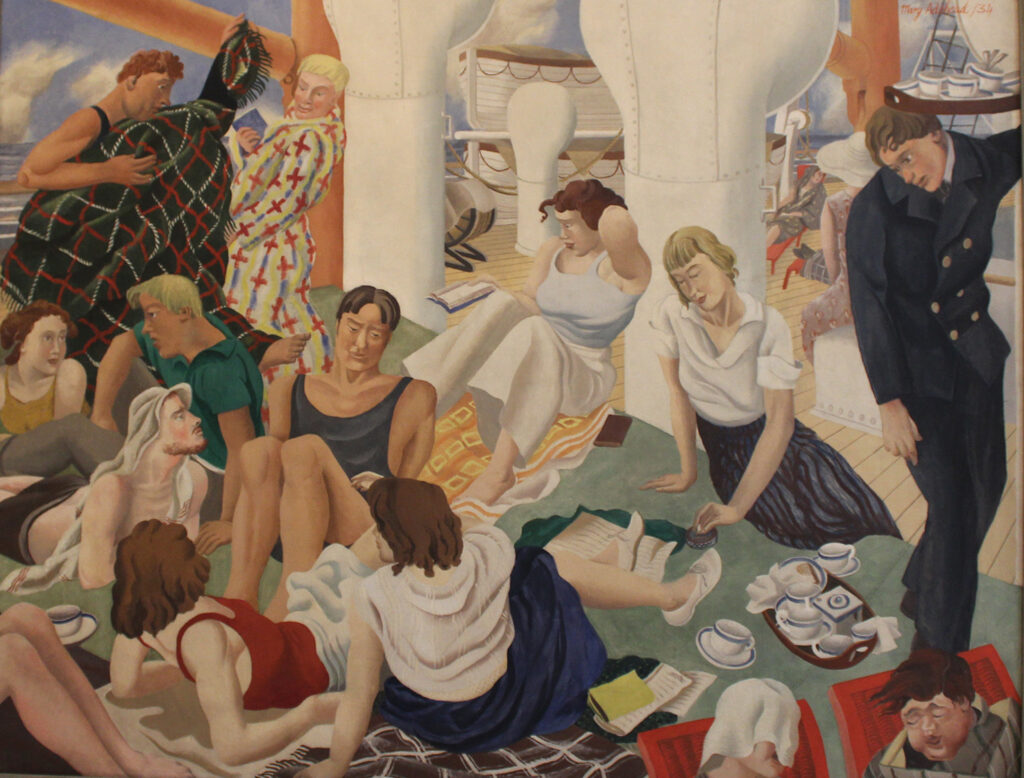
The Cruise by Mary Adshead
So it is unsurprising that the Hastings Contemporary should have chosen this theme for its exciting new summer show, Seaside Modern: Art and Life on the Beach. Not that most of the images are that modern. Although they span the 20th century, guest Curator James Russell has concentrated on a period between the world wars. “It’s a story of our changing relationships with the beach,” he told HIP, “and is partly about what people wear.” Wearing nothing had been the norm for 19th century men when swimming. The St Leonards Improvement Commissioners in 1862 stipulated: ‘Gentlemen are requested to bathe in drawers … a penalty not exceeding £5 may be inflicted in default of their not doing so’. Russell points to the 1920s as the moment when women were released from the prudery of full-body swimwear and allowed to bathe alongside men similarly attired in one-piece costumes.
It gave rather greater license to artists – particularly commercial ones whose posters extoll the (often female) attractions of seaside resorts and methods of travel to them. The exhibition opens with some of these works, transporting us towards the beach. And then, in the next room we suddenly find ourselves on board ship with Mary Adshead’s dominating 1934 oil, The Cruise. And what fun it is. Louche figures lounge around the deck.
A blonde-haired man takes a salacious peek at someone changing. A harassed waiter brings afternoon tea. All Adshead’s angles convey the vessel rolling on the swell.


Preparing for the summer exhibition
CREDIT: Susan McFie
The painting Russell has chosen as the motif for the show is perhaps slightly diminished by being hung next to The Cruise. This is William Roberts’ stunning The Seaside from 1966. It’s a tour de force, with ten people and a dog shoe-horned into the canvass, their outline making an almost perfect rectangle within the frame. Most face away from us as they look towards the water and cover themselves with sun cream. But it’s a much smaller canvas than its neighbour and, being protected by glass, loses some of the vibrant colour we expect from the reproductions.
Returning to inter-war works, there are several Paul Nash’s, including the muted and angular Promenade, his dark wood engraving The Bay, and his gallows-like The Diving Stage, all from 1922 and all reminders of the recent trauma of the First War. One of Nash’s protégées was East Sussex artist Eric Ravilious (on whom Russell is an expert – see our interview on the opposite page) and he is well represented in the show. Much more of a surprise, however, is L.S Lowry’s July, the Seaside from 1943. It’s a lovely example of his work. Away from the mill towns, his characteristic matchstick figures here crowd onto the beach, paddling, building sandcastles and generally having fun. It must have been a cold day, though, as everyone is fully dressed.
The exhibition is both extensive and eclectic, including items from more than 60 artists. Some of the big names have small works though. The exquisite Henry Moore Reclining Figure, is pocket size. Indeed when it was moved off its blanket, presumably heading for a display case, I suggested
that someone had nicked it. I don’t think the staff were amused.
• Seaside Modern: Art and Life on the Beach is at the Hastings Contemporary
until the 31st October.
• Read HIP’s interview with curator of Seaside Modern: Art and Life on the Beach James Russell here.
We hope you have enjoyed reading this article. The future of our volunteer led, non-profit publication would be far more secure with the aid of a small donation. You can also support local journalism by becoming a friend of HIP. It only takes a minute and we would be very grateful.


Leave a Reply