
Gates to Heaven
GARETH STEVENS reviews the stunning work of Yun Hyong-keun, currently on show at Hastings Contemporary.
The ambivalence I have towards abstract art has always baffled me. The fact that I both love it and detest it in equal measure is an example of cognitive dissonance at its purest. I follow multiple Instagram accounts of abstract painters and have abstract art on my walls at home and yet, intellectually, it is a vapid, self-indulgent idiom that is overly esoteric and essentially bourgeois. Hopefully, this contradictory mindset has helped me to develop a more discerning critical eye – who knows? Music is the purest form of abstraction to me, but unlike music, abstract visual art has never made the hairs on my arms stand on end or caused tears to roll down my cheeks.
A SILENT REFLECTIVE MOOD
And so it was with some trepidation that ‘I’ accepted the task of writing a review of the current exhibition of the work of Yun Hyong-keun at Hastings Contemporary. The doors to the downstairs gallery space are usually wedged open during exhibitions. This time no. On entering you experience a sudden drop in light levels. The north-facing window has been covered, as have the skylights, and it takes some time for your eyes to adjust to the twilight atmosphere. Immediately I am reminded of being immersed in the room that houses Rothko’s Seagram Murals at the Tate Britain. Before interacting with any of the individual works, I am overcome by a silent reflective mood that often descends when I step foot in a church or other place of worship.
CIRCUMVENTING THE EGO
This is the first-ever public gallery exhibition of works by Yun Hyong-keun (1928-2007) in the UK. A leading figure in the world of Korean art, he worked tirelessly to circumvent ego-based intentionality and to produce works that avoid any literalism. He explains that “the thesis of my painting is the gate of heaven and earth. Blue is the colour of heaven and umber is the colour of earth. Thus, I call them ‘heaven and earth’, with the gate serving as the composition.”
During a period of isolation following the Korean War (1950-1953) when the country was effectively cut off from the world’s art markets and movements, a group of South Korean artists began to develop work that brought together traditional approaches with the emerging abstract expressionism of the West. Their work became known as the Dansaekhwa movement. From the early 1970s onwards, Yun began to develop his distinctive style. Whilst a two-year stay in Paris, and the resulting contact he had with a number of European artists in the early 1980s, helped him to refine his creative process, his most influential mentor was his father-in-law the eminent Korean painter Kim Whanki (1913-1974).
CREPUSCULAR MELANCHOLY
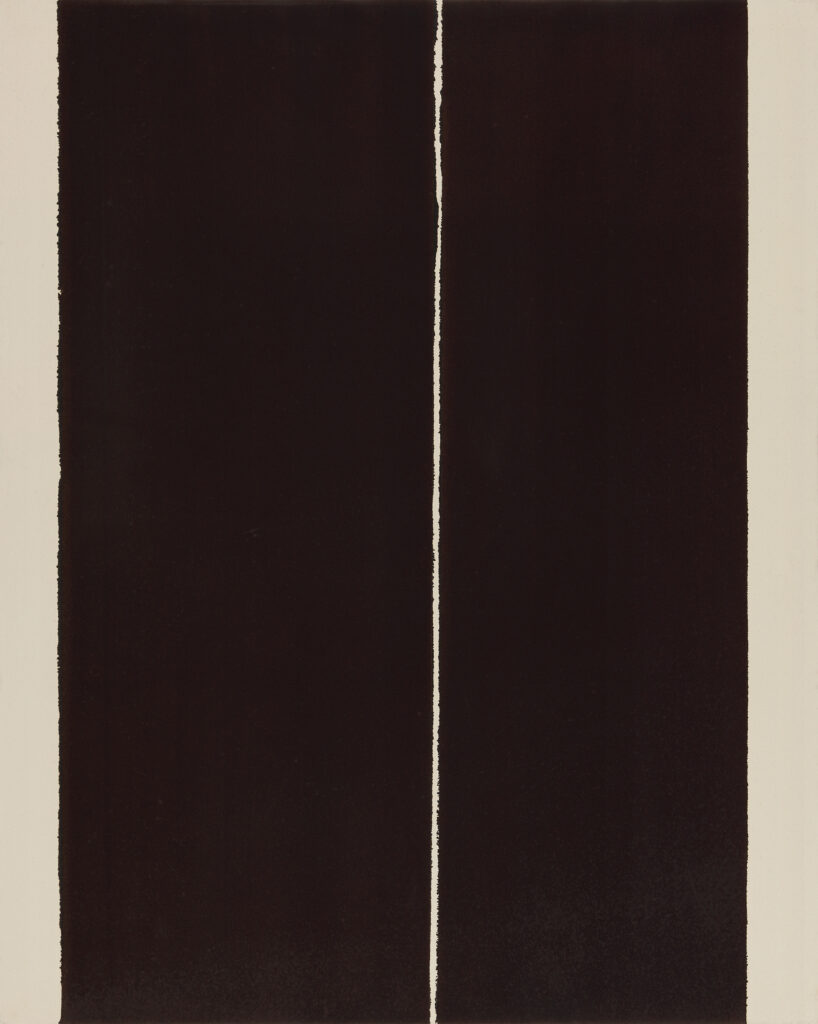
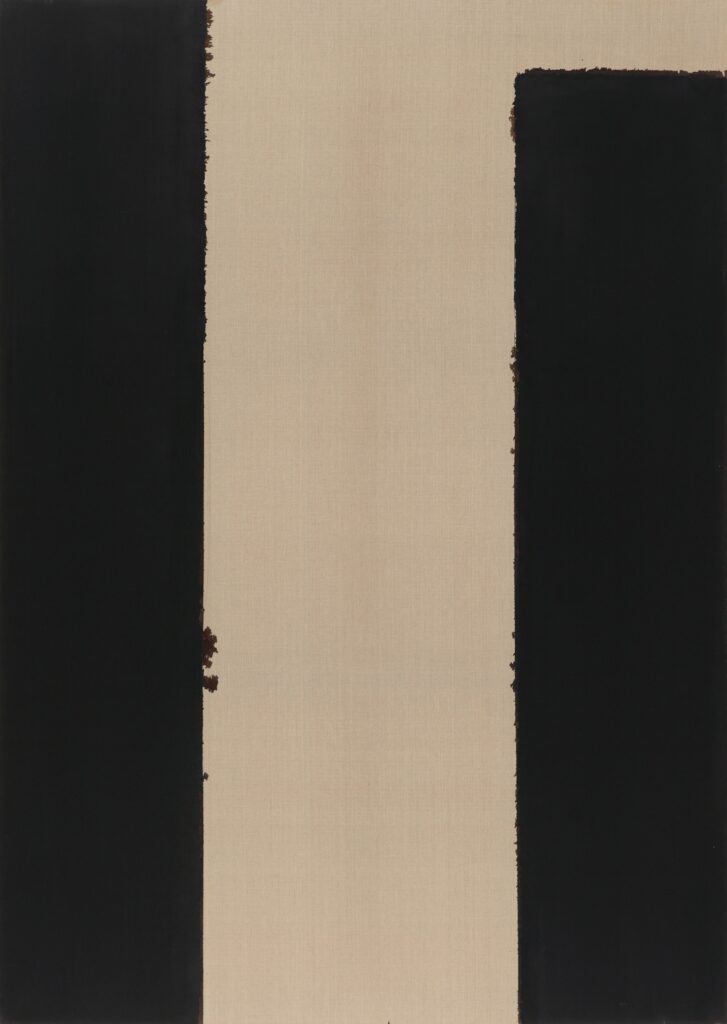
Much in the same way as Helen Frankenthaler would stain her canvas rather than apply paint on it, Yun painstakingly applies multiple layers of oil paint thinned with turpentine to produce monumental blocks – the gates – that have such mass and density that light just falls into them. This process produces blurred edges that induce the feeling that you are zoning out in an unfocussed, meditative daydream. The repeated theme of two immense blocks framing a luminescent golden umber creates an incredible sense of crepuscular melancholy. The paintings encourage us to engage with sadness in a very profound way. That said, the emotion elicited is not wholly negative – rather it is a deeply pensive, raw and moving sense of hope, spliced with the inevitability of fate. In many ways Yun’s work celebrates the fact that sorrow is woven into the very fabric of our lives, it is normal and therefore needs to be accepted – nay celebrated.
In Untitled 1993 (oil on linen), as well as the edges being softened by multiple layers of diluted paint, small polyp-like protuberances bleed into the umber field and provide some uncharacteristic detail that draws our attention. Always one to avoid contrivance, Yun rides with these serendipitous accidents.
Whilst these works seek to go beyond language and any literal references, our apophenic brains always look for patterns and equivalences. At first, the images reminded me of the twin towers NYC, and then I couldn’t help but draw parallels between Yun’s monolithic blocks of overlaid ultramarine and the nearby net shops on The Stade. Whilst valid, of course, neither idea is intentional. Yun’s paintings are mandalic, one and all. Looking at them should induce a state of contemplation – they nudge us to look within and ponder our mortality.
RETURNING TO THE EARTH

Burnt Umber & Ultramarine Blue 2007 (Oil on cotton) was painted in the year of Yun’s death. In this work, the umber that represents the earth is reduced to a very thin central strip. The ultramarine of heaven dominates the composition. It is as if the artist knew that his time was near. As he said in 1990: “Since everything on earth ultimately returns to earth, everything is just a matter of time. When I remember that this also applies to me and my paintings, it all seems so trifling.”
And so it was that my less cynical view of abstraction prevailed on the day. This exhibition is a nourishing antidote to the freneticism that often invades our lives. At a time when the world is facing such existential crises – when doom scrolling can cause such profound anger and anxiety, art like this can help us to recalibrate, defrag and find firmer ground within.
Yun Hyong-Keun is at Hastings Contemporary until 1 October. For more information visit hastingscontemporary.org
We hope you have enjoyed reading this article. The future of our volunteer led, non-profit publication would be far more secure with the aid of a small donation. You can also support local journalism by becoming a friend of HIP. It only takes a minute and we would be very grateful.

Leave a Reply