
Fun in the Post-Apocalyptic Slime
VICTORIA KINGHAM
Along with T. S. Eliot’s The Waste Land, W. B. Yeats’ Second Coming must be one of the most-quoted poems of the past hundred years. Things Fall Apart is the title of Chinua Achebe’s post-colonial allegory of the mutual destruction of different cultures; Joan Didion’s Slouching Towards Bethlehem tells of the tragic reality behind the San Francisco hippy dream. Things Fall Apart was used as a title for The Sopranos’ penultimate episode, signifying the disintegration of Tony Soprano’s New Jersey mob world, pre-figuring his death.
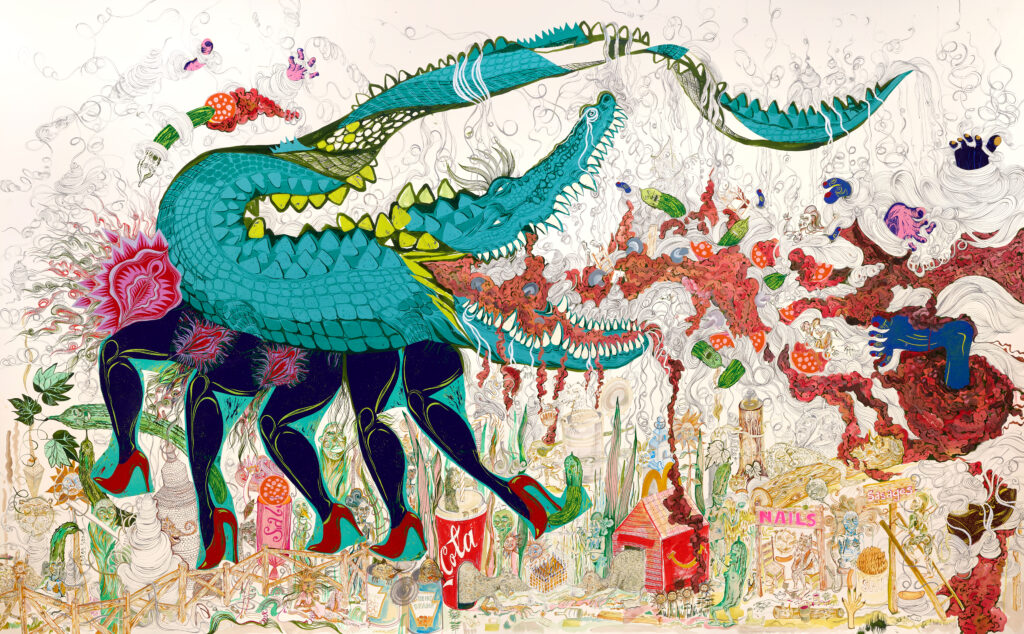
Isabel Rock, End of Everything
In contrast to Yeats’ slouching blank and pitiless beast, the beasts in Isabel Rock’s current Things Fall Apart, The Centre Cannot Hold exhibition are the ones which, in a rather accurate scenario, would be the ones to dominate what remains of the planet after humanity has finished piling it up with indestructible muck. Over the past two years she has created an extraordinary series of endlessly instructive works where the beasts take over. Unlike Wall-E or The Day of the Triffids though, there’s no hopeful ending, no projected re-assembly. Mountains of slugs move in to digest beautiful flowers, intent on destroying their own private paradise; crocodiles eagerly devour streets full of pasta (more, more, more!); giant rats drive rusting sports cars, and an enormous pig relentlessly slurps up what remains of a once-civilized town and its inhabitants.
HUMOUR WITH INTENT
Humorous, a bit bonkers, but with a serious clarity of intent. “I really like art that’s funny,” Isabel says. “So much art is dry and humourless. Especially with subjects like this, you need the humour to get people to engage with it.” Rock cites Hogarth as one of her favourite artists, and it’s easy to see why. Think of Gin Lane with its emaciated beggars, falling babies, collapsing buildings, hanging corpses. And Hogarth also does a nice line in puns: ‘Kilman’ distiller, ‘S. Gripe’ pawnbroker. But his message was clear: if you’re going to subdue hoi polloi, do it with good British beer rather than no-hope-heavily addictive cheap chemical spirits.
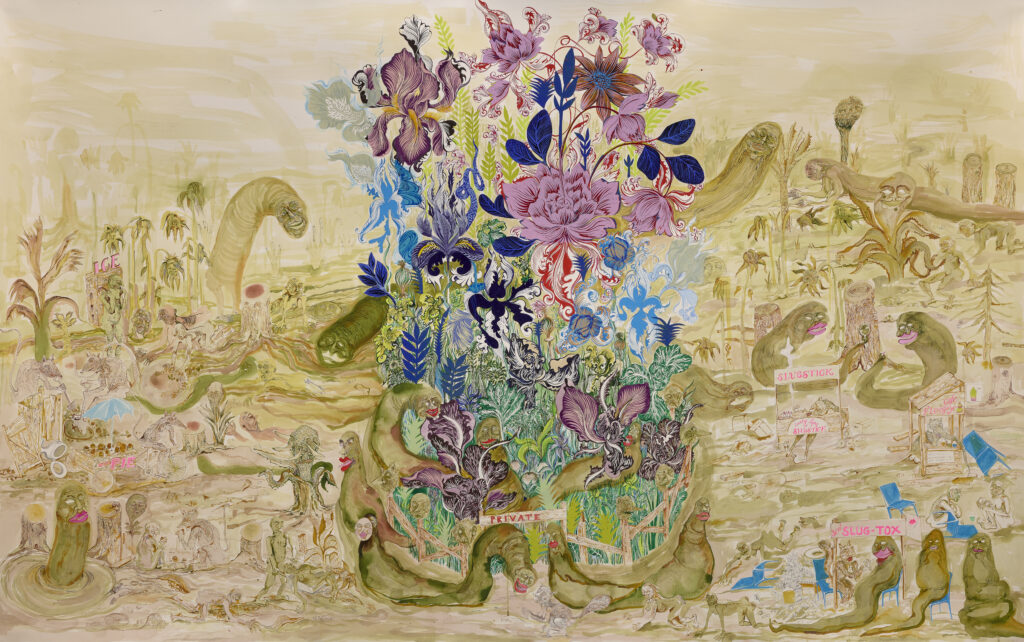
Isabel Rock, Slugstick, 2024
In Isabel Rock’s world, though replete with similar puns and desperate bodies, the theme is less local, more universal. In her world there isn’t a human ruling class: humanity has, by its own actions, imploded and been sucked into a black hole. What will be left to feed on the detritus? Slugs, of course. These insidious and deeply unpleasant beings already appear in disturbing droves after rain, make their way through small gaps in old houses to produce slimy tracks on kitchen carpets, frolic in uneaten cat food overnight, and lay waste outside to hostas, delphiniums, foxgloves, and a host of erstwhile edible vegetables. We keep these minibeasts at bay and we keep them small, but left to themselves, uncontrolled, with an infinite food supply, who knows what size they will grow to, what power they will attain?
CROCODILE TEARS
In a poor outskirt of Rio de Janeiro I once saw a large pond filthy with plastic containers, waste food, discarded engine parts, and choking strings of weed. In the middle of it was a huge living alligator, circling about sluggishly, raising and lowering its head to snack on whatever was nearby. Once a plastic bag stuck to its head as it raised it out of the water. It wasn’t captive; it had chosen the position. People circled and cycled about the area, going about their business or pleasure, ignoring the animal but keeping their distance. The sight has stayed with me these ten years.
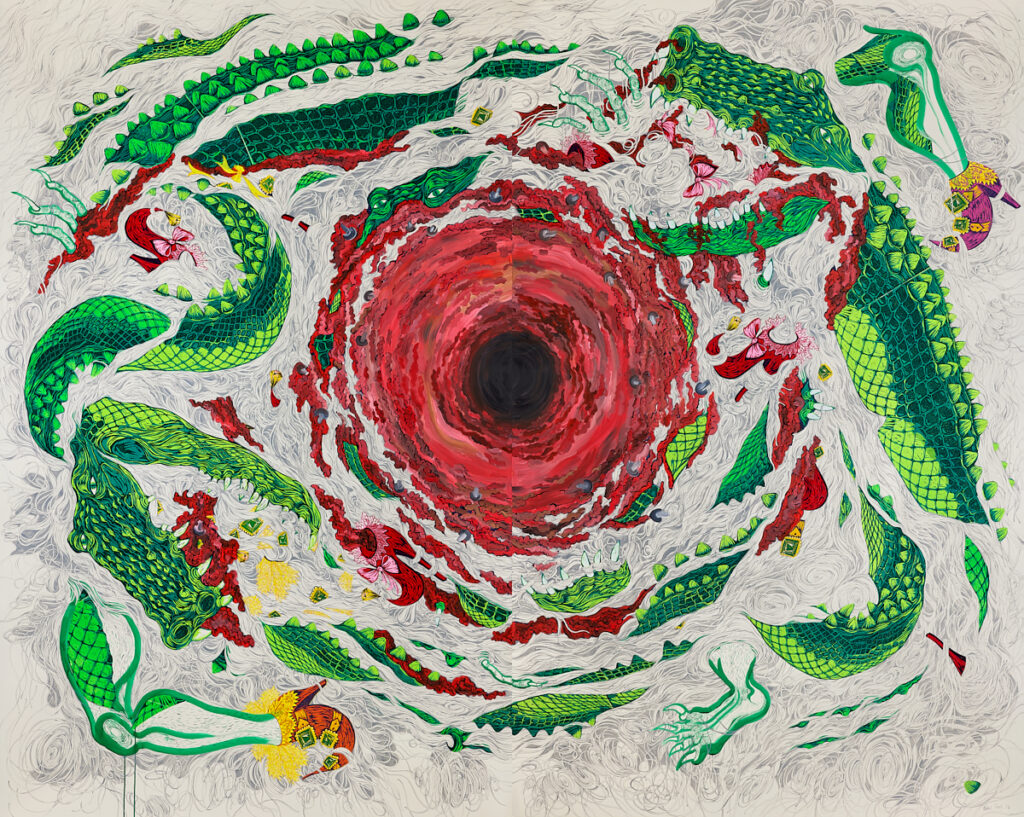
Isabel Rock chose crocodiles for their visual impact (and she likes drawing them) and they clearly symbolise power to subdue and conquer. Spaghetti Crocognese is a representation of the old story Strega Nona’s Pasta Pot, [the assistant starts the process, but doesn’t know the magic word to stop the pasta being made, and it begins to fill the village, the town, the world] which, Rock muses, “deeply influenced me. There’s something about the madness that can happen, that’s kind of fun. A lot of what I draw is based around eating, and I want to try to get that feeling in people of, a little bit funny but a little bit gross. That visceral reaction.” And, viscerally, the crocodile encircles the streets full of pasta while in the middle is a growing black hole into which everything will eventually be sucked.
THE MEDIUM IS THE MESSAGE
Her description was a reminder that this is art with a definite message. It is informed and inspired by Rock’s own activism; her prizewinning competition entry is an almost full-sized model of the cell in which she was detained on remand, after being arrested for climbing a gantry at the Just Stop Oil demonstration on the M5. This is assembled in a corner room at Hastings Contemporary, and comes equipped with a looming 8-foot papier-maché slug, motionless but slightly disturbing, lying on the top bunk. There are drawings in the cell – of her cell-mate Molly, also an activist. And “this is Phoebe” she goes on, “who threw the soup on Van Gogh’s Sunflowers.”
That was also a Just Stop Oil protest, and reminiscent of another act by a Suffragist activist more than a hundred years ago, when Mary Richardson slashed a priceless Velázquez canvas with a knife, as part of the long and extreme campaign to give women in the UK the right to vote (Interestingly a local writer has recently published Richardson’s biography, and a review will appear soon in this newspaper). The suffragists, much hated at the time, achieved something which we now take for granted. In a hundred years, I wonder, will we take it for granted that the continued burning of oil, making and use of plastic, excess of consumption, production of immortal waste, is leading to our own self-destruction? Or will it already be too late?
While art-with-a-message sounds slightly worthy (a bit like discovering that your favourite musician or actor wants you to give all your worldly goods to the Scientologists – L. Ron Hubbard has a lot to answer for), there is nothing remotely preachy about Rock’s drawings. The giant crocodiles, rats, and pigs dominate, abuse, and destroy the many smaller, scared, naked human beings. The intricacy, the detail, the narrative qualities inherent in her work are on a par with those of Grayson Perry, whom Rock also admires. “The difference between me and Grayson Perry” she says, “is that he draws people with clothes on. I like them naked, so it takes away the elements of class and status.” In her post-apocalyptic world the class and status belong to the gloopy slugs and the insatiable animals, and a big vain crocodile called Shirley who has grown five human legs (complete to the top, with bright pink vulvas) and prinks about on infeasibly high-heeled shoes. Comical, yet bleak.
LIFE’S MESSY CHAOS
Reflecting on the sheer practicalities of producing an exhibition like this in two years, I ask about the length of time it takes her to produce these graphically detailed representations of the inside of her head. We are in front of an exact depiction of a goddess, which is drawn directly from the mosaic goddess in Saint-Phalle’s Terra garden in Tuscany, which itself references both the mosaic fantasies of Gaudi and a previous 16th century park. It’s rare that Rock draws from life, but “there are a lot of references here. I’ve put Judy Chicago’s heads here – I like drawing dinner parties as well [there is another drawing of all the women in her cell block at lunch, naked, with the odd person cascading from the balcony]. I don’t know if I put them in exactly on purpose, but I really wanted to give a nod to powerful female artists. [And] the messy chaos of life.” Pointing to a particularly complex corner, she says that she started one during lockdown and completed that part, then came back to it two years later. In all, most of the artworks take her about a month [!] to do, this one “perhaps two months altogether.”
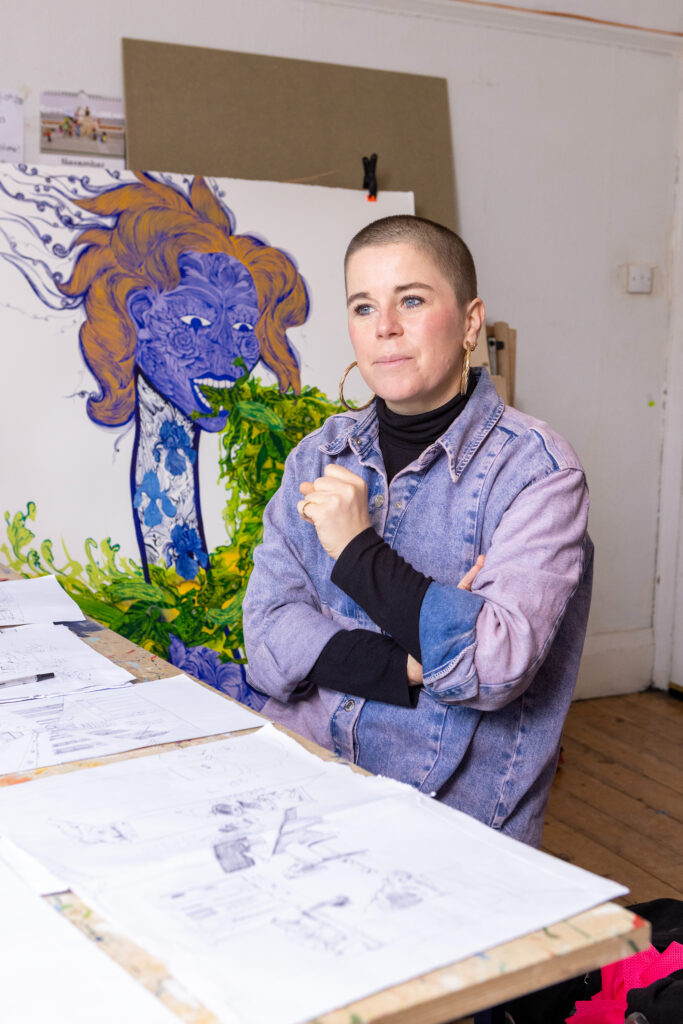
Isabel Rock in her studio
Perhaps two months, for something so compelling. That’s how she has been able to put together this most complex, elaborate, themed show, over less than two years. On a par with that of the best artists, her work borders on the obsessive, and she is admirably clear about what she wants to achieve. To get the detail that she craves, she works in ink rather than paint. Not satisfied with mere acrylic ink delineation, she has given many of the works added depth and a kind of three-dimensionality, by collaging drawings on top of drawings.
Many of the works depict centres that really cannot hold, like the black nothingness and the slugs’ paradise and decaying streets and erstwhile pavilions, and flowers subsumed into empty coke cans. Yeats’ poem symbolises the second coming as a great slouching lion/man, an overwhelming, inevitable force intent on the destruction of the Bethlehem of belief. It makes sense that it was published just after World War One, forty million or so senseless deaths leaving an ominous gap, filled ultimately by Hitler’s rise to power. Yeats’ poem can therefore be read as a premonition. Rock’s premonition here is an implosion, an inversion of the expected order, a grotesque kind of Animal Farm in which rats, crocodiles, slugs, and yes – pigs — do slouch, the Beast is a giant macrophagous crocodile. Bethlehem is too far to wade through what is left: oblivion will come sooner. and the black hole beckons. Not for nothing is one of Rock’s drawings entitled The End of Everything.
Things Fall Apart, The Centre Cannot Hold shows at Hastings Contemporary until 15 March 2026. The artist’s story videos that accompany it are at youtube: youtube.com/watch?v=1uLvGSU6wp0&t=4s and others. Exhibition details and gallery opening times are at hastingscontemporary.org/.
We hope you have enjoyed reading this article. The future of our volunteer led, non-profit publication would be far more secure with the aid of a small donation. You can also support local journalism by becoming a friend of HIP. It only takes a minute and we would be very grateful.

Leave a Reply