
Dancing to the Music of Time
VERA BELL
The current St Leonards Concerts season ended on 4 December with an extraordinary performance by five exceptional players. Who knew that the back room at the Horse and Groom could offer a unique chance to see them in action, a day prior to their appearance at the Queen Elizabeth Hall?
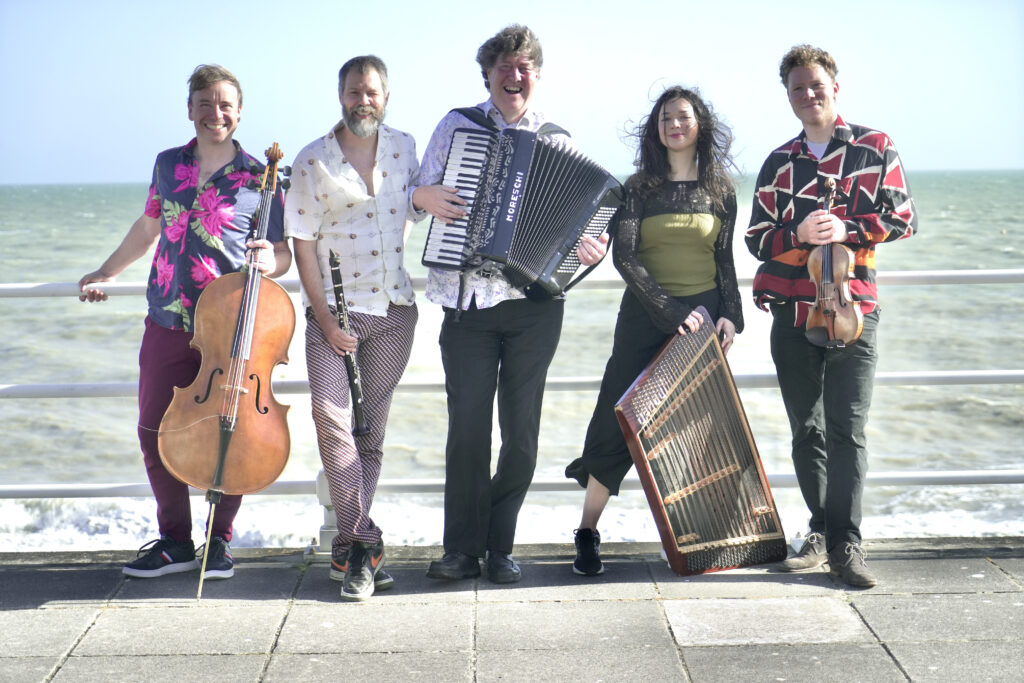
ZRI – Left to right: Matthew Sharp, Ben Harlan, Jon Banks, Iris Pissaride, Max Baillie
Good art, any kind of art, pays tribute to what has gone before, incorporates it, and creates something new. Imitation and technical skill is one thing, and a tribute band for example can be praised for doing what they do very well; incorporation is something deeper. Artists like Maggi Hambling, Grayson Perry and David Hockney all pay homage to past techniques or images while producing something contemporary and simultaneously uniquely timeless.
Popular composers like Hans Zimmer, Max Richter, Thomas Adès, acknowledge in their melodic and harmonic structures that which has gone before. (I’d also want to include the composer of two of the most evocative TV theme tunes, for Downton Abbey and Grantchester, John Lunn).
Clearly the use of traditional instruments in modern arrangements is one way to achieve this additional dimension. Some of you may have seen Tamsin Elliott’s band play the other day – Sid Goldsmith plays a cittern, a lute-like folk instrument that appears in 17th-century paintings by Vermeer.
The ensemble that Max Baillie has brought together to play his own unique arrangements of (mostly) classical pieces employs a splendid accordion (the poor man’s orchestra) from Jon Banks, and an instrument called the santouri, developed in an archetypal form by Babylonians about 3,000 years ago. Iris Pissaride is a leading performer (from Cyprus, now based in the UK), and the inclusion of this instrument adds body to Baillie’s arrangements.
ZRI is becoming well-known enough to be invited to play at the South Bank Centre, and they have already released four albums. The initials stand for Zum Roten Igel (to the Red Hedgehog), being the name of a tavern in 19th century Vienna frequented first by Schubert and later by Brahms. Both these composers loved gypsy music and incorporated it into their work. Conversely, Baillie and the quintet have taken their compositions and re-incorporated them into a kind of gypsy ensemble in a process they call ‘re-folking’.
It works wonderfully well, mainly because all five are outstanding musicians, able to invent and improvise as well as interpret musical notation. The versatile clarinettist Ben Harlan rarely looks at his score but besides reproducing it impeccably he produces, on standard Bb clarinet, bass clarinet, and bird-whistle, wonderful impromptu interludes. Also impressive was the fastest ever version of Brahms’ Rondo alla Turca. Their rendering of Schubert’s first Opus, the Erlking, also featured the voice of Matthew Sharp who, besides being a marvellous cellist, is also an operatic vocalist, adapting the timbre of his voice to represent Schubert’s conversation between father and son. It’s a tragic tale by Goethe: the Erlking (‘alder-king’) is an unpleasant elf-like being who lurks in woods stalking children whom he kills with a single touch; the boy sees him, but his father thinks he’s just looking at a little streak of fog and ends up devastated, carrying home a dead child.
Despite the tragic nature of this and the desperate Brother, Can You Spare A Dime, the classic American Depression lament (by socialist/songwriters Harburg and Gorney, based in fact on a Russian-Jewish lullaby), ZRI’s performance is one which transmits huge pleasure in its own realisation. Their verve and fun singles them out from many fine ensembles, and can only be had by musicians who are so thoroughly at ease with difficult material that they are able to explore, to adapt, and take enormous pleasure (in great pizzicato passages, for instance) in each other’s work during a performance.
Astonishing, and wonderful that the Hastings performances are always the first; I think Baillie’s loyal audience are aware of the privilege. If they aren’t, well, they should be.
ZRI are: Max Baillie, violin and viola; Ben Harlan, clarinets; Jon Banks, accordion; Iris Pissaride, santouri; Matthew Sharp, cello and vocals. St Leonards Concerts, now in its fifth year, recently launched a Friends’ scheme. Details at stlconcerts.co.uk/support
We hope you have enjoyed reading this article. The future of our volunteer led, non-profit publication would be far more secure with the aid of a small donation. You can also support local journalism by becoming a friend of HIP. It only takes a minute and we would be very grateful.

Leave a Reply