
Controlling Your Piano
HIP’s reviewer Victoria Kingham is knocked out by a recent recital from daring debutant Daisuke Yoshida
at The Stables.
On a seemingly ordinary Sunday afternoon approximately 60 people assembled, almost en passant, in the small art gallery of The Stables Theatre at Hastings to listen to an as yet unknown pianist give a solo recital.
This audience was privileged to hear three of the most difficult pieces in any musician’s – or composer’s – repertoire, played with the most extraordinary power and assurance by a 21-year-old of astounding ability. It was a performance which would not have been out of place in the Albert Hall.

Daisuke Yoshida
Beethoven’s Sonata 13 in E-flat was written at the same time as the Moonlight Sonata – number 14 – but is obviously lesser known. It is full of surprises. It moves constantly from simplicity to complexity, from stateliness to bawdiness, from serenity to unbridled passion, all in the space of fifteen minutes.

One of the special features of Yoshida’s performance was his hyperawareness of these changes, and his ability to transfer some of their drama via minuscule delicate pauses; dynamics, sudden changes in tempo, unexpected harmonies and bounciness in the bass clef, winding of the melody between the bass and treble, return of the original melody – and the final cadenza. I was on the edge of my seat.
In the second piece, Chopin’s ‘Sonata 2 in B-flat minor, op. 35’, we heard the swoops and soars of sustained harmonies, the majesty of the first movement, and the graceful romance of the scherzo leading in once again to drama, and then back to a final melodic fade.
The third movement of this sonata is the funeral march. Yoshida made it sound like the first time we had heard it and somehow emphasised the transition between it, the romantic middle section, and the concluding return. Yoshida’s exemplary rendering shaped the music into a thing of three dimensions, an almost tactile shape.
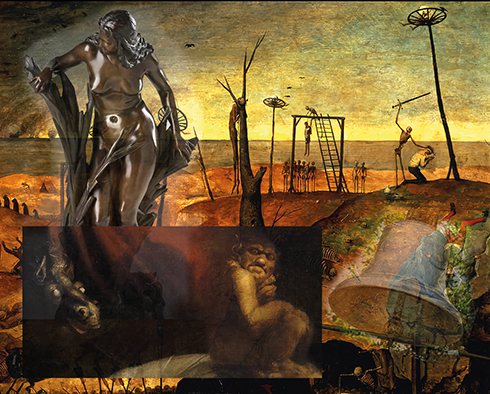
La Nuit by Daisuke Yoshida
CREDIT: Digital Collage Ba Kode
Moving to the twentieth century, Ravel’s Gaspard de la Nuit is based on three much earlier poems by Bertrand. Yoshida told us that it was supposed to be one of the most difficult pieces to play, but he would do his best. With this laughably modest introduction he gave a faultless and heartrending performance of this most complex set of – impressions? ‘A Gaspard de la Nuit’ – treasurer of the night – is someone in charge of the dark, the mysterious, the morose. Ravel said he wanted to portray with notes what a poet expresses with words. The first movement, ‘Ondine’, is the nymph Undine seducing her observer to her underwater kingdom, and we hear the water ebbing and flowing, sliding and shimmering. The second movement, ‘Le Gibet’, represents a view of the desert where the lone corpse of a hanged man stands in the setting sun, and a bell tolls all the way through. It is stately, slow, with emphasis on the space, the quiet, the inevitability. ‘Scarbo’, the third movement, is the uneven flight of a goblin in a nightmare. It is enormously fast, enormously brilliant, enormously difficult, and finishes with a rapid cadenza of suitably fiendish complexity. The fingers of Yoshida verged on the magical.
This is one of the first recitals in Britain by a virtuoso pianist about whom we are sure to hear more. He is still studying at Birmingham Conservatoire, and says he started to take the piano ‘seriously’ when he was about 16. An instrument, he said, he found a little difficult to control. A rare artist indeed. Thank you, Daisuke.
We hope you have enjoyed reading this article. The future of our volunteer led, non-profit publication would be far more secure with the aid of a small donation. You can also support local journalism by becoming a friend of HIP. It only takes a minute and we would be very grateful.


Leave a Reply