
Baroque and Roll
VICTORIA KINGHAM discovers the geniality of the Hastings Maestro.

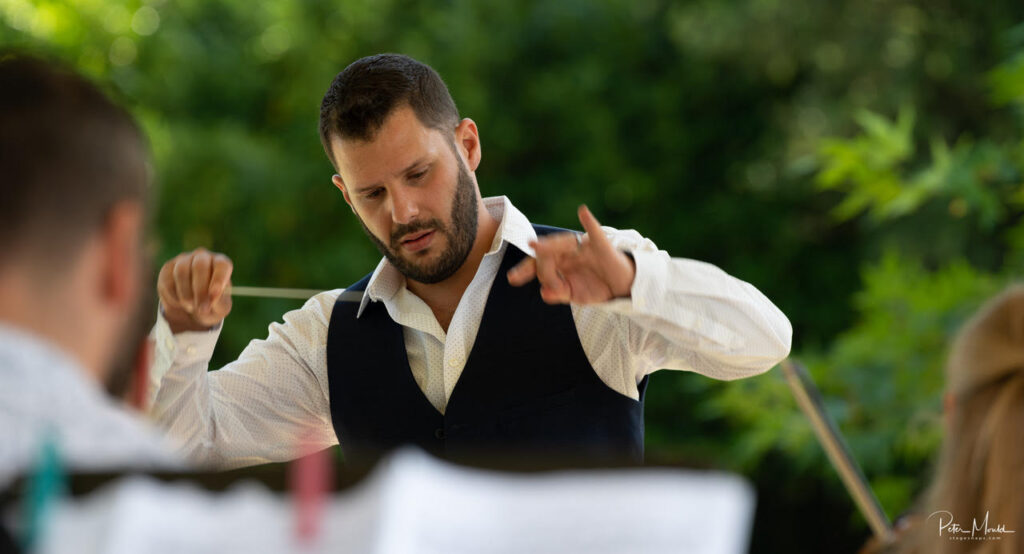
Watching Cate Blanchett in the film Tár recently and subsequently reading a work which is said to inspire it, The Maestro Myth: Great Conductors in Pursuit of Power, one would be forgiven for thinking that these rare, gifted leaders are unapproachable, arrogant, answerable only to themselves, inhuman in their quest for musical greatness. It was therefore with some hesitancy that I contacted our local Maestro, Marcio da Silva.
ACCESS TO CLASSICAL MUSIC
Perhaps because this is Hastings and St Leonards, a friendly, interesting, interested, tolerant, encouraging society, which values the Arts, we have in our midst a Maestro who is the absolute antithesis of the power-hungry myth; someone who is surprised if anyone addresses him as Maestro. But his achievements with both the Hastings Philharmonic Choir and the Hastings Philharmonic Orchestra (see previous articles in this newspaper) cannot be underestimated. He and his wife, Helen May da Silva, are between them a blaze of musical activity. This goes way beyond their own career aspirations; together they aim to bring classical music to a much wider local audience, to schools, to people who would not normally attend this kind of performance: to make it accessible.
A YOUNG PRODIGY
Apart from da Silva’s excellence at what he does, some of this missionary zeal could be a result of his upbringing. ‘Give me the child till he is seven years old, and I will show you the man’ was the well-known motto of Ignatius Loyola, the Jesuit founder, acknowledging Aristotle. Growing up in Belo Horizonte, Brazil, da Silva feels fortunate to have attended a Jesuit school, and in his case the philosophy has clearly been effective.
At a young age he was already well-known, performing regularly on Brazilian television. His family were perhaps musical, but there are no professional musicians in his background. His grandmother, however (perhaps his prime mentor) actually created a choir to sing with him when he was twelve.

I asked him how it felt to be a prodigy. “It was fun,” he muses. “It meant I could get out of school all the time because of choir rehearsals.”
He travelled as a young teenager to Phoenix Arizona, where he auditioned for the Phoenix Choir and after six months was inspired by his own previous musical experience and the brilliant a capella male choir Chanticleer to form his own choir when he was just fourteen years old.
MOVING TO HASTINGS

His career and achievements are already publicly well-documented, so I can refer you to his detailed biography at marciodasilva.com/biography. He had four years in France, three in Germany, and eventually took a Masters in conducting here at the Royal College of Music at the age of just 30. Randomly applying through an advertisement and obtaining the job of choir master for the Hastings Philharmonic Choir, he travelled down from London for three years until his grandmother (again) suggested that he move down here permanently, as it was such a conducive atmosphere; and also for the more prosaic reasons that he and his former wife, Ayşen Ulucan, could then afford a family house and a quieter atmosphere for the children.
HASTINGS PHILHARMONIC, BOSSA NOVA, FRANK SINATRA
Once in the job, conducting choral concerts, he was inspired to take over the directorship and re-formation of the Hastings Philharmonic Orchestra in 2016. He began at the same time to book his own players: to begin with a number of people that he knew from the Royal College and other places where he had studied and worked. He calls this smaller group the Orquesta – a name he had used for an ensemble in Germany – and they did a series of concerts in a London church. At the same time, he took over the directorship of the Woodhouse Opera Festival in Surrey from Monika Saunders, who died in 2018 but who he acknowledges was an inspiration to him. He loves conducting and directing romantic opera.
The Orquesta has become the go-to company for Baroque music and is now internationally well known. By contrast, he has staged a number of Bossa Nova concerts locally, and a full night of Tango. He also grew up loving Frank Sinatra. He has even composed his own Te Deum, which he will perform in June along with Poulenc’s unbearably beautiful, haunting Gloria.
UNSTOPPABLE
He lives in St Leonards with Helen May and his two children by his former marriage. Together they seem unstoppable. Their joint mission includes making high-quality performances appealing and accessible, offering, unusually, free tickets to under-18s, students, jobseekers, and recipients of universal credit.
They engage children, young people, and adults in interactive workshops and try to offer performance opportunities. They endeavour to share their work across as many and as diverse groups as possible and offer multi-art form opera projects, which also include movement, dance, physical theatre, and puppetry.
He and May have launched opera workshops at two primary schools in Hastings and St Leonards and have built strong links with Awards for Young Musicians and Create Music, thus supporting and mentoring local musical children and those from low-income families.
THE HUMAN TOUCH
Watching his performances in St Leonards, in Christ Church, I am struck by his readiness to address the audience personally, and furthermore his taking part in the performance while conducting – though this, he admits, was partly a financial decision. The cost of staging an orchestral concert is enormous (even filling the church with ticketholders does not really cover the cost) so because there was only one section of the C Minor Mass that required a baritone, he decided he could fill the part himself. The effect of this was in fact to strengthen the bond between the performers and the audience, but probably also to strengthen the bond of trust between him and the orchestra and choir.
This directness is important to him. He loves living here, and he loves being able to fill the church with an audience of people who know him, and many whom he can call friends. He readily and gratefully acknowledges all the help he has had from diverse sources. He thanks Christ Church, who opened their doors and allowed him to stage concerts for nothing, and John Read, a lifelong member of the Choir and Church Warden at Christ Church, whose help and encouragement he is particularly grateful for. His friends and family do a large share of the administrative work and organisation that enable an orchestral concert to happen, including fundraising.
Though he says he is quite strict about what he wants musically from the orchestra and choir, the way he obtains excellent results is by being the antithesis of the furious demanding Maestro. He is in his 40th year; we are extremely fortunate that this area and its residents are able to nurture his musical gifts, enjoy some brilliant orchestral and choral baroque performances, and appreciate his articulate, approachable humanity.
We hope you have enjoyed reading this article. The future of our volunteer led, non-profit publication would be far more secure with the aid of a small donation. You can also support local journalism by becoming a friend of HIP. It only takes a minute and we would be very grateful.

Leave a Reply