
A Triumph for Music and Humanity
VICTORIA KINGHAM

Ryan Zhu, 2026 winner
Hastings International Piano competition had sponsorship to offer free places in the early stages for everyone who wanted to wander in off the street to watch geniuses vying for a place in the finals. The other morning, I arrived to watch Khadizha Israpil play, with extraordinary assurance, the most challenging suite by Hindemith. It isn’t exactly easy listening. If it were a painting, it would be one of those that you just know are great but would find too disturbing to hang on your living room wall. Full of angry discords, passionate non-sequiturs, determinedly unexpected and unfinished arpeggios, and some occasional almost-sweet wistfulness, the piece has a marked overall trajectory and, given its complexity, a surprising unity that by the time it gets to the restatement of the melody, you almost think you understand it.
But you don’t, not really. The performer has clearly grasped it and wrestled with all its anger and contention and searching and shouting and eventual compromise. If she doesn’t win, I’ll be surprised, but then she is the first competitor I have seen so far, and I’m prepared to be surprised all day.
What strikes me about this near-incredible competition is not just the organisation, the logistics of getting the orchestra and the soloists in place and scheduled, the musical brilliance, the expertise, and the generous sponsorship. All these things are required for the organisation, and it seems that the standard of musicianship and the number of entries now increase year on year.
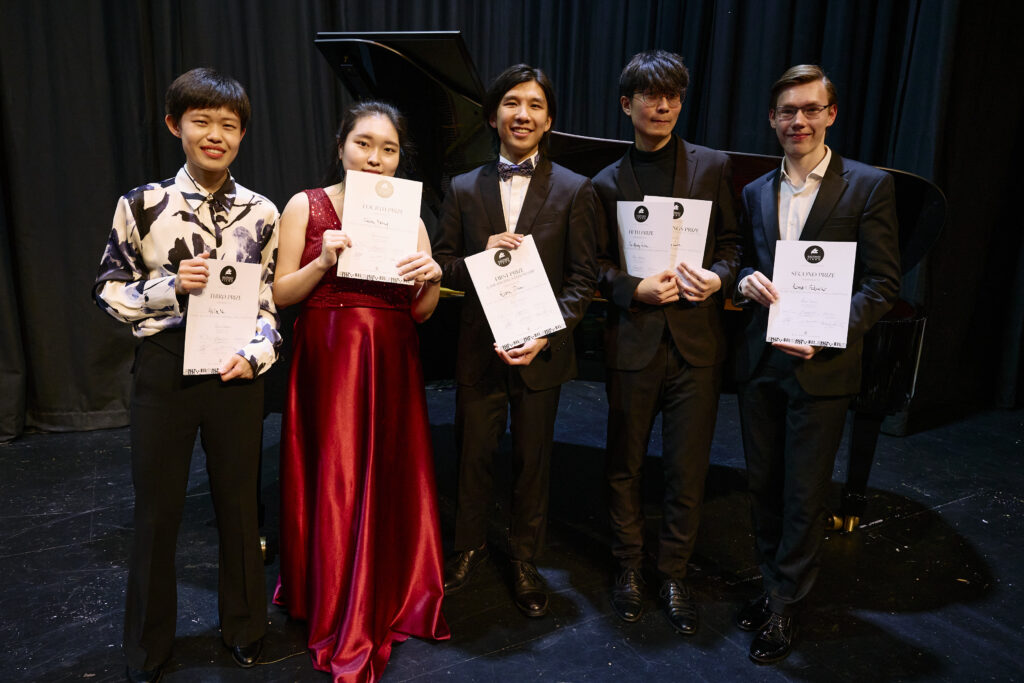
Prizewinners 2026
Beyond that, what strikes me is how international an event it is. How the music of very great composers brings people together from everywhere. Entrants, judges, sponsors, and audiences alike come from Ukraine and Ireland, Cyprus and Japan, Zimbabwe and South Korea. The designated concertos are written by Austrians, Germans and Russians, but played without regard for cultures or continents because the only important thing is that they express emotions common to all humanity. Without being too sentimental, it seems to me that if everyone spent time listening to this music, played by these special musicians at the peak of their ability, there would be less world conflict, less emphasis on the differences between cultures and nations, and more on what brings us together. Maybe for some of them, there is an idea that they are representing their country, as though they were Olympic athletes; much more likely is that they themselves don’t give that a thought.
Great music does that. Exceptional visual Art does that. Supreme literary writing, in any language, does that. “That’s what it’s for, an escape,” said the pleasant woman in the next seat to me. But I don’t agree. These things are not an escape from life, but a window on how life could be. Beethoven’s and Mozart’s concertos have been played consistently for almost 300 years, and certainly, listening to the lovely phrases of Beethoven’s 4th, you can hear all the characteristics of subsequent popular music, all the harmonies we have internalised and taken for granted for most of our lives, the bounciness and the joy of a pop song, the despair of the minor-key ballad, the flattened blue notes of jazz music.
How much the pianists make the music speak for itself must, I suppose, be part of the criteria for judging. Many of the criteria would be so technical as to be beyond the reach of the everyday listener, audible only to the fine-tuned excellence of the judges’ ears. Most of the competing players are so good that their ego disappears into the perfection of their technique. Similarly, looking into a Donatello sculpture or a Botticelli painting is looking, not at how clever the artist is, but how perfectly that artefact becomes its own universe. Or, Middlemarch is actually what the News of the World used to say about itself: all human life is there.
The competition winner was Ryan Zhu from Canada, just 22 years old who plays with the assurance, grace, and depth of a seasoned virtuoso, and also won the Leeds Piano competition a couple of years ago.
That’s another Hastings International Piano competition over for another two years but you can catch all of the performances on the YouTube channel, strongly worth repeated watching. It doesn’t seem a minute since the last one, and the dedicated team behind it keeps it alive through school and institution outreach, concerts, and now a YouTube channel. Great for Hastings, but great for the hope of humanity..
Hastings International Piano: hastingsinternationalpiano.org. For the live stream enter Hastings International Piano into the YouTube search. Day 1 of the final: youtube.com/watch?v=TZZBqYx6UXI
We hope you have enjoyed reading this article. The future of our volunteer led, non-profit publication would be far more secure with the aid of a small donation. You can also support local journalism by becoming a friend of HIP. It only takes a minute and we would be very grateful.

Leave a Reply