
A Song as Lovely as a Tree
Bev Lee Harling is a disarmingly innocent-looking singer, songwriter, musician and actor with a lightness and naturalness to her performances which belie the care, originality, and thought with which they are planned. Last year she presented Ploughing the Salt Sea, a piece of autobiographical theatre rooted in research into her own ancestry and roots in Hastings, which was the first time she had ever presented a theatrical show.
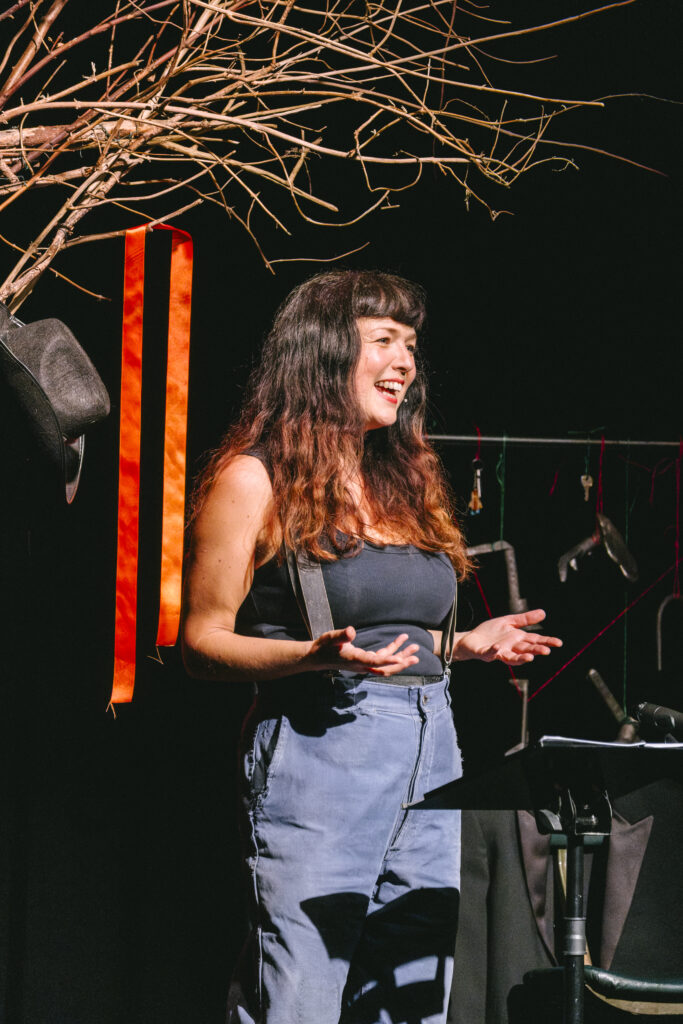
Her story, for the festival, was much more immediate. She was writing it at the same time as grieving the loss of her father – “so I was really writing through it” she explains. She continues “I was trying to get to the heart of our relationship, and what it means when you almost start saying goodbye to somebody before they’ve left, as they change.”
“Then,” she adds, “there’s the element of the tree”, which was in her mind the whole time she was developing the performance. It is, indeed, an inspired idea. The tree at the centre of the performance was designed by “total Hastings treasure” sculptor Leigh Dyer. Harling’s father owned and worked in a foundry on IvyHouse Lane, and Dyer’s sculptures are made in metal, so he was often at the foundry. The lovely boat that rises from the shingle on the beach, the stainless steel octopuses and snakes in George Street at Butler’s Gap holding the chess pieces, and the gates by the Print Works, are all his work.
TREE OF A LIFE
He planned the shimmering tree round a contour, making an initial drawing that followed Harling’s shape, holding her violin. Across and between its main branches, different instruments were placed – keyboards, strings that could be bowed. All wonderfully integrated so that she could use them to accompany herself in song, or at various places in the narrative, or put her arms round it. “He knew my dad, he absolutely understood him, so he was able to understand my vision [for the tree] from a personal point of view.”
Together with her partner, exceptional and versatile musician Frank Moon, and Dyer’s sculpture, Harling has succeeded in creating, around the tree, a compelling narrative that interweaves her own recollections of the last few months of her father’s life, and re-imagines his own reminiscences, in both song and performance. There’s a particularly poignant scene where she (or perhaps her mother) dances with him – represented by an empty suit jacket – and there are songs that he knew, songs that he liked, and stories of his former life in the East End of London.
I wondered whether this work fitted into a particular theatrical genre. She works with a coach, Morris (Mo) Cohen, whose specialism is autobiographical theatre. But she doesn’t feel that this label covers the show as a whole. It doesn’t. It’s a truly composite work of art – the superior music, the visual direction, the narrative, the tree as reflection of herself, the undeniable authenticity, all make for something beyond categorisation, indefinably a world in itself.
MUSICAL ROOTS
Because Bev Lee Harling is so integrally a part of the Hastings music scene it’s perhaps less recognised how successful she has been nationally as a touring musician. Further, that she has made a whole series of impeccably produced and quite beautiful albums and EPs, beginning with Impossible Human in 2006. Or that she has a degree in jazz. Also, she grew up in the Music Centre system here in Hastings, when “at the time, it was absolutely thriving. Anyone could learn an instrument, and you could go to orchestras and go on tours.” There was a centre on Croft Road where the East Sussex Music Service would arrange for promising students to play with the Philharmonic Orchestra, and for them to travel to play in the Albert Hall.
There was no musical tradition in her family, but for her own inspiration she credits her much older sister, who begged for a violin when quite young. Bev could then grow up hearing music at home, with her sister sometimes teaching her things on the piano. She studied classical music but had the feeling that she “wasn’t quite classical enough.” She also didn’t think, after completing her university course, that she was quite a jazz musician either. Having played the violin since she was five, I suspect she manages to be both with ease, but her vocal style and her instrumental expertise and her ability to tell stories through music, make her unique.
She is quick to praise everyone involved: Frank Moon for the sound design, Jonathan Richardson for the lighting, Mae Dewsbery for production support, Mo Cohen for the coaching, Leigh Dyer for the tree, and 18 Hours for the Good Grief Festival and their support, plus St John’s Church, The Stables, and the Arts Council for financial help.
“We all experience grief in some way or another,” so with Hey Good Lookin’ she has succeeded in producing, from the stage, an environment which the audience can all understand. “We all have stories, and we all have the potential to be able to share these stories with other people, to have a meaningful connection … every time I do one of these shows, so many people want to talk to me afterwards, and they have incredible stories, and maybe that’s the only time they get to share them.” Somehow her presentation gives people permission to respond: a rare gift.
Bev Lee Harling performed Hey Good Lookin’ at St John’s Church Hall, Brittany Road, St Leonards on Saturday 23 May. Another performance is scheduled for the annual Hastings Storytelling Festival in October at The Stables Theatre, date to be confirmed.
We hope you have enjoyed reading this article. The future of our volunteer led, non-profit publication would be far more secure with the aid of a small donation. You can also support local journalism by becoming a friend of HIP. It only takes a minute and we would be very grateful.

Leave a Reply