
Water Bill Boycott: Town Hall Event

There is something about the impunity with which England’s water companies are allowed to dump sewage into our rivers and seas: it seems emblematic of the corruption and gross inequality that pervade all corners of our crumbling public realm. The town hall meeting clearly laid out how this is allowed to happen. It was explained that although the companies are monopolies and we have no choice as to who provides our water, they are protected legally and financially. Meanwhile, consumers and the environment have no protection at all.
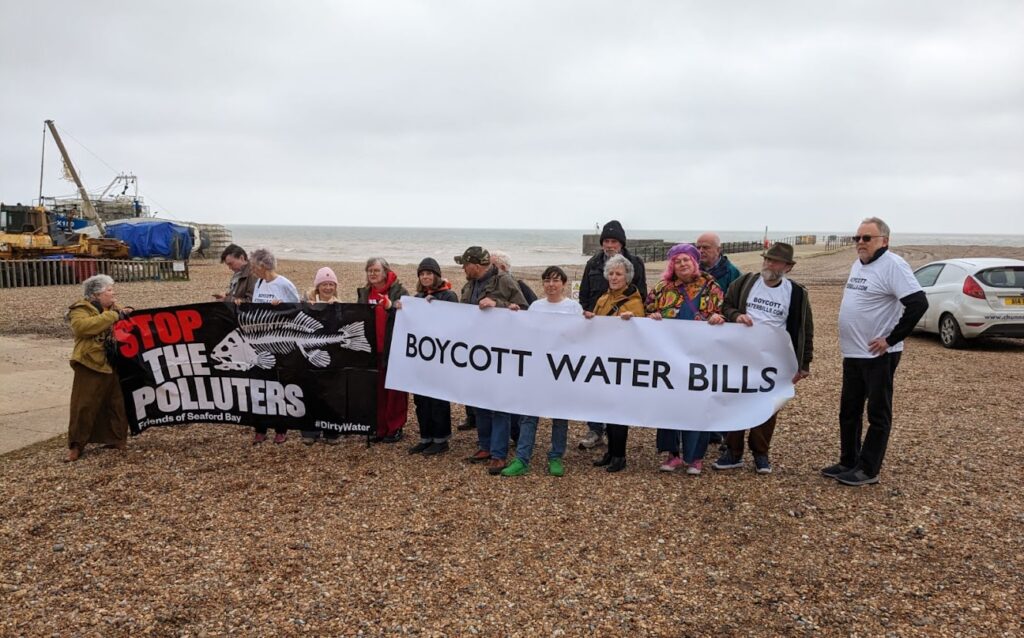
The meeting was attended by people who refuse to pay for phantom wastewater services or are considering refusal. Also attending were those who have attempted to seek redress in the courts – or are in the process of doing so – and those whose lives have been made a misery by trying to get a byzantine and dysfunctional Southern Water to deal with the sewage that rises in their home every time Hastings floods. All were united by a sense of frustration and outrage.
A stunning 70% of England’s water companies are owned by foreign investors, including investment firms, banks, hedge funds, foreign governments, and businesses based in tax havens. Since privatisation in 1989, these owners have extracted money from the water companies for their shareholders while loading them with debt. Southern Water owes £5.7 billion; if you are a Southern Water customer, 27% of your bill goes on servicing that debt.
So how are the water companies able to borrow so much money? At the meeting on 15 March, Julie Bygraves laid out how the price we pay for water is determined by a regulator. Amongst other things, the regulated asset base not only guarantees profits for water companies, but also allows them to charge borrowing costs to their customers. In addition, as collateral for borrowing, the companies use their physical assets, which we paid for before they received them debt-free at privatisation – and continue to pay for. Both of these mechanisms incentivise the borrowing of increasing sums of money, the charges for which are loaded onto customers’ bills.
In 1991, two years after the privatisation of water companies, the Water Industries Act overrode common law in a clause that protects water companies from individual legal challenges. There are now only two bodies, OFWAT and the Environment Agency (EA) that can prosecute water companies for not carrying out their legal duties. This includes the safe and legal disposal of wastewater: i.e. not dumping it into rivers and seas.

As pointed out in the meeting, these bodies have the powers to regulate and enforce the water companies; they just don’t do it. So, is this a case of ‘failure by design’? The revolving doors between the water companies and the regulating bodies would seem to suggest this. However, there is another, even more pernicious, reason. In a letter to OFWAT last month, the Chair of the Environment, Food, and Rural Affairs Committee wrote that it was “concerned” that enforcing regulations and issuing fines against “consistently failing entities” would risk causing their financial collapse, so OFWAT should therefore not use “the full extent of its powers.” In other words, indebted water companies should be allowed to break the law to stave off their probably inevitable collapse.
There is, however, one area where the consumer does have some leverage: Southern Water has 2.6 million customers. Many of them are paying by direct debit, which allows the water company to keep those accounts in surplus, often to the tune of hundreds of pounds. This creates a huge pool of ‘borrowed’ money to help keep them afloat, on which, of course, they are paying no interest. So, if Southern Water’s banditry is making you furious, cancel that direct debit now.
For more information go to sussexbylines.co.uk and search Money down the drain and Water nationalisation is the best option.
We hope you have enjoyed reading this article. The future of our volunteer led, non-profit publication would be far more secure with the aid of a small donation. You can also support local journalism by becoming a friend of HIP. It only takes a minute and we would be very grateful.

Leave a Reply