
Making Links in Hastings
With immigration front and centre of the political agenda, MEL STEEL visits the Links Project to look at the issues being faced by local residents – who also happen to be migrants
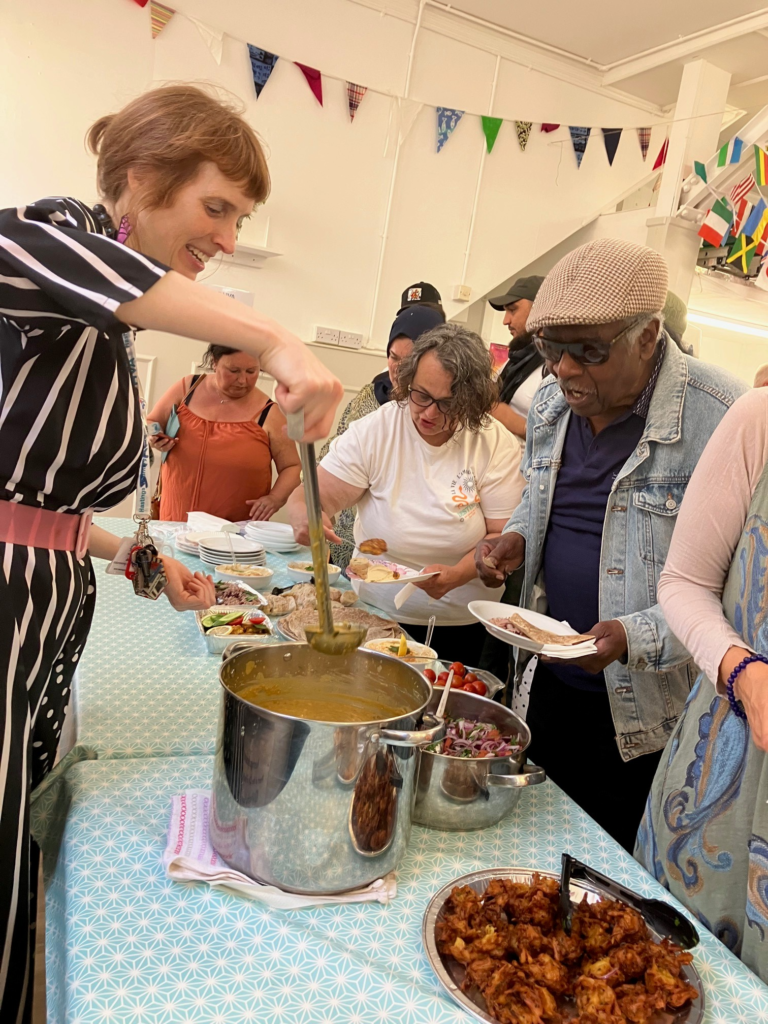
“I love this town!” declares Arzo, from behind the café counter of the Links Project weekly drop-in. “I’ve been to lots of other places in the UK, but I’d never move anywhere else.”
Arzo has been in the UK for 15 years now and is a British citizen. She came here from Iraq to join her husband, who fled their country years earlier to claim asylum and was eventually recognised as a refugee. She first came to the Links Project in 2012, she says, for advice on what to do when her spouse visa expired.
She stayed on for the feeling of community, solidarity and a safe social space where she could meet people from all over the world. A qualified English teacher in Iraq, she now works in a coffee shop and is a regular volunteer at the drop-in, helping other people to feel as welcome as she did all those years ago.
The Links Project has been running in Hastings in one form or another since the early 2000s, when the Adelphi Hotel on Warrior Square became an accommodation centre for asylum seekers and there was a need to provide advice and support for its residents in a safe community space. Since then, their remit has broadened, and the project works with people from across East Sussex and across the spectrum of migration, including resettled refugees, people on the Homes for Ukraine scheme, asylum seekers, people here on skilled worker or spouse visas, and people with no recourse to public funds. Most of the 50 or so asylum seekers hosted in the town now are families, and the Adelphi Hotel has long been converted into flats.

When I visit, the atmosphere at the drop-in is friendly and buzzy. Rima is serving up homemade soup in the kitchen, and people are chatting over cups of tea. A lively English class is taking place around one table, led by qualified volunteer tutors. There are advisers from local agencies stationed around the room, all fully occupied and talking to clients. Overseeing proceedings is Marc Turczanski, who has been running the project for 25 years and who shows no sign of running out of energy or enthusiasm.
“Quite a lot of people come back repeatedly,” he explains. “They might need more advice or they might just want a chat. We’ll triage them when they arrive and make sure they get to see the right person. If it’s their first time, we’ll try to find out what kind of help they need. Very often it’s immigration advice that they really need, and that’s not something we can provide – but I’ll always try to direct them to an accredited adviser.”
PUNITIVE POLICIES
I wonder what kinds of issues people are presenting with at the moment, given recent government announcements about yet more changes to immigration legislation.
“Well we’re seeing all the usual issues – problems with housing; destitution; people needing referrals to food banks to be able to afford to eat,” he says. “But a couple of things are causing particular concern. The government has said that people coming to the UK on skilled work visas will no longer be able to bring their dependants with them – so people will now have to make a choice between earning to support their families and being able to be with them. And the proposed changes to settled status are making people really anxious.”
These are changes which would mean that refugees and EU citizens who can currently apply for settlement in the UK after five years will now have to wait 10 or even 20 years before they can apply to remain here indefinitely. They will also have to ‘earn’ their settlement by demonstrating a very high level of English (roughly equivalent to ‘A’ level standard), a specified level of income, and working in their community through, for example, volunteering.
Lawrence’s story illustrates how the complex and ever-changing immigration rules can easily catch people out. A regular visitor to the drop-in, he was born in South Africa to a British mum and arrived in the UK on an ancestry visa but, as happened to many children of the Windrush generation, had no idea that he then needed to make an active application for settlement in the UK. He missed the small window to apply and effectively became an overstayer, suddenly finding himself with no status, no home and no recourse to public funds after believing himself to be British.
The Links Project helped him get the advice he needed to regularise his status and he now has limited leave to remain – but will need to apply to renew this every 30 months for the next ten years, at considerable cost, before he can apply to settle in the country he has lived in for nearly 30 years. Lawrence would still be street homeless and destitute without the project’s support. “They’ve helped me for years,” he says. “Just as a human. They showed me compassion.”
Disne and Diline, both from Sri Lanka, came to the UK a couple of years ago on skilled work visas. Disne is a qualified medical laboratory technician; Diline a qualified nurse. Both are now working as care assistants because their professional qualifications aren’t recognised here. They were lucky that they were able to bring their families with them before the rules changed; even so, they are both now anxious about whether they’ll be able to renew their visas when they expire this year. They’re at the drop-in to join the free English classes because they can’t afford college fees.
“We love it here,” says Disne, “but our children are worried about the current political climate in the UK. They want to study medicine and engineering but are talking about where else they could go.”
HOSTILE ENVIRONMENT
Muna, originally from Yemen, came to the UK to join her British husband in 1997. She now works for the council in their refugee employability service and helps people into work. She tells me it’s hard to find meaningful work for migrants, even when they are skilled: people often feel pressurised into taking any work on offer and the job centre doesn’t care about them getting stuck in low-paid menial roles.
I ask her whether she thinks things are harder for migrants in the UK now than when she first arrived. “Definitely,” she says. “I’d never experienced overt racism in Hastings before, but over the past year I’ve had people swearing at me, asking me what I’m doing here, telling me to go back home, using the F- word… . And I know that some of our clients’ children are being ostracised at school and being made the butt of jokes. The media has emboldened people to be more openly racist, especially against Muslims. When the flags started going up I initially thought ‘fair enough, it’s their flag and their country’ – but then seeing them started to make me feel angry.”
Even Arzo, as much as she loves this town, has noticed a change in people’s attitudes. Her three children are all British, born and brought up in Hastings, but she says that the family recently had to endure racist abuse in the town centre from a man demanding to know what they were doing in the country.
With Reform on the rise and anti-migrant feeling spilling onto the streets, the work that the Links Project does has never been as important.
For more information visit hastingsvoluntaryaction.org.uk/project/links-project
Note: Some names have been changed

We hope you have enjoyed reading this article. The future of our volunteer led, non-profit publication would be far more secure with the aid of a small donation. You can also support local journalism by becoming a friend of HIP. It only takes a minute and we would be very grateful.

Leave a Reply