
I’ll Swim to France 4: When the Chimp Wants Out
SARAH MILNE
The last couple of weeks have been encouraging. My stroke is getting stronger and faster as I work through my technical notes from Dover, although fixing one thing inevitably seems to create another issue. Fortunately, Mike and Dee, my local coaches, are quick to spot and correct new faults. I’ve also completed the London Marathon Swims Virtual Challenge, swimming 10K one Sunday morning at Summerfields. I can officially call myself a marathon swimmer! Now I need to get my technique up to speed. Literally. We’re aiming for two miles (3.2K) an hour, giving me the best chance of completing the Channel in around 12 hours, within two six-hour tides. It’s ambitious, but at least I have a target and a plan.
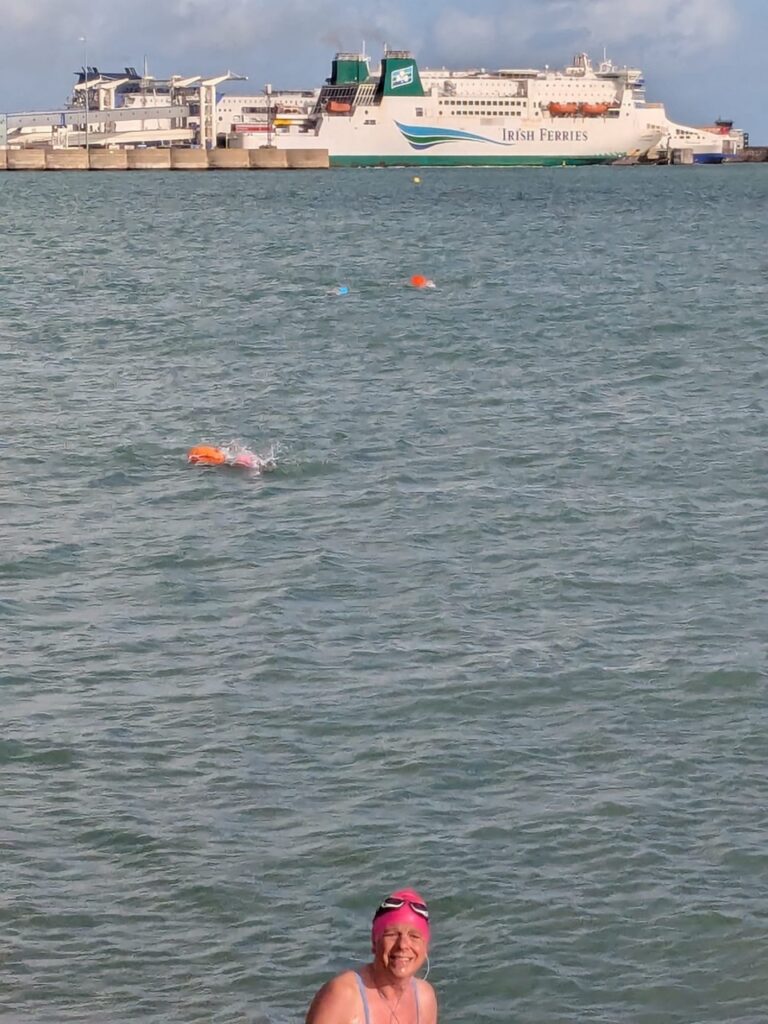
My week in Dover also exposed an unexpected weakness: my ability to keep going when my mind tells me to stop. During a six-hour session, I became convinced my stroke had fallen apart and I couldn’t swim against the strong harbour currents. I got out, spent an hour ashore, then returned to finish. The following day, I got out again and called it a day. Afterwards, I was told I shouldn’t have stopped. I hadn’t been in distress; I’d convinced myself I couldn’t do it. I thought I had enough mental grit. When training for marathons, I’d happily push my limits. If I went too far, I might end up bruised and embarrassed on the ground, but I could pick myself up and hobble on. Pushing myself in a strong current, in the middle of the sea, feels very different. The risks are real, and my instinct to get out isn’t entirely irrational. But I now realise that all the physical training in the world won’t be enough if I can’t develop the mental resilience to manage fear – and keep going when it’s safe to do so.
I’m a psychologist, so I’ve gone back to the books. One I’ve picked up again is The Chimp Paradox by Steve Peters. He uses the ‘Chimp’ as a metaphor for our emotional, instinctive reactions, and the ‘Human’ for our rational side, which can pause, assess the evidence and decide how to respond. My Chimp is particularly unhappy about swimming across the Channel.
Of course, the sea can be dangerous. The trick is distinguishing genuine warning signs from the discomfort of doing something difficult. That’s where my Human needs to do a better job. Whenever I settle into the rhythm of a long swim, my Chimp pipes up. Am I paying attention? Have I switched off? Am I aware of danger? Its interruptions make it difficult to relax into the rhythm and let my swimming become almost automatic.
So, I’m training my body and mind in parallel. Alongside improving my stroke, endurance and cold-water acclimatisation, I’m using sports psychology techniques such as positive self-talk and visualisation. I need to be able to reassure my Chimp: I’ve trained for this. I trust my stroke. I’ve swum in colder water and rougher conditions. I can focus on swimming to the next feed rather than the long hours ahead. I’m also practising imagining and visualising difficult moments and seeing myself staying calm, assessing the situation and finding my rhythm again.
France is a long way to swim. I suspect my Chimp will have plenty to say before I get there, but I will be ready to answer back.
We hope you have enjoyed reading this article. The future of our volunteer led, non-profit publication would be far more secure with the aid of a small donation. You can also support local journalism by becoming a friend of HIP. It only takes a minute and we would be very grateful.

Leave a Reply